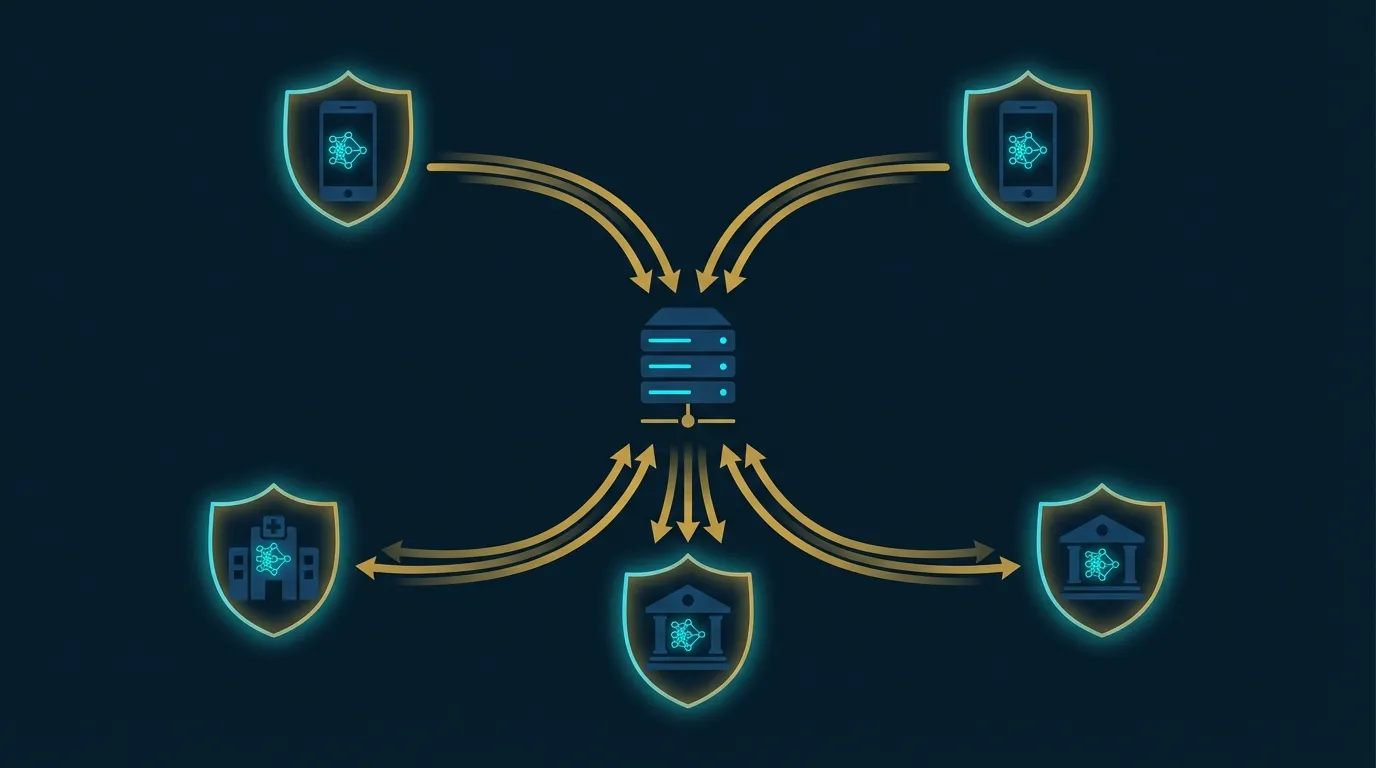
- Synthetic data is data generated by algorithms rather than collected from the real world. Gartner predicts that by 2030, synthetic data will surpass real data in AI model training[3] — it is becoming a key technology for solving data scarcity, privacy restrictions, and class imbalance problems
- Generative adversarial networks[1] and CTGAN[6] are the primary technologies for structured tabular data generation, Diffusion Models[4] have comprehensively surpassed GANs in image synthesis quality, and LLM-driven text generation (such as Microsoft's phi-1.5[5]) has demonstrated that synthetic textbook data can train small models that outperform models ten times their size
- Differential privacy[7] provides mathematically provable guarantees for synthetic data privacy protection — combined with synthetic data generation, enterprises can conduct model development and cross-department collaboration without ever touching the original sensitive data
- Synthetic data quality validation requires systematic evaluation across three dimensions: statistical fidelity, downstream task utility, and privacy risk[2][8] — none can be omitted
1. Why Synthetic Data Is the Next Inflection Point for the AI Industry
AI model quality depends on data quality and quantity — this is a consensus in the machine learning community. However, in reality, most enterprises face not the problem of "how to use good data," but the dilemma of "not having enough data at all." This data scarcity stems from the convergence of multiple pressures:
Tightening privacy regulations. GDPR, CCPA, Taiwan's Personal Data Protection Act, and other regulations impose strict limitations on the collection, storage, and use of personal data. Data in healthcare, finance, and insurance are subject to even higher compliance requirements — even if enterprises possess the data, they cannot freely use it for AI development. A bank's risk management team wants to train a fraud detection model, but regulations prohibit directly sharing customer transaction records with external AI vendors.
The long-tail problem of rare events. In many critical applications, the most important data is also the scarcest. Autonomous driving needs to learn to handle pedestrians crossing during blizzards, but this scenario might only occur once per 100,000 kilometers. Medical imaging AI needs to identify rare diseases, but there might be only a few hundred confirmed cases globally. Credit card fraud detection faces positive-to-negative sample ratios of 1:10,000.
The explosion of labeling costs. Large language models require tens of thousands of high-quality instruction-response pairs for fine-tuning, with each potentially requiring 10–30 minutes of domain expert time to compose. For medical Q&A, labeling costs requiring licensed physicians to write and review can reach $50–100 per entry.
Synthetic data is the systematic response to these challenges. It refers to data generated by algorithms rather than directly collected from the real world[2]. Ideal synthetic data is statistically highly similar to real data but contains no information traceable to specific individuals.
The Value Proposition of Synthetic Data:

Problem 1: Insufficient Data
  Real data: 100 rare disease images
  Synthetic data: Generate 10,000 statistically consistent images → Model accuracy ↑15-30%

Problem 2: Privacy Restrictions
  Real data: Cannot transmit patient data to the cloud
  Synthetic data: Generate de-identified data → Can be safely used for development and testing

Problem 3: Class Imbalance
  Real data: Fraudulent transactions account for 0.01%
  Synthetic data: Generate balanced training sets → Recall ↑20-40%

Problem 4: Labeling Costs
  Real data: Each medical QA labeling cost $50-100
  Synthetic data: LLM generation + human review, cost reduced to $2-5/entry
Gartner predicts that by 2030, the volume of synthetic data used in AI models will surpass real data[3]. This is not a distant vision — Tesla is already using synthetic data to train autonomous driving perception models, Google uses synthetic instruction data to train Gemini, and Waymo uses simulated environments to generate billions of miles of driving scenarios. Synthetic data is moving from the lab to the production line.
2. Classification of Synthetic Data: Tabular, Image, Text, and Time Series
Synthetic data is not a single technology but encompasses vastly different generation methods and quality standards depending on the data modality. Understanding these classifications is the prerequisite for selecting the right tools.
2.1 Structured Tabular Data
Tabular data is the most prevalent data type in enterprises — customer records, transaction logs, and sensor readings all exist in tabular form. The challenge of tabular synthetic data lies in preserving inter-column correlations (e.g., the relationship between age and income), categorical column distribution characteristics (e.g., gender ratios), and the statistical properties of outliers. Primary generation methods include CTGAN[6], TVAE, and Copula-based statistical models.
2.2 Image Data
Image synthesis is the most deeply researched direction in the synthetic data field. From the pioneering work on GANs[1], through the progressive improvements of the StyleGAN series, to the comprehensive breakthrough of Diffusion Models[4], synthetic image quality has reached a level where the human eye cannot distinguish them from real images. Primary application scenarios include medical image augmentation (generating rare pathology images), autonomous driving (simulating extreme weather and corner cases), and manufacturing (generating defect images for quality inspection).
2.3 Text Data
The rise of large language models has unlocked entirely new possibilities for text synthetic data quality. LLMs can generate instruction-response pairs, domain-specific Q&A, code snippets, product reviews, and virtually any form of text. Microsoft's phi-1.5[5] demonstrated a surprising conclusion — a 1.3B model trained on synthetic "textbook" data generated by GPT-4 outperformed many 10B+ models on reasoning tasks.
2.4 Time Series Data
Time series data (such as stock price movements, sensor readings, website traffic) requires preserving temporal dependencies, cyclical patterns, and trend characteristics. Specialized architectures like TimeGAN and DoppelGANger are designed to capture these temporal properties. Finance, IoT, and medical monitoring are the core application domains for time series synthetic data.
| Data Modality | Primary Generation Methods | Key Challenges | Typical Applications |
|---|---|---|---|
| Structured Tabular | CTGAN, TVAE, Copula | Inter-column correlations, mixed data types | Financial risk control, medical research, market analysis |
| Image | GAN, Diffusion Models, NeRF | High resolution, semantic consistency | Medical imaging, autonomous driving, quality inspection |
| Text | LLM (GPT-4, Claude), template engines | Factual correctness, diversity | LLM fine-tuning, NLP training, test data |
| Time Series | TimeGAN, DoppelGANger, Diffusion Models | Temporal dependencies, cyclicality | Financial simulation, IoT monitoring, medical prediction |
3. GAN and VAE-Driven Structured Data Generation
Generative adversarial networks (GAN)[1] are the foundational technology for synthetic data generation. The framework proposed by Goodfellow et al. in 2014 learns the distribution of real data and generates new samples through adversarial training between a generator and a discriminator.
3.1 The Basic Architecture of GANs
GAN Training Objective (Minimax Game):

min_G max_D  V(D, G) = E_{x~p_data}[log D(x)]
                      + E_{z~p_z}[log(1 - D(G(z)))]

Where:
  G: Generator — generates synthetic samples G(z) from random noise z
  D: Discriminator — determines whether input is real data (D→1) or synthetic data (D→0)
  p_data: Real data distribution
  p_z: Prior noise distribution (typically standard normal)

Training Dynamics:
  1. Fix G, train D to distinguish real from fake → D becomes increasingly "smart"
  2. Fix D, train G to fool D → G generates increasingly realistic data
  3. Ideal equilibrium: G learns the real distribution, D cannot distinguish (D(x) = 0.5)
However, the original GAN was designed for continuous data (such as image pixels), and directly applying it to mixed-type tabular data (containing numerical, categorical, boolean columns) encounters serious problems: the discreteness of categorical columns cannot be naturally handled by continuous generators, and complex conditional dependencies between columns are difficult to learn.
3.2 CTGAN: A GAN Designed Specifically for Tabular Data
CTGAN (Conditional Tabular GAN) proposed by Xu et al.[6] made three key improvements addressing the specifics of tabular data:
CTGAN Core Innovations:

1. Mode-Specific Normalization
  Problem: Numerical columns may be multimodal, e.g., income distribution with multiple peaks
  Solution: Use Variational Gaussian Mixture to decompose each numerical column
           into multiple Gaussian components, normalizing separately
  Effect: More accurate capture of non-Gaussian distributions

2. Conditional Generator
  Problem: Minority categories (e.g., rare diseases) are ignored during training
  Solution: Randomly select a specific value of a discrete column as a condition during training,
           forcing the generator to learn to generate samples under that condition
  Effect: All categories receive sufficient learning opportunities

3. Training-by-Sampling
  Problem: Class imbalance causes the generator to favor majority classes
  Solution: Re-sample training batches by log-probability
  Effect: More balanced class distribution in generated data

Typical CTGAN Workflow:
  1. Input real tabular data (CSV/DataFrame)
  2. Automatically detect column types (numerical vs categorical)
  3. Train CTGAN model (typically 300-500 epochs)
  4. Generate specified quantity of synthetic data
  5. Validate synthetic data quality
3.3 VAE and TVAE
Variational autoencoders (VAE) provide an alternative generation pathway. Unlike GAN's adversarial training, VAE compresses data into a latent space via an encoder, then reconstructs it via a decoder. TVAE (Tabular VAE) is widely used in the SDV (Synthetic Data Vault) ecosystem — its training is more stable than CTGAN, but it is typically slightly inferior at capturing complex data distributions.
| Method | Core Mechanism | Training Stability | Distribution Capture | Suitable Scenarios |
|---|---|---|---|---|
| CTGAN[6] | Adversarial training + conditional generation | Medium | Excellent | Complex tabular data, class imbalance |
| TVAE | Variational inference + reconstruction loss | High | Good | Rapid prototyping, medium-complexity tables |
| Copula GAN | Copula modeling + GAN | High | Good | Scenarios emphasizing column correlations |
| Gaussian Copula | Purely statistical method | Very high | Limited | Simple distributions, baseline method |
Selection guidance: For most enterprise tabular data synthesis tasks, CTGAN is the first choice. If training stability is the priority (e.g., in automated pipelines), TVAE is more suitable. For simple numerical column data, Gaussian Copula can meet the need without requiring a GPU.
4. Diffusion Models-Driven Image Synthesis
In 2020, Ho et al. proposed Denoising Diffusion Probabilistic Models (DDPM)[4], revolutionizing the field of image generation. Unlike GAN's adversarial training, Diffusion Models adopt a more stable and intuitive approach: gradually adding noise to data (forward process), then learning to gradually remove noise (reverse process).
4.1 Core Principles of Diffusion Models
The Two Processes of Diffusion Models:

Forward Process (Adding Noise) — Fixed Markov Chain:
  q(x_t | x_{t-1}) = N(x_t; √(1-β_t) · x_{t-1}, β_t · I)

  x_0 → x_1 → x_2 → ... → x_T ≈ N(0, I)
  (Original image gradually becomes pure noise)

Reverse Process (Denoising) — Learned Neural Network:
  p_θ(x_{t-1} | x_t) = N(x_{t-1}; μ_θ(x_t, t), Σ_θ(x_t, t))

  x_T → x_{T-1} → ... → x_1 → x_0
  (From pure noise, gradually restore a clear image)

Training Objective (Simplified):
  L = E_{t, x_0, ε}[‖ε - ε_θ(x_t, t)‖²]

  ε: Noise added at step t (ground truth)
  ε_θ: Neural network predicted noise
  → Model learns to "predict and remove" noise at each time step

Diffusion vs GAN:
  GAN:       One-step generation, but unstable training (mode collapse)
  Diffusion: Multi-step generation (slower), but extremely stable training, higher quality
4.2 Synthetic Image Applications in Vertical Domains
The value of Diffusion Models in synthetic data generation lies not only in image quality but also in their powerful conditional control capability. Through text descriptions, semantic masks, or reference images, users can precisely control the semantic features of generated content.
Medical imaging. Training radiology AI requires large quantities of annotated images, but obtaining sufficient rare pathology cases is extremely difficult. Diffusion Models can generate statistically consistent synthetic images based on existing small sets of pathology images and physician semantic descriptions (e.g., "2cm nodule in the right upper lobe, irregular margins"). Research shows that adding 30–50% synthetic images to the training set can improve lesion detection model sensitivity by 10–20%.
Autonomous driving. Corner cases that autonomous driving systems need to handle — pedestrians in blizzards, traffic signs in backlight, non-standard lane markings in construction zones — are extremely rare in the real world. Through Diffusion Models combined with 3D rendering engines, these scenarios can be systematically generated. Tesla, Waymo, and NVIDIA all use synthetic data at scale to enhance perception model robustness.
Manufacturing quality inspection. Defect rates on factory production lines are typically below 1%, causing defect detection models to face severe class imbalance. Synthetic defect images — scratches, cracks, color deviations — can improve the positive-to-negative sample ratio from 1:100 to 1:3, dramatically improving detection precision.
4.3 Diffusion Models vs GAN: The Generational Shift in Image Synthesis
| Dimension | GAN[1] | Diffusion Models[4] |
|---|---|---|
| Image Quality | High (but artifact risk) | Very high (lower FID scores) |
| Diversity | Limited (mode collapse problem) | Excellent (naturally avoids mode collapse) |
| Training Stability | Poor (requires fine-tuning) | Excellent (standard loss function) |
| Generation Speed | Fast (one forward pass) | Slow (requires multi-step denoising, but can be accelerated) |
| Controllability | Limited | Powerful (text, masks, reference images) |
| Representative Models | StyleGAN3, BigGAN | Stable Diffusion, DALL-E 3 |
5. LLM-Driven Text and Instruction Data Generation
The emergence of large language models has opened entirely new possibilities for text synthetic data. Compared to traditional rule-based text generation or small language models, frontier LLMs like GPT-4 and Claude can generate high-quality, diverse, and semantically consistent text — making the quality of synthetic text data sufficient for direct use in model training for the first time.
5.1 Synthetic Textbooks: The Revelation of phi-1.5
Microsoft Research's phi-1.5[5] is the most notable success story of synthetic text data. The research team used GPT-3.5 to generate approximately 20 billion tokens of synthetic "textbooks" and "exercises," and the 1.3B parameter model trained on this data outperformed many 10B+ parameter models trained on real web data in commonsense reasoning and language understanding tasks.
phi-1.5 Synthetic Data Strategy:

Data Type 1: Synthetic Textbooks
  - Generated by GPT-3.5 based on topic outlines
  - Covering science, history, mathematics, logical reasoning, and more
  - Features: Clear structure, progressive difficulty, includes examples

Data Type 2: Synthetic Exercises
  - Q&A pairs designed around textbook content
  - Includes problem-solving steps and reasoning processes
  - Emphasizes "why" rather than "what"

Key Findings:
  1. Data quality >> Data quantity
     - 20B tokens of synthetic textbooks > 300B tokens of web data
  2. Diversity is crucial
     - Topic diversity (covering broad knowledge domains)
     - Style diversity (different difficulty levels, different narrative angles)
  3. "Textbook-style" structure aids reasoning
     - Organized knowledge > fragmented web text

Implication:
  Small high-quality model + synthetic data = better reasoning than large models
  → Synthetic data is not just "supplementary" — it can be a "superior" training source
5.2 LLM-Driven Instruction Data Generation
Beyond textbook-style knowledge data, LLMs are also widely used to generate instruction-response pairs needed for instruction tuning. Methods like Self-Instruct and Evol-Instruct dramatically reduce human annotation costs through LLM self-generation and iterative improvement.
Typical Pipeline for LLM Synthetic Instruction Data:

Step 1: Seed Instructions
  Manually write 100-200 high-quality demonstrations
  → Define task types, difficulty range, response style

Step 2: Instruction Generation
  Use LLM to generate new instructions based on seed instructions
  → "Given these examples, generate 10 new, diverse instructions..."

Step 3: Response Generation
  Use LLM to generate responses for each instruction
  → Can generate multiple candidate responses, select the best

Step 4: Quality Filtering
  - Length filtering: Responses too short or too long
  - Duplicate detection: Overly similar to seeds or other generated samples
  - Consistency check: Whether the response truly addresses the instruction
  - Safety filtering: Exclude harmful content

Step 5: Human Review (Optional)
  Sample 10-20% for manual quality review
  → Continuously calibrate generation quality

Typical Scale:
  Input: 175 seed instructions
  Output: 50,000-100,000 synthetic instruction-response pairs
  Cost: ~$500-2,000 (API fees) vs $250,000+ (fully manual annotation)
5.3 The Self-Reinforcing Loop of Synthetic Data
A noteworthy trend is the "self-reinforcing loop" of synthetic data: models trained on synthetic data can generate better synthetic data, which in turn trains stronger next-generation models. phi-1.5[5] itself is an early example of this loop — a small model trained on synthetic data generated by GPT-3.5 already approaches GPT-3.5 level performance on certain tasks.
However, this loop also carries risks: model collapse. If the distribution of synthetic data diverges too far from real data, iterative training amplifies these deviations, causing model quality to degrade with each generation. Research shows that retaining at least 10–20% real data in iterative synthetic data training can effectively mitigate model collapse.
6. Privacy Protection: Differential Privacy and Compliance Considerations
One of the most attractive promises of synthetic data is privacy protection — the generated data "looks real but isn't any real individual's data." However, this promise requires rigorous mathematical guarantees, not just intuition. A seemingly randomly generated synthetic sample may still leak sensitive information about an individual in the training data.
6.1 The Mathematical Guarantee of Differential Privacy
Differential privacy[7] is currently the only framework providing quantifiable privacy guarantees. Its core idea is: regardless of how much background knowledge an attacker possesses, they cannot determine with high confidence from the synthetic data whether any single individual is present in the original dataset.
Applying Differential Privacy to Synthetic Data Generation:

Method 1: DP-GAN (Differentially Private GAN)
  - Inject noise during discriminator training
  - Gradient clipping + Gaussian noise injection
  - Gradient clipping: g ← g · min(1, C/‖g‖)
  - Noise injection: g ← g + N(0, σ²C²I)
  - Guarantee: Generated synthetic data satisfies (ε, δ)-differential privacy

Method 2: PATE-GAN
  - Uses "teacher-student" architecture
  - Multiple teacher discriminators trained on non-overlapping data subsets
  - Student discriminator learns through noisy aggregation of teacher votes
  - Privacy cost concentrated in teacher→student knowledge transfer

Method 3: DP-Synthetic (Post-Processing Method)
  - First estimate data marginal distributions and correlation structure with differential privacy
  - Then sample from estimated distributions to generate synthetic data
  - Advantage: More efficient privacy budget usage

Practical Privacy Budget ε Guidelines:
  ε ≤ 1:   Strong privacy — suitable for highly sensitive data (medical, financial)
  1 < ε ≤ 5: Moderate privacy — suitable for general personal data
  5 < ε ≤ 10: Relaxed privacy — suitable for low-sensitivity scenarios
  ε > 10:  Weak privacy — limited protection, risk assessment needed
6.2 Compliance Considerations: Is Synthetic Data Still "Personal Data"?
A critical legal question is: does synthetic data still fall under the jurisdiction of privacy regulations like GDPR? The answer depends on whether the synthetic data can still be "reasonably" linked to a specific individual[8].
If synthetic data is generated without differential privacy guarantees, it can theoretically still leak individual information (e.g., through membership inference attacks), and may therefore still be legally considered a derivative of personal data. Conversely, if the synthetic data generation process has quantifiable differential privacy guarantees, there is a stronger legal basis to argue that the data no longer constitutes personal data.
Practical recommendation: In scenarios involving sensitive personal data (healthcare, finance, insurance), it is advisable to use differential privacy synthetic data generation methods, and to document in technical documentation the specific privacy budget epsilon values, noise mechanism parameters, and the complete privacy analysis process. This is not only a technical best practice but also provides a reliable evidence chain for compliance audits.
6.3 Privacy Attacks and Defenses
| Attack Type | Attack Target | Defense Mechanism |
|---|---|---|
| Membership Inference Attack | Determine whether a record is in the training set | Differential privacy (ε ≤ 5) |
| Attribute Inference Attack | Infer an individual's sensitive attributes | Differential privacy + k-anonymity |
| Reconstruction Attack | Reconstruct original records from synthetic data | Strong differential privacy (ε ≤ 1) |
| Model Inversion Attack | Extract training data from the generative model | Differentially private training + model access control |
7. Synthetic Data Quality Validation Methods
Generating synthetic data completes only half the work — the other half is validating its quality. Low-quality synthetic data not only fails to help model training but may introduce systematic biases, leading to unpredictable failures after deployment. Jordon et al.[2] and El Emam et al.[8] point out that synthetic data quality must be systematically evaluated across three orthogonal dimensions.
7.1 Statistical Fidelity
Statistical fidelity measures the degree of similarity between synthetic and real data in their statistical properties. This includes marginal distributions (whether each column's distribution is consistent), joint distributions (whether inter-column correlation structures are preserved), and higher-order statistics (such as tail distributions and outlier characteristics).
Fidelity Evaluation Metrics:

1. Column-wise
  - Continuous columns: KS Test (Kolmogorov-Smirnov), Wasserstein Distance
  - Categorical columns: Chi-Square Test, Total Variation Distance
  - Pass threshold: KS statistic < 0.1, p-value > 0.05

2. Pairwise
  - Numerical-Numerical: Pearson/Spearman correlation coefficient differences
  - Numerical-Categorical: Group mean differences
  - Categorical-Categorical: Contingency table similarity
  - Pass threshold: Correlation coefficient difference < 0.05

3. Joint Distribution
  - Maximum Mean Discrepancy (MMD)
  - Frechet Inception Distance (FID) — image-specific
  - Jensen-Shannon Divergence

4. Machine Learning Efficacy (ML Efficacy)
  - Train on Synthetic, Test on Real (TSTR)
  - Train on Real, Test on Real (TRTR) — baseline
  - Pass threshold: TSTR / TRTR ≥ 0.85
7.2 Downstream Task Utility
High statistical fidelity does not equal high practical value. Downstream task utility directly measures "whether models trained on synthetic data can perform well on real data." This is the ultimate proof of value for synthetic data.
The standard evaluation protocol is TSTR (Train on Synthetic, Test on Real): train a model on synthetic data, test on real data. Compare TSTR results with the TRTR (Train on Real, Test on Real) baseline. If TSTR achieves 85% or more of TRTR performance, synthetic data quality is generally considered acceptable.
7.3 Privacy Risk Assessment
Privacy risk assessment ensures that synthetic data does not leak individual information from training data. This involves two levels of evaluation:
Distance-based metrics. Calculate the distance between each synthetic record and its nearest neighbor in the real data. If there are synthetic records that are too close (i.e., synthetic records that nearly "copy" a real record), there is a privacy risk.
Attack-based metrics. Simulate membership inference attacks and attribute inference attacks, quantifying the attacker's success rate. The closer the success rate is to random guessing (50%), the better the privacy protection.
| Quality Dimension | Core Question | Primary Metrics | Pass Threshold (Recommended) |
|---|---|---|---|
| Fidelity | Does synthetic data resemble real data? | KS Test, correlation coefficients, MMD | KS < 0.1, correlation diff < 0.05 |
| Utility | Are models trained on synthetic data useful? | TSTR / TRTR ratio | ≥ 0.85 |
| Privacy | Does synthetic data leak individual information? | MIA success rate, nearest neighbor distance | MIA success rate ≤ 55% |
8. Enterprise Application Scenarios and ROI Analysis
Synthetic data has moved from academic research to enterprise production environments. Below are four application scenarios with clear ROI analysis.
8.1 Finance: Anti-Money Laundering and Fraud Detection
Financial institutions face a core contradiction: anti-money laundering models need large quantities of positive samples (money laundering transactions) for training, but money laundering transactions account for less than 0.1% of all transactions and are subject to strict data protection regulations. Synthetic data can solve this problem from two directions: (1) generating synthetic money laundering transactions to balance the training set, improving model recall; (2) generating synthetic customer datasets for cross-department or cross-border model development, avoiding violations of cross-border data transfer restrictions.
Financial Synthetic Data ROI Estimate:

Investment:
  - CTGAN model training and tuning: 2-4 weeks of engineer time
  - Differential privacy integration: 1-2 weeks
  - Quality validation and compliance review: 2-3 weeks
  - Estimated cost: $30,000-80,000

Output:
  - Fraud detection recall improved 20-40%
  - Annual reduced fraud losses: $500,000-5,000,000
  - Cross-border model development time reduced 60%
  - Compliance review time reduced 50%
  - ROI: 10x-50x (first year)
8.2 Healthcare: Accelerating Clinical AI Development
Healthcare AI development is doubly constrained by data scarcity and privacy regulations. Synthetic medical images can expand training sets for rare diseases, and synthetic electronic health records (EHR) allow AI teams to develop and test models without ever touching real medical records. Multiple medical AI companies are already using synthetic data to accelerate FDA/CE certification processes.
8.3 Software Testing: Test Data Generation
A frequently overlooked application scenario is software testing. Enterprise systems (ERP, CRM, HIS) testing requires large amounts of simulated data, but using production environment real data for testing introduces privacy and compliance risks. Synthetic data can generate test datasets that are structurally identical to real data but contain no real personal information. This enables development teams to conduct stress testing, performance testing, and functional validation in near-real environments.
8.4 LLM Fine-Tuning: Instruction Dataset Construction
For enterprises planning to fine-tune LLMs, synthetic instruction data is the most cost-effective data source. For domain-specific assistants (such as legal consultation, medical Q&A, technical support), GPT-4 or Claude can be used to generate tens of thousands of instruction-response pairs based on domain knowledge bases, followed by human expert sampling review, to obtain high-quality fine-tuning datasets. Cost is reduced by over 90% compared to fully manual annotation.
| Application Scenario | Core Synthetic Data Type | Key Technology | Estimated ROI |
|---|---|---|---|
| Financial Fraud Detection | Synthetic transaction records | CTGAN + DP | 10x-50x |
| Healthcare AI Development | Synthetic images + EHR | Diffusion + DP-GAN | 5x-20x |
| Software Testing | Synthetic test data | CTGAN / Copula | 3x-10x |
| LLM Fine-Tuning | Synthetic instruction-response pairs | LLM generation + filtering | 20x-100x |
8.5 Adoption Roadmap
| Phase | Activities | Deliverables | Timeline |
|---|---|---|---|
| 1. Needs Assessment | Data audit, scenario identification, compliance requirements analysis | Synthetic data requirements report | 1-2 weeks |
| 2. Proof of Concept | Select 1-2 scenarios for PoC, baseline quality comparison | PoC results report, quality metrics | 3-4 weeks |
| 3. Pipeline Construction | Automated generation pipeline, quality monitoring, privacy audit | Production-grade synthetic data pipeline | 4-8 weeks |
| 4. Production Deployment | Integration into ML training workflow, compliance documentation | SOP, compliance documentation | 2-4 weeks |
| 5. Continuous Optimization | Quality monitoring, model updates, new scenario expansion | Periodic quality reports | Ongoing |
9. Conclusion: The Ethical Boundaries and Future of Synthetic Data
Synthetic data is evolving from an auxiliary tool for AI development into core infrastructure. From the pioneering work on GANs[1] to the quality breakthrough of Diffusion Models[4], to LLM-driven text generation[5], synthetic data generation technology has matured sufficiently to deliver substantial value in production environments.
However, technical maturity does not mean it can be used without limits. The ethical boundaries of synthetic data must be taken seriously:
- Risk of bias amplification. If the original data contains systemic biases (such as racial bias in credit scoring models), synthetic data will faithfully replicate and potentially amplify these biases. Models trained on synthetic data will not automatically become more "fair" — unless explicit debiasing is performed during the generation process.
- The trap of overconfidence. Synthetic data can be generated in unlimited quantities, which can easily give teams a false sense of security — "we have a million records, the model must be good enough." But if the synthetic data distribution fails to accurately reflect the complexity of the real world, more data only makes the model more confidently wrong.
- Proliferation of false content. The same technology can be used to generate deepfake videos, fake news, and social engineering attacks. The democratization of synthetic data technology means defense and detection must keep pace.
- Long-term risk of model collapse. If increasingly more AI models are trained on synthetic data, and these models are then used to generate the next generation of synthetic data, it may form a closed loop that gradually diverges from the real world. For the foreseeable future, the anchoring role of real data remains irreplaceable.
For enterprise decision-makers, adopting synthetic data requires a pragmatic strategy[8]:
Step 1: Identify high-value scenarios. Which AI projects are progressing slowly due to insufficient data, privacy restrictions, or class imbalance? These are exactly where synthetic data can deliver the most value.
Step 2: Choose the right technology. Use CTGAN for tabular data, Diffusion Models for images, LLMs for text — don't try to solve all problems with a single tool.
Step 3: Establish quality validation processes. Statistical fidelity, downstream utility, privacy risk — all three dimensions are indispensable[2]. Unvalidated synthetic data is more dangerous than having no data at all.
Step 4: Integrate differential privacy. If synthetic data involves sensitive personal information, differential privacy[7] is not optional — it is a necessity. The mathematical guarantees it provides are the cornerstone of compliance audits and customer trust.
Synthetic data will not replace real data, but it is fundamentally changing how we acquire, use, and protect data. In the AI era where data is oil, synthetic data is the technology that ensures this well never runs dry — provided we use it responsibly.