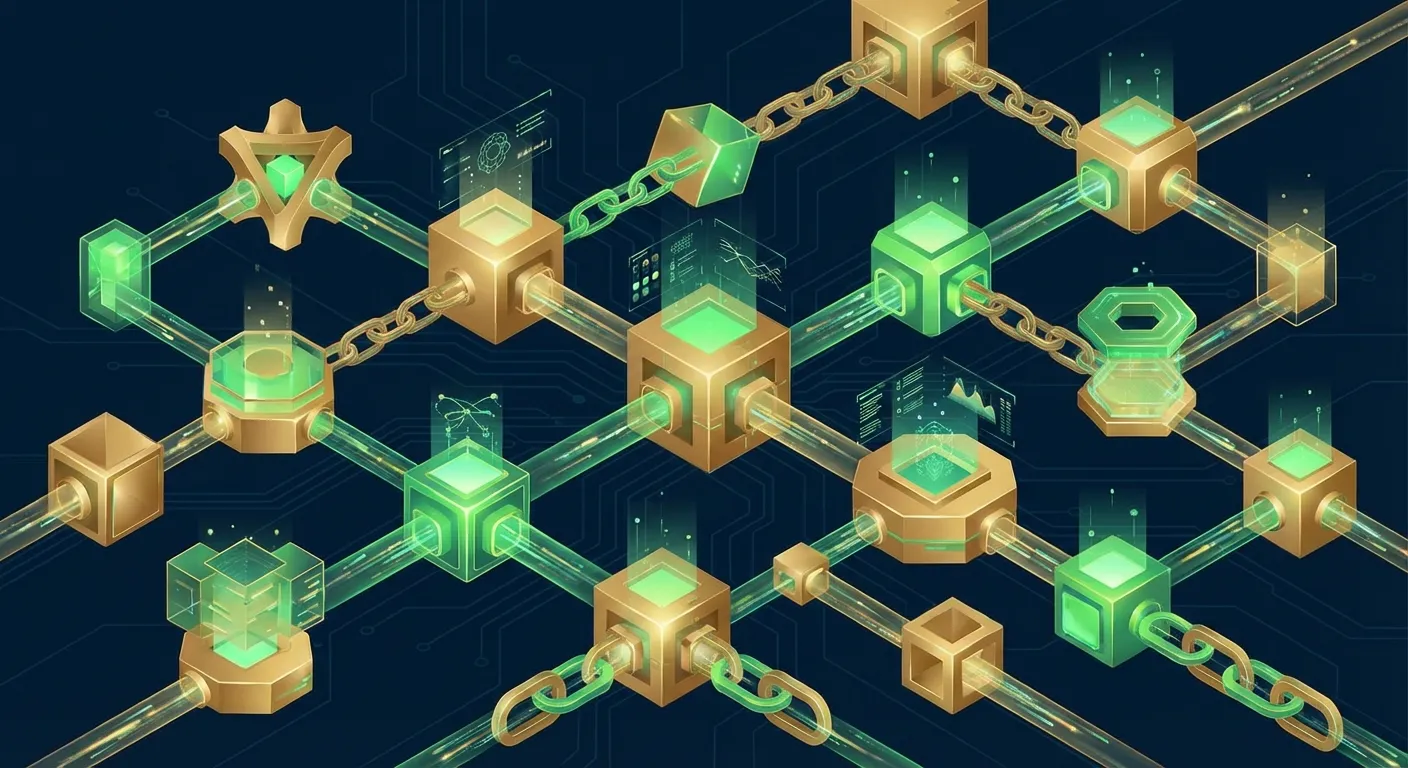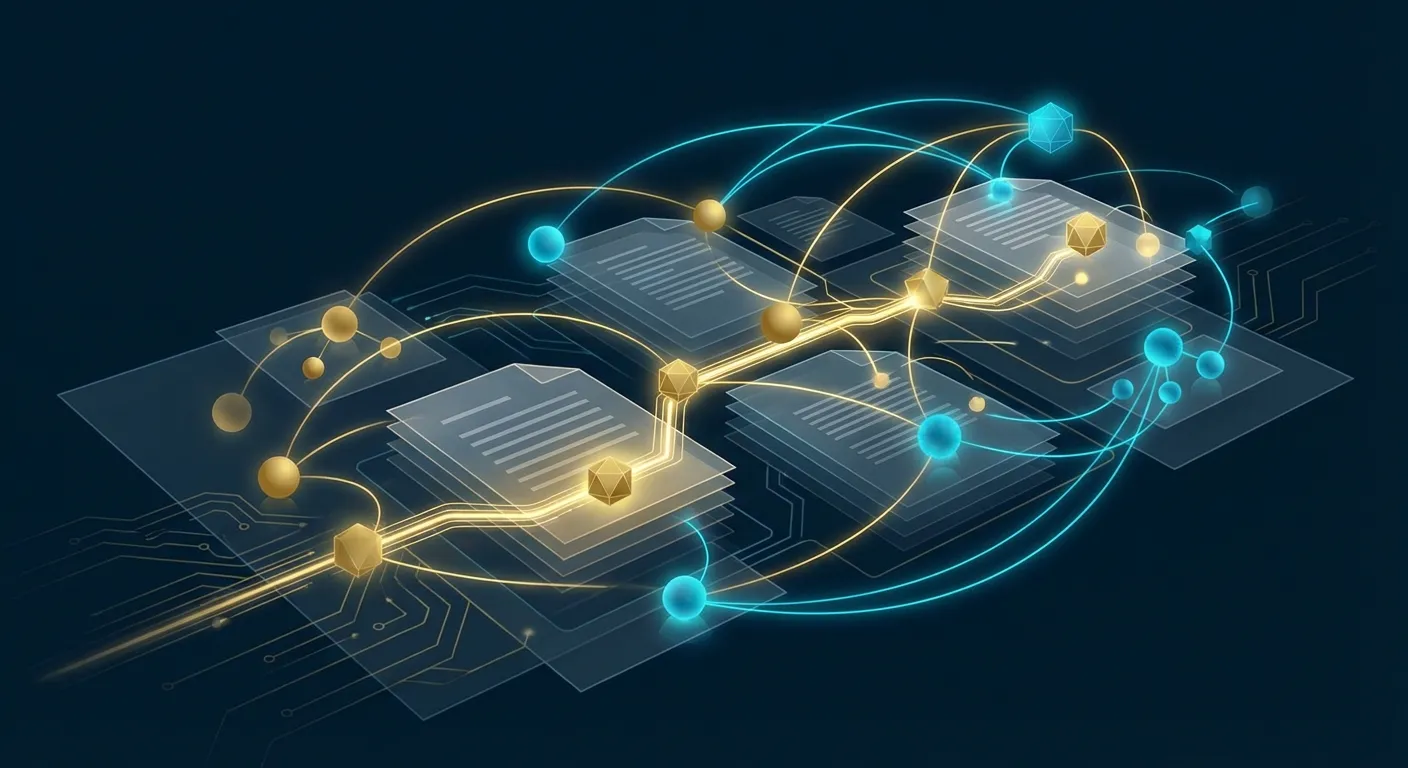
- GraphRAG (Retrieval-Augmented Generation) automatically constructs knowledge graphs combined with community detection and hierarchical summarization, improving answer comprehensiveness by 50–70% over traditional vector RAG on global questions ("What are the main themes across the entire corpus?")
- Microsoft Research's open-source GraphRAG system employs an LLM-driven entity and relationship extraction pipeline that converts unstructured text into knowledge graphs, completing graph construction without manual annotation
- Local Query is suited for precise factual queries while Global Query is suited for corpus-wide summarization and thematic analysis — the two mechanisms complement each other, covering the full spectrum of enterprise knowledge Q&A scenarios
- Enterprise-grade GraphRAG deployment requires integrating a graph database (Neo4j / ArangoDB), a vector database, and an LLM inference engine — a hybrid retrieval architecture with phased rollout is recommended
I. The Bottleneck of Traditional RAG: Why Vector Retrieval Is Not Enough
Since Lewis et al. proposed Retrieval-Augmented Generation (RAG) in 2020[3], it has become the mainstream architecture for enterprise deployment of large language models (LLMs). Its core logic is straightforward: split enterprise documents into text chunks, convert them into vectors via an embedding model, and store them in a vector database; when a user asks a question, retrieve the semantically closest chunks using the query vector, and feed them as context for the LLM to generate an answer. This approach performs well for single-point factual queries, but as enterprise deployments deepen, its structural limitations become increasingly apparent.
In their 2023 RAG survey[5], Gao et al. identified three core bottlenecks of traditional vector RAG. The first is inability to handle global questions: when users ask questions like "What are the core themes of these documents?" or "What are the most frequently mentioned risk factors across all reports?" — questions requiring comprehensive analysis across the entire corpus — vector retrieval can only return a handful of chunks with surface-level semantic similarity to the query, unable to provide a global perspective. The second is broken multi-hop reasoning: answering many professional questions requires chaining multiple scattered knowledge fragments — for example, "Which seismic zone is the factory of Company A's supplier B located in?" — which demands understanding the relationship chain between entities, not merely matching semantic similarity. The third is the semantic silo effect: fixed-length chunking strategies forcibly split originally coherent paragraphs, causing cross-paragraph causal, temporal, and hierarchical relationships to be lost during retrieval.
The more fundamental issue is that vector space is a "flat" semantic representation — all knowledge is compressed into points in high-dimensional space, with only distance relationships between them, lacking structural connections. Enterprise knowledge is inherently a network: regulations cite other regulations, products depend on supply chains, and research papers cross-reference one another. When we flatten this network into a set of vectors, vast amounts of structural information are irreversibly lost. This is precisely the fundamental problem GraphRAG aims to solve.
II. The Core Idea of GraphRAG: The Power of Structured Knowledge
The core idea of GraphRAG can be summarized in one sentence: layer a knowledge graph's structural understanding on top of vector retrieval. In the seminal paper published by Edge et al. at Microsoft Research in 2024[1], they formally proposed the "from local to global" Graph RAG approach, establishing the academic and engineering foundation for this direction.
A Knowledge Graph is a formalized method of representing knowledge using graph structures (nodes and edges). In their authoritative survey in ACM Computing Surveys[4], Hogan et al. defined three elements of a knowledge graph: entities (nodes in the graph, representing people, places, things, concepts, etc.), relations (edges in the graph, representing semantic connections between entities), and attributes (descriptive information attached to nodes or edges). GraphRAG's innovation lies in not requiring a manually pre-built knowledge graph; instead, it leverages the language understanding capability of LLMs to automatically extract entities and relationships from unstructured text, dynamically constructing the knowledge graph.
In their LLM and knowledge graph integration roadmap published in IEEE TKDE[2], Pan et al. categorized this integration into three modes: KG-enhanced LLM (using graph knowledge to strengthen model reasoning), LLM-enhanced KG (using language models to automatically construct graphs), and LLM-KG synergistic reasoning. GraphRAG combines the latter two modes — first using LLMs to construct the graph, then using the graph structure to assist LLM retrieval and reasoning.
From a system architecture perspective, GraphRAG inserts three key components into the traditional RAG "index → retrieve → generate" pipeline: graph construction (converting text into entity-relationship graphs), community detection (performing hierarchical community clustering on the graph), and community summarization (generating natural language summaries for each community). These three components enable the system to answer not only precise local questions but also open-ended questions requiring a global perspective — a capability traditional vector RAG cannot achieve.
III. Automated Knowledge Graph Construction: From Unstructured Text to Graph
The first technical component of GraphRAG is automatically converting unstructured text into a knowledge graph. In Microsoft's open-source implementation[9], this process is called the "Indexing Pipeline" and consists of four main steps.
Step 1: Text Chunking. Similar to traditional RAG, GraphRAG first splits long documents into manageable text fragments. However, unlike fixed-length chunking, GraphRAG recommends using a larger chunk size (e.g., 1200 tokens) to ensure each fragment contains sufficient context for identifying relationships between entities. The chunking strategy directly affects downstream entity extraction quality — chunks that are too small will sever cross-sentence relationships.
Step 2: Entity & Relationship Extraction. This is GraphRAG's core innovation. The system uses an LLM (such as GPT-4 or Claude) to process each chunk individually, employing carefully designed prompt templates to instruct the model to identify entities (person names, organizations, locations, concepts, events, etc.) and their relationships within the text. Research by Trajanoska et al.[10] has demonstrated that LLMs can match or even surpass traditional supervised extraction models in knowledge graph construction tasks, particularly in open-domain scenarios.
Step 3: Entity Resolution & Graph Merging. Entities extracted from different chunks may refer to the same entity under different names (e.g., "Microsoft," "MSFT," or its local-language equivalent). GraphRAG uses LLM-driven entity resolution to merge these duplicate entities, constructing a unified global knowledge graph. Ji et al. noted in their knowledge graph survey[6] that entity resolution is one of the most challenging aspects of graph construction, and the semantic understanding capability of LLMs provides a new approach to this problem.
Step 4: Graph Embedding Generation. Finally, the system generates vector embeddings for each node and edge in the graph, enabling subsequent retrieval operations to simultaneously leverage both graph structure and vector semantics. This dual-indexing mechanism is key to GraphRAG's ability to flexibly support different query types.
IV. Community Detection and Hierarchical Summarization
One of GraphRAG's most innovative designs is the introduction of community detection and hierarchical summarization on the knowledge graph. The combination of these two mechanisms enables the system to answer global questions that traditional RAG simply cannot handle[1].
Community detection is a classic problem in graph theory: identifying subgraphs (communities) in a large graph that have dense internal connections but sparse connections between them. GraphRAG employs the Leiden algorithm — an improved Louvain community detection method — to perform multi-level clustering on the knowledge graph. The Leiden algorithm's advantage is its ability to produce hierarchical community structures: Level 0 contains the finest-grained communities (a few highly related entities), Level 1 aggregates multiple Level 0 communities, and so on, forming a community tree.
Once each community is identified, GraphRAG uses an LLM to generate natural language community summaries. The summaries cover the core entities, key relationships, and semantic themes within each community. For example, in a knowledge graph of enterprise internal documents, a Level 1 community summary might read: "This community covers the company's Asia-Pacific operations. Key entities include the Taiwan subsidiary, the Singapore regional headquarters, and three contract manufacturing partners. Core relationships involve supply chain management and regional compliance."
The value of hierarchical summarization lies in pre-computing the global knowledge structure. When a user asks "What are the core themes of these documents?", the system does not need to traverse all original text — it simply consults top-level community summaries to provide a structured global answer. This is a strategy of trading "index-time computation" for "query-time efficiency." In their paper, Edge et al. reported[1] that on global questions, GraphRAG's answer comprehensiveness and diversity significantly outperformed baseline vector RAG systems, while answer latency was kept under control through pre-computed community summaries.
Research by Peng et al.[7] further confirmed that when LLMs have access to structured external knowledge summaries, both their factual accuracy and self-correction capabilities improve significantly, providing theoretical support for community summaries as an LLM augmentation mechanism.
V. Local Query vs Global Query Mechanisms
GraphRAG defines two complementary query mechanisms — Local Query and Global Query — each targeting different types of user questions with the most appropriate retrieval and generation strategy.
Local Query is suited for specific questions requiring precise facts, such as "What papers on graph neural networks did Professor Chen publish in 2024?" or "When did the partnership between Company A and Company B begin?" The workflow operates as follows: first, the system extracts key entities from the query; then, it locates these entities in the knowledge graph and collects related entities, relationships, and original text fragments along their neighborhood relations (1-hop or 2-hop neighbors); finally, it feeds the collected structured knowledge and original text together as context to the LLM for answer generation. In the Think-on-Graph research published at ICLR 2024, Sun et al.[8] demonstrated a similar strategy: enabling LLMs to perform "graph-based reasoning" on knowledge graphs, exploring answers step by step along entity relationship chains.
Global Query is suited for open-ended questions requiring a global perspective, such as "What are the most frequently encountered regulatory risk areas across the entire corpus?" or "What are the common failure modes across all project reports?" Its workflow is fundamentally different: the system does not extract entities from the query but instead directly consults pre-computed community summaries. Specifically, the system batch-feeds community summaries of the appropriate level to the LLM, requesting the model to generate a partial answer for each community based on the query along with an importance score; then, all partial answers are sorted by score, merged, deduplicated, and finally synthesized into a comprehensive answer with a global perspective.
The complementary nature of the two mechanisms can be understood through an analogy: Local Query is like looking up a specific chapter of a specific book in a library, while Global Query is like asking a librarian to produce a thematic analysis report of the entire collection. In their ablation experiments, Edge et al. found[1] that Global Query improved answer comprehensiveness by approximately 50–70% over baseline vector RAG on "sensemaking" questions, while Local Query was more efficient and accurate for precise factual queries. Therefore, when deploying GraphRAG in an enterprise setting, the appropriate combination of query mechanisms should be selected based on the distribution of query types in the business scenario; one can even build a query router that automatically determines the question type and dispatches it to the corresponding query pipeline.
VI. GraphRAG vs Traditional RAG: Performance Comparison
To quantify GraphRAG's advantages and costs relative to traditional vector RAG, we conduct a systematic comparison across five dimensions, combining Edge et al.'s experimental data[1] with industry practice observations.
| Evaluation Dimension | Traditional Vector RAG | GraphRAG (Local) | GraphRAG (Global) |
|---|---|---|---|
| Precise Factual Query | Excellent | Excellent (slightly better) | Not applicable |
| Global Summarization / Thematic Analysis | Poor | Moderate | Excellent |
| Multi-hop Reasoning | Poor (requires multiple retrievals) | Excellent (graph traversal) | Moderate |
| Answer Comprehensiveness | Moderate | Good | Excellent (+50–70%) |
| Index Construction Cost | Low (embedding computation) | High (LLM extraction + community detection + summary generation) | |
| Query Latency | Low (millisecond-level) | Medium (graph traversal + LLM) | Medium-High (multi-round LLM summary merging) |
| LLM Token Consumption | Low | Medium | High (proportional to number of communities) |
Advantage 1: Global Understanding. This is GraphRAG's most significant advantage. When answering questions about "the main themes of the corpus," traditional RAG can only return a few chunks with surface-level semantic similarity to the query, unable to provide structured global analysis. GraphRAG's community summarization mechanism pre-computes the hierarchical structure of knowledge, making global queries possible.
Advantage 2: Multi-hop Reasoning. The graph structure of a knowledge graph naturally supports relationship chain traversal. When answering a question requires chaining together three scattered knowledge fragments — "A is B's supplier," "B's factory is located in C," and "C belongs to seismic zone D" — graph traversal can find this path in O(n) time, whereas vector retrieval may require multiple iterations with no guarantee of path completeness[8].
Cost 1: Indexing Cost. GraphRAG's index construction requires calling an LLM for entity and relationship extraction on each chunk, followed by community detection and summary generation. According to Microsoft's documentation, for a medium-sized corpus (approximately 100,000 chunks), the complete indexing pipeline may consume millions of LLM tokens, with construction time ranging from hours to days. This means GraphRAG is better suited for scenarios where the knowledge base changes infrequently — such as regulatory libraries, technical manuals, and research paper collections — rather than real-time news feeds or social media data.
Cost 2: System Complexity. Traditional RAG only requires a vector database to operate, while GraphRAG additionally requires a graph database, community detection algorithms, an LLM extraction pipeline, and other components, significantly increasing deployment and operational complexity. When evaluating GraphRAG adoption, enterprises should factor these operational costs into their TCO (Total Cost of Ownership) calculations.
VII. Graph Database Selection: Neo4j, ArangoDB, and Neptune
One of the core infrastructure components of a GraphRAG system is the graph database, responsible for storing and querying the knowledge graph. The current market offers three main categories of options, each suited to different enterprise scenarios and technical requirements.
Neo4j is the most mature native graph database, using the Cypher query language, and possesses the most complete ecosystem in the knowledge graph domain. Neo4j's strengths include its highly optimized graph traversal performance, rich visualization tools (Neo4j Browser, Bloom), and deep integration with LLM frameworks (LangChain's Neo4jGraph, LlamaIndex's KnowledgeGraphIndex). According to Ji et al.'s knowledge graph survey[6], Neo4j holds a dominant position in both academic research and industrial applications. For GraphRAG systems with knowledge graphs at their core, Neo4j is the top choice. Its Community Edition is free and open source, while the Enterprise Edition provides cluster deployment and advanced security features.
ArangoDB is a multi-model database that simultaneously supports document (JSON), graph, and key-value data models. Its AQL (ArangoDB Query Language) unifies the query interface across all three models. ArangoDB's unique value is that enterprises do not need to deploy separate systems for graph and document databases — a single ArangoDB instance can store both original document chunks and the knowledge graph. This reduces the complexity of the system architecture, making it particularly suitable for small and medium-sized enterprises or resource-constrained teams. The downside is that its graph query performance on extremely large-scale graphs (billions of edges) falls short of Neo4j.
Amazon Neptune is AWS's fully managed graph database service, supporting both Apache TinkerPop Gremlin and SPARQL query interfaces. Neptune's core advantage is cloud-native full management — no infrastructure management required, automatic backups, and cross-availability-zone high availability. For enterprises already deeply invested in the AWS ecosystem, Neptune offers the smoothest integration with SageMaker (ML training), Bedrock (LLM inference), and S3 (document storage). However, Neptune costs more and lacks Neo4j's rich third-party integrations within the knowledge graph ecosystem.
| Evaluation Aspect | Neo4j | ArangoDB | Amazon Neptune |
|---|---|---|---|
| Data Model | Pure Graph (Property Graph) | Multi-model (Document + Graph + KV) | Property Graph + RDF |
| Query Language | Cypher | AQL | Gremlin / SPARQL |
| Graph Traversal Performance | Excellent | Good | Good |
| LLM Framework Integration | Rich (LangChain, LlamaIndex) | Moderate | Moderate (AWS Bedrock) |
| Deployment Model | Self-hosted / Cloud (Aura) | Self-hosted / Cloud (Oasis) | AWS Fully Managed |
| Ideal Scenario | Knowledge graph-intensive applications | Mid-size teams with multi-model data needs | Deep AWS users |
VIII. Enterprise-Grade GraphRAG System Architecture Design
Advancing GraphRAG from a research prototype to an enterprise-grade production system requires a comprehensive architecture design covering three layers: data pipeline, query engine, and infrastructure. Below, we propose a deployable reference architecture based on Microsoft Research's open-source framework[9] and industry best practices.
8.1 System Architecture Overview
Enterprise-Grade GraphRAG System Architecture:

┌─────────────────────────────────────────────────────┐
│  User Interface Layer (Chat UI / API Gateway)       │
└─────────────────────┬───────────────────────────────┘
                      │
┌─────────────────────▼───────────────────────────────┐
│  Query Router Layer                                  │
│  ┌──────────────┐  ┌──────────────┐                  │
│  │ Local Query  │  │ Global Query │                  │
│  │ Engine       │  │ Engine       │                  │
│  └──────┬───────┘  └──────┬───────┘                  │
└─────────┼─────────────────┼──────────────────────────┘
          │                 │
┌─────────▼─────────────────▼──────────────────────────┐
│  Retrieval Layer                                      │
│  ┌────────────┐  ┌────────────┐  ┌────────────┐      │
│  │ Graph DB   │  │ Vector DB  │  │ Community  │      │
│  │ (Neo4j)    │  │ (Milvus)   │  │ Summary    │      │
│  │            │  │            │  │ Index      │      │
│  └────────────┘  └────────────┘  └────────────┘      │
└──────────────────────────────────────────────────────┘
          ▲                 ▲              ▲
┌─────────┴─────────────────┴──────────────┴───────────┐
│  Indexing Pipeline                                     │
│  Chunking → Entity Extraction → Graph Merge →          │
│  Community Detection → Summary Generation              │
└─────────────────────┬────────────────────────────────┘
                      │
┌─────────────────────▼───────────────────────────────┐
│  Data Sources (Enterprise docs, knowledge bases,     │
│  regulatory libraries, technical manuals)             │
└─────────────────────────────────────────────────────┘
8.2 Engineering Considerations for the Indexing Pipeline
The indexing pipeline is the most computationally expensive component of a GraphRAG system. Enterprises should focus on the following engineering aspects when designing the indexing pipeline:
- Incremental Indexing: When new documents are added or updated in the knowledge base, the system should not rebuild the entire graph — it should only process the changed portions and merge them into the existing graph. This requires the indexing pipeline to support diff computation and graph merge operations
- LLM Cost Control: Entity extraction and summary generation involve heavy LLM usage. Enterprises should set token budget caps, use more economical models (e.g., GPT-4o-mini) for straightforward extraction tasks, and reserve high-capability models (e.g., GPT-4o or Claude Opus) for complex summary synthesis
- Quality Monitoring: Automatically extracted entities and relationships may contain errors or noise. It is recommended to implement a human-in-the-loop mechanism that allows domain experts to review and correct critical nodes and relationships in the graph
- Parallel Processing: Entity extraction tasks from text chunks are highly parallelizable. Using a queue system (e.g., Celery, AWS SQS) to manage LLM call tasks can significantly reduce index construction time
8.3 Query Router Layer Design
The query router layer is responsible for determining the type of user question and dispatching it to the Local Query or Global Query engine. An effective routing strategy is to use an LLM as a classifier: feed the user query into a lightweight LLM and ask it to determine whether the question is a "precise factual query" (route to Local), "global analysis/summary" (route to Global), or "hybrid" (run both in parallel, merge results).
Pan et al.'s research[2] points out that synergistic reasoning between LLMs and knowledge graphs is particularly critical in scenarios requiring multi-step logical deduction. Enterprises can further extend the router layer by adding a third query mode — Graph Traversal Query — specifically designed for multi-hop reasoning problems, collecting evidence step by step along the knowledge graph's relationship chains.
8.4 Phased Rollout Roadmap
- Phase 1 POC (4–6 weeks): Select a well-defined knowledge base (e.g., internal technical manuals or regulatory document collections), build an end-to-end prototype using the Microsoft GraphRAG open-source framework, and validate graph quality and query effectiveness. Use Neo4j Community Edition as the graph database
- Phase 2 MVP (2–3 months): Implement the incremental indexing pipeline, query router layer, and basic quality monitoring dashboard. Integrate into the enterprise's existing chatbot or knowledge Q&A interface
- Phase 3 Production (3–6 months): Adopt enterprise-grade graph database clusters, LLM cost optimization, comprehensive audit logs, and access control. Establish workflows for domain experts to participate in graph maintenance
- Phase 4 Scale (Ongoing): Extend the GraphRAG architecture to knowledge bases across more business domains, build a cross-domain unified knowledge graph, and explore graph-driven Agent Workflow applications
IX. Conclusion: The Convergence of Knowledge Graphs and LLMs
The emergence of GraphRAG marks a paradigm shift in RAG architecture from "flat vector retrieval" to "structured knowledge reasoning." This is not merely a technical upgrade but a shift in mindset — from treating knowledge as points in vector space to treating knowledge as an interconnected semantic network.
From the trajectory of academic research, the integration of LLMs and knowledge graphs is accelerating. Pan et al.'s roadmap[2] outlines three parallel development tracks: knowledge graphs enhancing LLM reasoning capabilities, LLMs automating knowledge graph construction and maintenance, and deep synergy between the two on complex reasoning tasks. Sun et al.'s Think-on-Graph[8] demonstrates how LLMs can perform "graph-based reasoning" on knowledge graphs, providing an interpretable and auditable reasoning paradigm for future Agent systems.
However, we must also clearly recognize GraphRAG's current limitations. The LLM cost of index construction remains high for large-scale corpora; the quality of automatically extracted graphs has not yet reached fully trustworthy levels; and community summaries in rapidly changing knowledge domains may quickly become outdated. These problems are not unsolvable, but they require continuous engineering optimization and academic breakthroughs.
For enterprise technology decision-makers, our recommendation is: don't wait for GraphRAG to be perfect before taking action, but don't blindly adopt it without understanding its limitations. Start with a well-scoped POC, quantify GraphRAG's gains and costs in your specific business scenario, and then decide whether to expand investment. The value of knowledge graph technology is cumulative — the more refined the graph, the higher the query quality — and this takes time and sustained involvement from domain experts.
The research team at Meta Intelligence continuously tracks the latest breakthroughs in GraphRAG, knowledge graphs, and LLM integration, and assists enterprise clients in designing next-generation knowledge architectures tailored to their business needs. From graph construction strategies to graph database selection, from query engine design to full-system performance optimization, we are committed to translating cutting-edge research into deployable enterprise solutions.