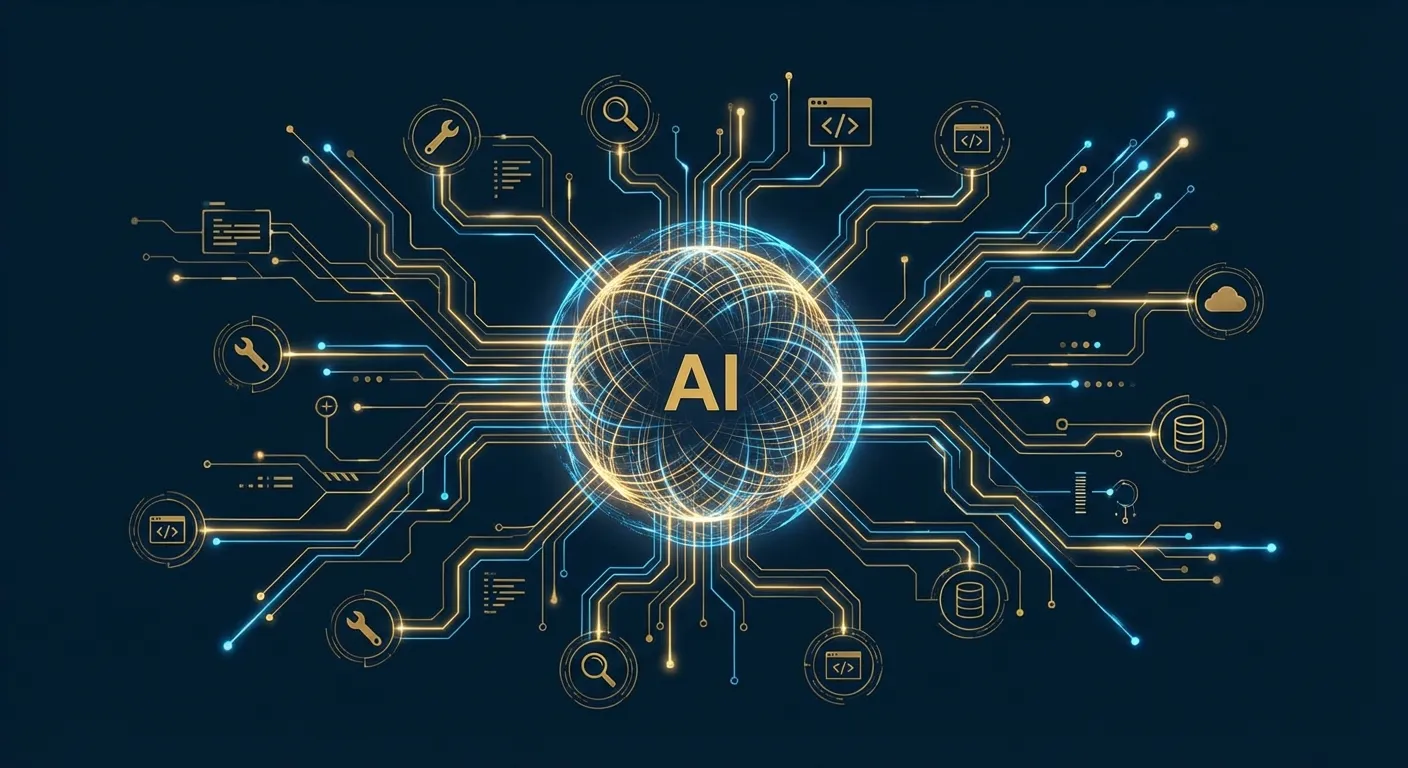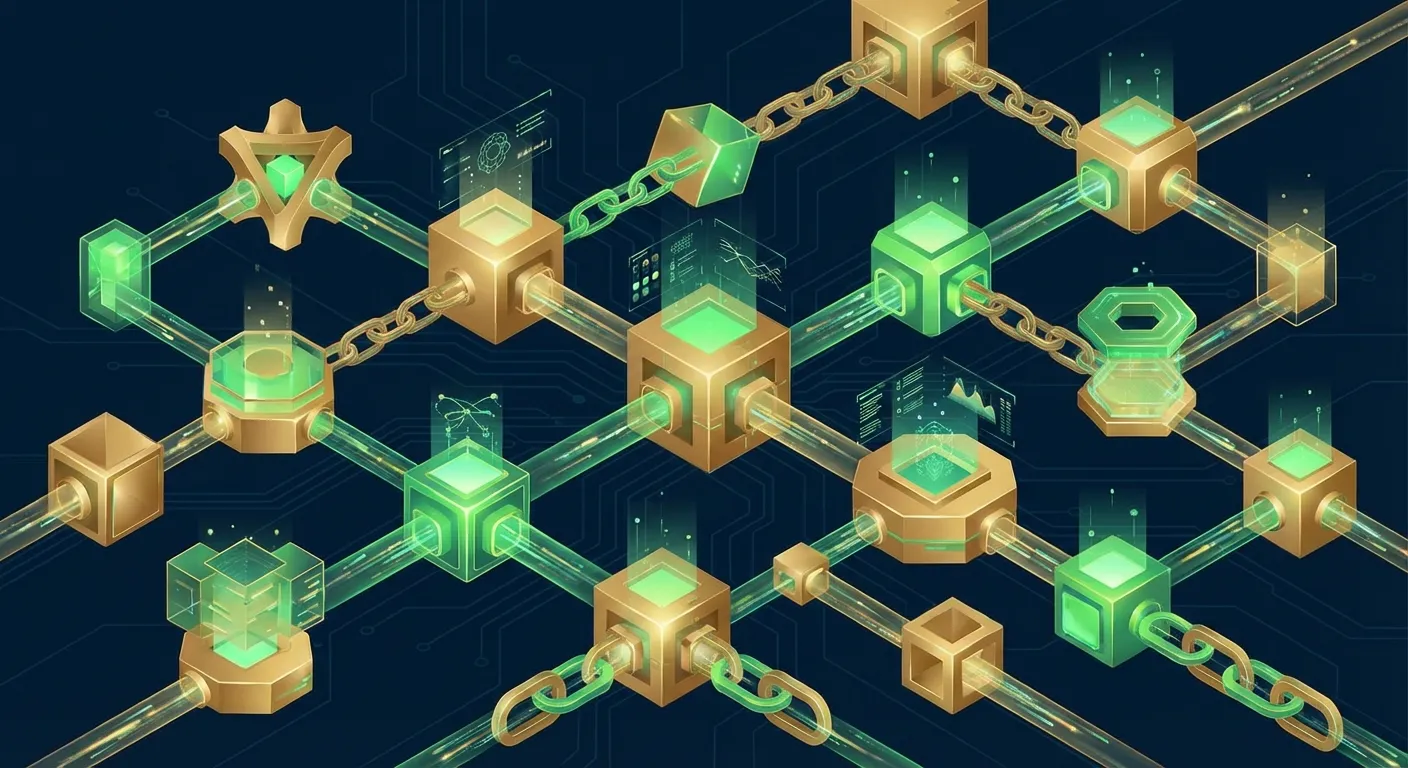
- LangChain is currently the most mature LLM application development framework, with a modular design that decouples Model, Prompt, Chain, Memory, and Tool — developers can assemble everything from simple Q&A to complex multi-step reasoning enterprise-grade applications like building blocks
- LangChain Expression Language (LCEL) uses declarative syntax to chain Runnable components, providing native streaming output, batch processing, and asynchronous execution capabilities, greatly simplifying production environment deployment
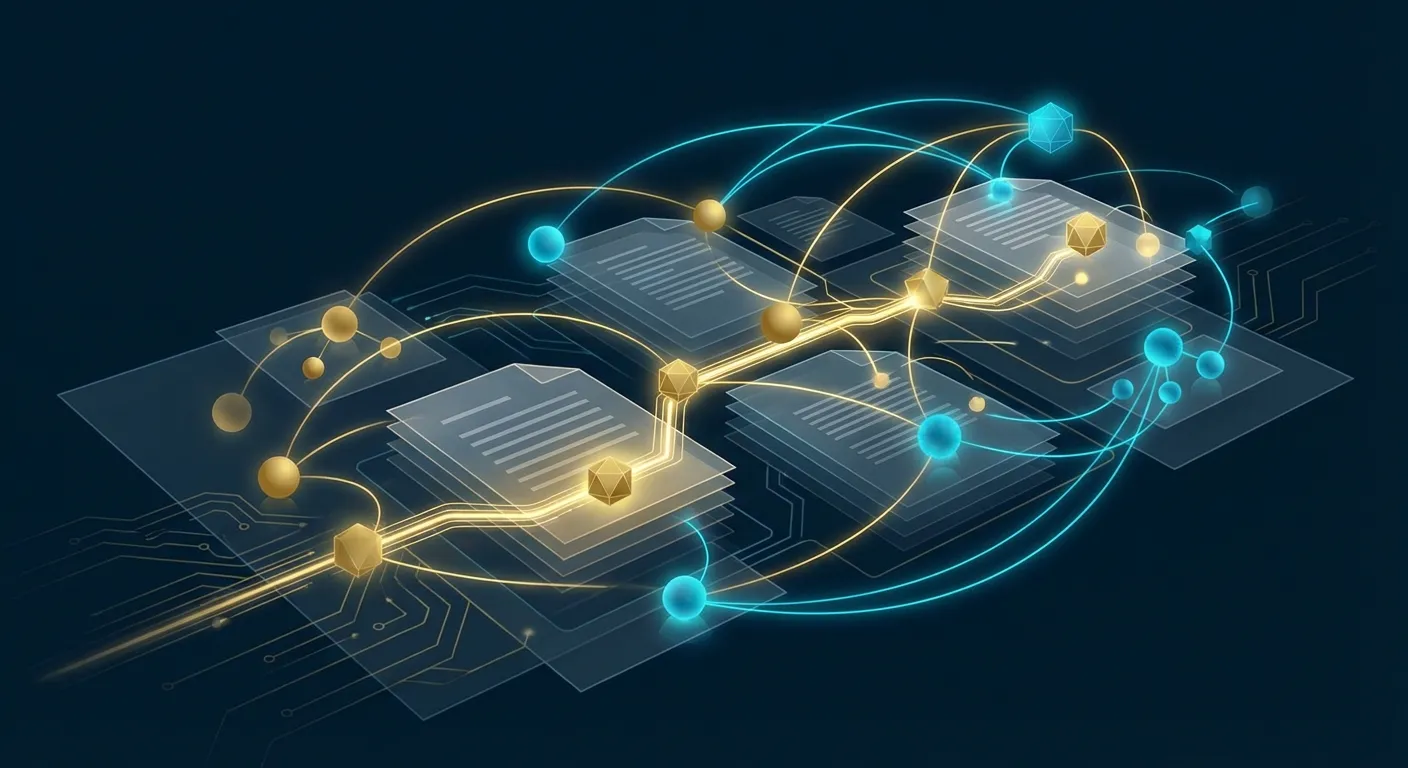
- Combining Document Loader, Text Splitter, Embedding Model, and Vector Store, LangChain provides an end-to-end RAG (Retrieval-Augmented Generation) pipeline construction solution — the shortest path for enterprises to adopt knowledge-enhanced LLM applications
- LangGraph models Agent execution flows as directed state graphs, supporting conditional branches, loops, and human-in-the-loop nodes — the preferred architecture for building production-grade multi-step AI Agents
1. LangChain's Positioning: The Swiss Army Knife of LLM Application Development
Since Harrison Chase first released LangChain in 2022[1], this open-source framework has grown from an experimental Python package to a standard infrastructure for LLM application development with over 90,000 GitHub Stars and millions of monthly downloads. LangChain's core value proposition is crystal clear: providing developers with a modular, composable abstraction layer that transforms the raw capabilities of large language models into reliable applications.
Before LangChain, developing an LLM application meant dealing directly with each model provider's API — OpenAI had one interface, Anthropic had another, and Google yet another. Switching models meant rewriting almost all code. Even more challenging was the enormous engineering gap between "a working demo" and "a shippable product": How to manage conversation memory? How to chain multiple LLM calls? How to integrate external data sources? How to implement error handling and retry mechanisms? Each of these problems required substantial boilerplate code.
Topsakal and Akinci pointed out in their 2023 research[7] that LangChain encapsulates these engineering challenges into reusable modules through unified abstract interfaces. Developers can focus solely on business logic — which model to choose, what Prompt to design, what steps to chain — without worrying about underlying API compatibility, serialization, or error handling infrastructure. This design philosophy is similar to Django's or Rails' role relative to raw HTTP handling in web development.
LangChain's ecosystem now extends far beyond the framework itself. LangGraph provides stateful Agent architecture[2]; LangSmith provides observability and evaluation platforms; LangServe provides one-click deployment as REST APIs. This complete toolchain makes LangChain not just a framework but a platform covering the entire lifecycle of LLM application development, testing, deployment, and monitoring.
2. Core Modules: Model, Prompt, Chain
LangChain's architecture can be understood as layered abstractions stacked upon each other. The bottom layer is Model — a unified wrapper for various LLM providers; above it is Prompt — structured prompt engineering tools; the next layer up is Chain — a composition mechanism for chaining multiple components into complete workflows. Understanding these three layers of abstraction is the foundation for mastering LangChain.
2.1 Model: A Unified Model Interface
LangChain defines two core model interfaces: LLM (plain text input/output) and ChatModel (conversation model based on message lists). Regardless of whether the underlying model is OpenAI GPT-4o, Anthropic Claude, Google Gemini, or open-source Llama, developers call models through the same .invoke() method. The value of this abstraction layer is: when you decide to switch from GPT-4o to Claude Opus, you only need to change one line of model initialization code — the rest of the business logic is completely unaffected.
2.2 Prompt Template: Reusable Prompt Engineering
Good Prompts are the soul of LLM applications, and LangChain's PromptTemplate and ChatPromptTemplate elevate prompt engineering from hardcoded strings to parameterizable, version-controllable engineering artifacts. A typical ChatPromptTemplate includes a System Message (defining role and rules), Few-shot Examples (providing demonstrations), and Human Message (user input), allowing developers to inject dynamic content through variables. Wei et al.'s research[6] confirmed that well-designed Chain-of-Thought Prompts can significantly improve LLM reasoning performance, and LangChain's Prompt Template mechanism makes managing and iterating on such complex Prompts systematic.
2.3 Chain and LCEL: Declarative Workflow Composition
Chain is LangChain's most iconic concept. A Chain links multiple processing steps into a pipeline — for example, "receive user input → fill Prompt template → call LLM → parse output." LangChain introduced LangChain Expression Language (LCEL) in v0.2, using the | pipe operator to compose Runnable components in declarative syntax:
from langchain_openai import ChatOpenAI
from langchain_core.prompts import ChatPromptTemplate
from langchain_core.output_parsers import StrOutputParser

prompt = ChatPromptTemplate.from_template("Summarize the following content: {text}")
model = ChatOpenAI(model="gpt-4o")
parser = StrOutputParser()

chain = prompt | model | parser
result = chain.invoke({"text": "LangChain is an open-source framework..."})
LCEL's design philosophy is heavily influenced by functional programming: each Runnable is a pure function that receives input and produces output, and can be freely composed. This design brings the additional benefit of native support for streaming output (.stream()), batch processing (.batch()), and asynchronous execution (.ainvoke()) without additional engineering effort.
3. Memory System: Enabling LLMs to Remember Conversation Context
A fundamental limitation of LLMs is the lack of persistent memory — each API call is stateless. For applications requiring multi-turn conversations (customer service bots, consulting assistants, interactive analysis tools), this is an engineering problem that must be solved. LangChain's Memory system provides a series of strategies for managing conversation history and context.
3.1 ConversationBufferMemory: Full Retention
The most intuitive strategy is to fully preserve all conversation history and inject it into the Prompt on each call. ConversationBufferMemory implements this approach. The advantage is zero information loss; the drawback is that token consumption grows linearly as conversation turns increase, potentially exceeding the model's Context Window limit. For short conversation scenarios (such as technical support Q&A), this is the simplest and most effective choice.
3.2 ConversationSummaryMemory: Compression Strategy
To address the token growth problem, ConversationSummaryMemory uses an LLM to compress conversation history into summaries after each turn. This "trading LLM calls for token space" strategy is suitable for scenarios requiring long-term conversation memory without needing verbatim recall. The summarization process itself introduces additional API latency and cost, requiring a balance between memory fidelity and performance.
3.3 ConversationBufferWindowMemory and Advanced Strategies
ConversationBufferWindowMemory offers a compromise: retaining only the full content of the most recent K conversation turns. This "sliding window" strategy is practical enough for most commercial scenarios — users typically care about the recent context of the current topic, not historical details from dozens of turns ago. For more complex needs, LangChain also supports advanced solutions based on Entity Memory (tracking the state of entities mentioned in conversations) and vector memory (embedding conversation history into vector space for semantic-relevance retrieval).
In enterprise-grade applications, Memory design decisions are often more important than one might expect. A medical consultation bot needs to precisely remember symptoms the patient previously described; a legal assistant needs to track key facts in a case. Choosing the wrong Memory strategy can range from degrading answer quality to causing critical information loss. We recommend benchmarking based on specific scenarios rather than blindly applying default solutions.
4. RAG Pipeline Construction: From Document Loading to Vector Retrieval
Retrieval-Augmented Generation (RAG) is currently the most mainstream architectural pattern for enterprise LLM adoption[3]. Its core logic is: before the LLM generates an answer, first retrieve relevant documents from the enterprise knowledge base, inject them as context into the Prompt, enabling the model to answer questions based on the most current and specific knowledge. LangChain provides mature modular tools for every stage of the RAG pipeline.
4.1 Document Loader: Unified Data Extraction
The first step in RAG is loading enterprise knowledge assets into the system. LangChain provides over 160 Document Loaders supporting PDF, Word, HTML, CSV, Notion, Confluence, Google Drive, GitHub, S3, and virtually all common data sources. Each Loader converts raw data into a unified Document object containing page_content (text content) and metadata (source, page number, last modified time, and other metadata).
4.2 Text Splitter: Semantic-Aware Document Chunking
Loaded documents are typically too long to feed directly into an LLM's Context Window. Text Splitters are responsible for splitting long documents into appropriately sized chunks. Gao et al.'s RAG survey[8] pointed out that chunk quality directly determines RAG system retrieval precision. LangChain provides multiple splitting strategies: RecursiveCharacterTextSplitter (hierarchical recursive splitting, prioritizing paragraph integrity), TokenTextSplitter (precise length control by token), and MarkdownHeaderTextSplitter (splitting by Markdown heading structure). In practice, we recommend setting chunk_overlap (overlap regions) to prevent semantic breakage at chunk boundaries.
4.3 Embedding and Vector Store: Semantic Indexing
Split chunks are converted to high-dimensional vector representations through an Embedding Model and stored in a Vector Store to build a semantic index. LangChain supports OpenAI Embeddings, Cohere, Hugging Face, and other mainstream Embedding models, as well as Chroma, FAISS, vector databases, Weaviate, Milvus, and Qdrant. During queries, user questions are similarly converted to vectors, and the most relevant chunks are retrieved through cosine similarity or inner product, then injected into the LLM Prompt for answer generation.
A complete RAG Chain expressed in LCEL is remarkably concise:
from langchain_core.runnables import RunnablePassthrough

rag_chain = (
{"context": retriever | format_docs, "question": RunnablePassthrough()}
| prompt
| model
| StrOutputParser()
)
This code chains retrieval, formatting, Prompt filling, model calling, and output parsing into a single pipeline, demonstrating LCEL's elegance in expressing complex workflows.
5. Tool and Agent: Enabling LLMs to Use External Tools
A purely text-generation-based LLM has a fundamental limitation: it cannot interact with the external world. It cannot query real-time data, perform calculations, operate databases, or call APIs. Schick et al.'s Toolformer research[5] pioneered the demonstration that LLMs possess the ability to learn tool usage, and LangChain's Tool and Agent system engineers this capability.
5.1 Tool: Encapsulation of External Capabilities
In LangChain, a Tool is a standardized encapsulation of external functionality, comprising three elements: name, description, and callable function. The description is critical — it is the sole basis for the LLM to decide when and how to use the tool. LangChain includes built-in tools for search engines (Tavily, SerpAPI), calculators (LLMMath), Python REPL, Wikipedia, weather APIs, and more, and developers can easily define custom tools through the @tool decorator.
5.2 Agent: Dynamic Decision Engine
If a Chain is a predefined static pipeline, then an Agent is an intelligent entity that can dynamically decide its next action based on context. The ReAct framework proposed by Yao et al.[4] is the theoretical foundation of LangChain Agents: at each step, the LLM first Reasons about the current context, then decides whether to call a tool (Act) or directly answer the user. The result returned by the tool becomes the Observation for the next round of reasoning, looping until the task is complete.
LangChain's Agent system has undergone significant evolution. The early AgentExecutor provided a simple ReAct loop implementation but was inadequate for scenarios requiring complex control flows. Wang et al.'s Agent survey[9] pointed out that production-grade Agents need error recovery, parallel tool calling, human-in-the-loop, and other advanced capabilities. These needs directly led to the creation of LangGraph — an entirely new framework that models Agent execution flows as directed graphs.
5.3 Function Calling: Structured Tool Invocation
Modern LLMs (GPT-4o, Claude, Gemini) natively support Function Calling — the model can output structured JSON to specify which function to call and its parameters. LangChain binds Tool definitions to models through the .bind_tools() method, enabling LLMs to call tools in a structured manner, significantly improving the reliability and parsability of tool calls. Compared to the earlier approach of relying on Prompt Engineering to have models "speak" tool invocation instructions, Function Calling represents a qualitative leap in stability.
6. LangGraph: Stateful Multi-Step Agent Architecture
LangGraph is the Agent framework launched by the LangChain team in 2024[2], with the design philosophy: modeling Agent execution flows as a Directed Graph where nodes represent processing steps, edges represent transition logic between steps, and the graph's global state is shared and updated across nodes.
6.1 Graph State Machine Design Philosophy
The traditional AgentExecutor was an opaque black-box loop: the LLM decides an action, executes a tool, observes the result, then decides the next action. Developers had extremely limited control over this loop. LangGraph "unfolds" this loop into a visualizable graph where every decision point and processing step becomes an explicit node on the graph. This design brings three key advantages:
First, fine-grained control. Developers can insert custom logic at any node — data validation, permission checks, cost controls, logging. Second, conditional branches and loops. Through conditional edges, Agents can follow different execution paths based on intermediate results or loop back to earlier nodes for retry when conditions aren't met. The "self-reflection loop" advocated in Shinn et al.'s Reflexion research[10] can be naturally expressed as a back-edge on the graph in LangGraph. Third, Human-in-the-loop. By inserting interrupt commands at critical decision nodes, Agents can pause before execution and wait for human confirmation — essential for high-stakes scenarios (financial transactions, medical decisions).
6.2 Implementation of State, Node, and Edge
LangGraph's core API consists of three concepts. State is a TypedDict that defines the graph's global state structure — including message history, intermediate results, tool return values, etc. Node is a Python function that receives the current State and returns state updates. Edge defines transition rules between nodes, which can be fixed (from A always to B) or conditional (direction determined by the value of a field in the State). Here is the construction paradigm for a basic ReAct Agent in LangGraph:
from langgraph.graph import StateGraph, MessagesState, START, END
from langgraph.prebuilt import ToolNode

graph = StateGraph(MessagesState)
graph.add_node("agent", call_model)
graph.add_node("tools", ToolNode(tools))
graph.add_edge(START, "agent")
graph.add_conditional_edges("agent", should_continue, {"continue": "tools", "end": END})
graph.add_edge("tools", "agent")

app = graph.compile()
This code defines a minimal ReAct loop: the Agent node calls the LLM to decide the next action, conditional edges determine the flow based on whether the LLM requests a tool call — if a tool is needed, it routes to the Tools node for execution, then returns to the Agent node; if no tool is needed, it ends. The entire graph structure is clearly visualizable, testable, and debuggable.
6.3 Persistence and Checkpoints
LangGraph has a built-in Checkpointer mechanism that can persist the graph state at any point in time to a database. This not only supports long-running tasks (Agent workflows spanning hours or even days) but also enables "time-travel debugging" — developers can rewind to any checkpoint, inspect the complete state at that time, and replay subsequent steps. For troubleshooting in production environments, this is an extremely valuable capability.
7. LangSmith: Observability and Evaluation
A major challenge in building LLM applications is that traditional software engineering's deterministic testing methods (given input, expect exact output) fail in the face of non-deterministic language models. LangSmith is the observability and evaluation platform launched by the LangChain team, specifically addressing the question of "how to know if your LLM application is working properly."
7.1 Tracing
LangSmith automatically records the complete details of every LLM call, Tool call, and Retriever query in LangChain applications: inputs, outputs, latency, token usage, and error information. These trace records are presented as nested Run Trees, allowing developers to precisely pinpoint which stage in a complex Chain or Agent went wrong. In RAG applications, the tracing feature is particularly valuable — you can clearly see which documents were retrieved, how the LLM generated answers based on those documents, enabling diagnosis of "poor retrieval quality" versus "poor generation quality" as two fundamentally different problems.
7.2 Evaluation
LangSmith provides a systematic evaluation framework: define Datasets, create Evaluators, run batch tests, and compare performance across different versions. Evaluators can be rule-based (keyword matching, JSON Schema validation), LLM-based (using another LLM to judge answer quality), or human-annotated. This toolset enables developers to quantitatively measure the impact of changes after each Prompt iteration, model swap, or RAG parameter adjustment, rather than relying on subjective "it feels better" judgments.
7.3 Prompt Hub and Collaboration
LangSmith includes a built-in Prompt Hub, enabling teams to version-control, share, and iterate on Prompt Templates. In enterprise environments, Prompts are often iterated by product managers, domain experts, and engineers together — Prompt Hub provides a unified collaboration interface, avoiding the chaos of Prompts scattered throughout the codebase without trackable change history. Combined with the evaluation framework, each Prompt change can automatically trigger regression tests, ensuring changes don't introduce unexpected quality degradation.
8. Enterprise Architecture Design and Performance Optimization
Moving LangChain applications from Prototype to Production requires a series of critical architectural design decisions. The following are practical lessons we've distilled from multiple enterprise-grade projects.
8.1 Model Routing and Fallback Strategies
In production environments, not all requests should be sent to the same model. Simple classification or summarization tasks can use lightweight models (such as GPT-4o-mini or Claude Haiku), while only complex queries requiring deep reasoning are routed to flagship models. LangChain's Runnable abstraction makes implementing a model router intuitive: first use a lightweight model to assess query complexity, then route to the appropriate model based on the result. Additionally, automatic fallback to alternative models when the primary model API is unavailable is an essential design for production environments.
8.2 Caching and Cost Control
LLM API call costs can quickly escalate in high-traffic scenarios. LangChain includes multiple caching strategies: InMemoryCache (development environments), SQLiteCache (single-machine deployment), RedisCache (distributed environments). For Embedding computation, the caching benefits are especially significant — the Embedding result for the same text is deterministic and doesn't need to be recomputed. In RAG applications, we recommend establishing separate caching layers for Document Embeddings and common query LLM responses, which can reduce API costs by 40-60%.
8.3 Asynchronous and Streaming
LCEL natively supports asynchronous execution (ainvoke, astream), which is critical for web services requiring high concurrency. Paired with asynchronous frameworks like FastAPI, a LangChain service can process other requests while waiting for LLM API responses, significantly improving throughput. Streaming output directly impacts user experience — allowing users to see results token by token as the LLM generates answers, rather than waiting for the complete response, can reduce perceived latency from seconds to hundreds of milliseconds.
8.4 Security and Compliance
Enterprises deploying LLM applications must take security risks seriously. LangChain provides Input/Output Guard mechanisms, allowing content filtering logic to be inserted at Chain entry and exit points — detecting and blocking Prompt Injection attacks, filtering sensitive PII, and restricting the model's output topic scope. For regulated industries (finance, healthcare), we recommend adding manual review nodes to LangGraph Agent workflows to ensure high-risk decisions are confirmed by humans before execution.
9. Conclusion: The Future of the LangChain Ecosystem
LangChain grew from an experimental open-source project in 2022 to the de facto standard framework for LLM application development in just three years[1]. This trajectory reflects not only the framework's technical strength but also the entire industry's urgent need for answers to "how to systematically build LLM applications."
Looking ahead, we observe several clear trends. First, Agent architecture will become mainstream. As LLM reasoning capabilities continue to improve and Function Calling becomes widespread, LLM applications are evolving from static Chain pipelines to dynamic Agent systems. LangGraph's directed graph model provides a solid engineering foundation for this, and its ecosystem is rapidly expanding — from Checkpoint persistence to LangGraph Cloud managed deployment, the engineering maturity of Agents is rapidly catching up with traditional software.
Second, multimodal capabilities will be deeply integrated. Current LangChain applications are primarily text-based, but as models like GPT-4o and Gemini natively support image, audio, and video inputs, RAG pipelines need to expand to multimodal retrieval — retrieving not only text but also charts, video clips, and audio recordings. LangChain's modular architecture makes this expansion technically feasible, but Embedding strategies and Vector Store selection require rethinking.
Third, observability and evaluation will become essential. As LLM applications move from POC to production, "it seems to work correctly most of the time" is no longer an acceptable quality standard. The direction represented by LangSmith — systematic tracing, evaluation, and continuous monitoring — will transition from "nice-to-have" to "must-have." We expect that within the next year, quality assurance systems for LLM applications will mature, forming automated evaluation pipelines similar to traditional software CI/CD.
For enterprises and developers, the LangChain ecosystem provides a complete path from proof of concept to production deployment. However, the framework is just a tool — the real challenge lies in: how to design appropriate Prompt strategies based on deep understanding of business scenarios, choose the right Memory mechanism, build high-quality RAG knowledge bases, and define robust Agent workflows. These decisions require teams with both LLM engineering practice experience and domain expertise. Meta Intelligence continues to help enterprises make optimal technology choices on this journey, transforming LangChain's engineering capabilities into quantifiable business value.