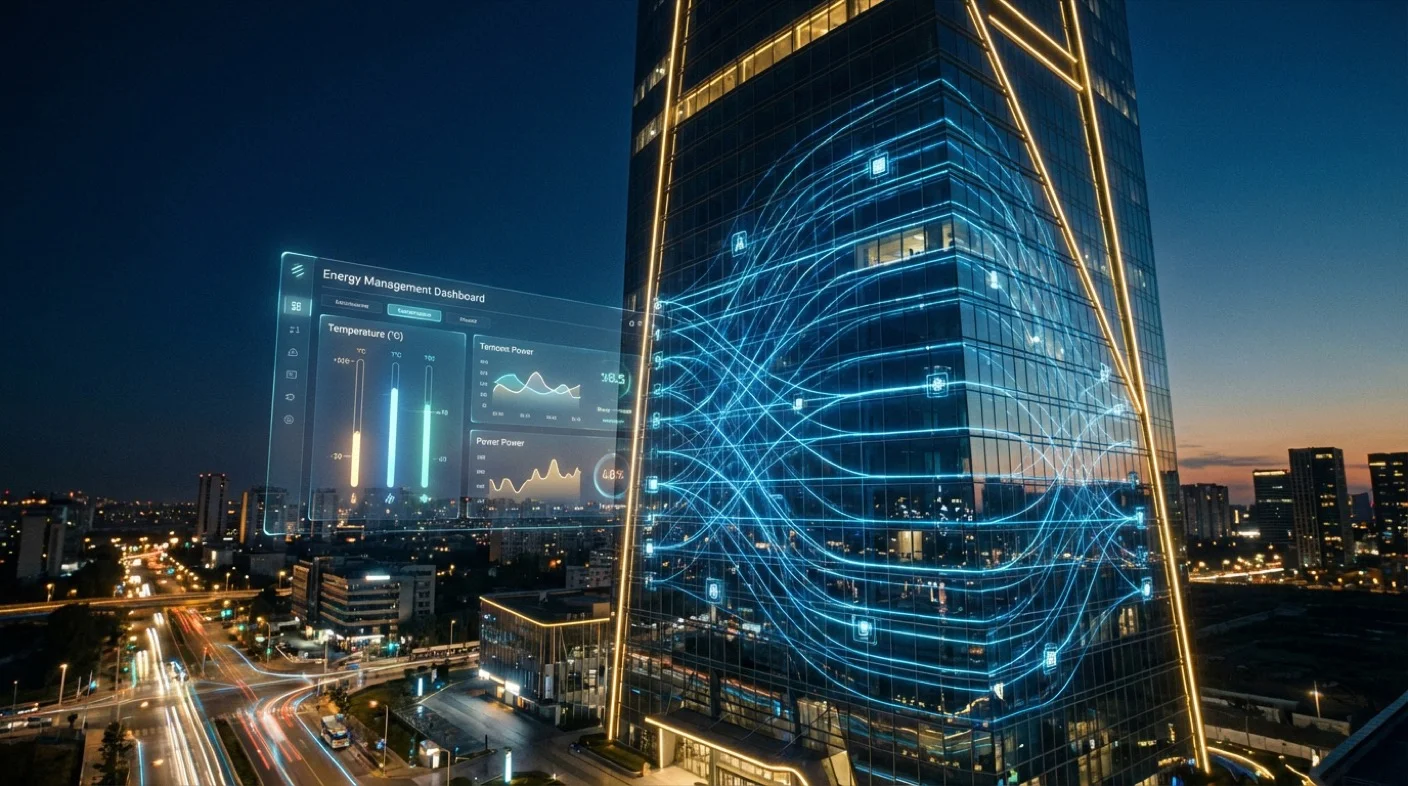
- The building sector accounts for approximately 30% of global end-use energy consumption and about 26% of carbon emissions, making it the area with the greatest leverage for decarbonization[4]
- AI-driven Building Energy Management Systems (BEMS) combined with Model Predictive Control (MPC) can reduce HVAC energy consumption by 15-30% while maintaining or improving indoor comfort[1]
- Deep Reinforcement Learning (Deep RL) has demonstrated energy savings exceeding 20% over traditional rule-based control in HVAC AI control, without requiring manual thermodynamic model construction[3]
- Taiwan's Intelligent Building Label has incorporated AI applications into its evaluation criteria, and the dual-certification system combined with the Green Building Label is driving the building industry's zero-carbon transformation[7]
1. Buildings Account for 40% of Global Energy: Why Smart Buildings Are Key to Decarbonization
When global climate discussions focus on the transportation and industrial sectors, the carbon emissions from the building sector are frequently underestimated. According to the IEA's tracking report[4], building operations and construction combined account for nearly 40% of global end-use energy consumption, with HVAC, lighting, and electrical appliances during the operational phase occupying the majority share. In Taiwan, building electricity consumption accounts for approximately 35% of national total electricity consumption, with commercial building HVAC systems alone representing 50-60% of total building electricity use. This means that effectively reducing energy consumption during the building operational phase would yield decarbonization benefits far exceeding those of most other industry efficiency measures.
Traditional building energy management has long relied on manual scheduling and fixed rules — HVAC turns on at 8 AM and off at 6 PM, lighting activates building-wide after sunset. This "one-size-fits-all" control logic completely ignores the dynamic nature of building use: conference rooms may sit empty all day while HVAC continues running, lobbies overheat in the afternoon due to western sun exposure but the system cannot pre-adjust the load, and only a few floors are occupied on weekends yet building-wide lighting remains on. These "visible yet unmanageable" waste scenarios are exactly the core problem that smart building technology aims to solve.
The core concept of Smart Buildings is integrating sensor networks, IoT platforms, and AI algorithms to give buildings closed-loop capabilities of "sensing, analyzing, deciding, and executing." Farzaneh et al. systematically traced the evolution of AI in smart buildings in their review in Applied Sciences[6]: from early simple rule engines, to statistical models (regression analysis, time series), to today's deep learning and reinforcement learning — each leap in AI technology has brought finer control granularity and higher optimization ceilings for building energy efficiency.
Notably, smart buildings are not simply about "adding sensors." Drgoňa et al. emphasized in their MPC review[1] that truly effective building energy management requires three levels of integration: the physical layer (sensor and actuator data collection and control execution), the model layer (building thermodynamic models or data-driven predictive models), and the optimization layer (multi-objective optimization decisions based on model predictions). Missing any layer reduces the system to nothing more than an expensive dashboard rather than a truly intelligent management system.
2. The AI Evolution of Building Energy Management Systems (BEMS)
Limitations of Traditional BEMS
The Building Energy Management System (BEMS) is the brain of a smart building. Traditional BEMS is based on Programmable Logic Controllers (PLCs) and Supervisory Control and Data Acquisition (SCADA) systems, controlling HVAC, lighting, and power systems through preset schedules and fixed setpoints. However, traditional BEMS has three fundamental limitations. First, lack of predictive capability — the system can only react to the current state and cannot foresee weather changes or personnel movements in the next hour. Second, inability to handle multivariable interactions — HVAC efficiency is simultaneously affected by dozens of variables including outdoor temperature, solar angle, occupant density, and equipment heat generation, and fixed rules cannot capture the nonlinear relationships between these variables. Third, lack of self-learning mechanisms — once the system is configured, even when building usage patterns change (such as post-pandemic hybrid work models), the control logic does not automatically adjust[6].
Architectural Evolution of AI-BEMS
The next generation of AI-driven BEMS is fundamentally changing this landscape. Its architecture can be divided into four functional modules: the data collection layer (IoT sensor networks collecting temperature, humidity, CO2 concentration, light intensity, occupant count, and other data), the predictive analytics layer (machine learning models forecasting energy demand, weather changes, and occupant flows for the next 1-24 hours), the optimization decision layer (optimizing control strategies based on prediction results and multi-objective constraints), and the execution feedback layer (sending optimized commands to HVAC chillers, lighting controllers, and power management systems, and collecting execution results for closed-loop learning).
Gonzalez-Briones et al. in their research in the Energies journal[5] specifically proposed a Multi-Agent System (MAS) application framework for building energy management: different AI agents are respectively responsible for local optimization of HVAC, lighting, elevators, and renewable energy systems, then reach global energy optimization through negotiation mechanisms. The advantage of this distributed architecture is that each subsystem can be independently upgraded and maintained, and a failure in a single subsystem does not affect the operation of others.
In Taiwan's practical scenarios, the implementation of AI-BEMS typically faces the challenge of integrating existing systems. Most commercial office buildings already have traditional BEMS installed, but different brands of HVAC chillers, lighting controllers, and metering systems each use proprietary protocols (such as BACnet, Modbus, LonWorks). Building the AI layer first requires a middleware platform to unify these heterogeneous protocols into a standardized data format, which typically accounts for 30-40% of the overall project budget. However, once data integration is complete, AI models can unleash the enormous potential of cross-system coordinated optimization — for example, automatically adjusting zone HVAC pre-cooling and lighting presets based on meeting room booking systems, or automatically coordinating load-shedding priorities across systems during peak power demand periods.
Experience How AI Adjusts Building Energy in Real Time
Drag the controls to observe how BEMS automatically optimizes energy consumption based on environmental changes
3. HVAC Load Forecasting and Optimal Control
Why HVAC Is the Core Battleground for Building Energy Efficiency
HVAC systems account for 50-60% of total commercial building electricity use, making them the single most impactful system for building energy efficiency. Under Taiwan's subtropical climate, HVAC operates for 8-10 months per year, making it the primary source of building carbon emissions. Afram and Janabi-Sharifi pointed out in their review in Building and Environment[2] that HVAC system energy waste primarily comes from three areas: overcooling (setpoint temperatures lower than actual needs), improper pre-cooling timing (starting HVAC too early or continuing operation during unoccupied periods), and poor part-load efficiency (HVAC chiller energy efficiency ratio drops significantly below design conditions at low load rates).
Technical Principles of Model Predictive Control (MPC)
Model Predictive Control (MPC) is currently the most promising HVAC optimization method recognized by both academia and industry. Drgoňa et al.'s landmark review[1] divides MPC application in buildings into three core steps. First, build a predictive model — this can be a physics-based white-box model (thermodynamic equations describing building heat conduction, convection, and radiation behavior), a data-driven black-box model (neural networks learning the mapping between temperature and energy consumption from historical data), or a gray-box model combining both. Second, define the objective function and constraints — typical objective functions minimize energy cost, while constraints include maintaining indoor temperature within the comfort range (e.g., 24-26°C) and equipment not exceeding rated power. Third, rolling optimization — recalculating the optimal control strategy for the next 4-24 hours every 15-30 minutes, executing the first time step's control commands, then updating predictions based on new measurement data and repeating the cycle.
The key advantage of MPC lies in its "foresight" — it doesn't react after room temperature exceeds limits, but proactively considers future weather changes, occupancy schedules, and electricity price fluctuations, adjusting HVAC strategies in advance. For example, when the model predicts a heat wave at 2 PM, MPC can begin gradually increasing pre-cooling load at 11 AM, avoiding the peak power demand spike from suddenly starting multiple compressors in the afternoon. Research by Afram and Janabi-Sharifi[2] shows that compared to traditional PID control, MPC can reduce HVAC energy consumption by 15-30% while controlling temperature fluctuations to within +/-0.5 degrees C.
Data-Driven Load Forecasting Models
MPC's effectiveness is highly dependent on the accuracy of the predictive model. In recent years, deep learning models have gradually replaced traditional statistical methods as the mainstream for building load forecasting. Recurrent neural networks (Long Short-Term Memory networks) are particularly adept at capturing temporal patterns in HVAC load — different usage curves on workdays versus holidays, load trend changes during seasonal transitions, and load spikes from special events (such as large conferences). Research by Farzaneh et al.[6] shows that LSTM models can achieve over 95% accuracy in 24-hour-ahead load forecasting, far exceeding the 80-85% of traditional ARIMA models. Additionally, incorporating weather forecast data (temperature, humidity, solar radiation, cloud cover) as exogenous variables can further improve prediction accuracy by 3-5 percentage points.
4. AI Lighting Control and Daylight Optimization
Optimization Potential for Lighting Energy
Lighting systems account for 15-25% of total commercial building electricity use. While this proportion is lower than HVAC, the marginal benefit of energy savings is very high — because lighting waste patterns are more pronounced and easier for AI to capture. Typical waste scenarios include: entire floors fully illuminated when only a few workstations are occupied, window-side seats maintaining full artificial lighting during abundant daylight, and corridors and stairwells continuously lit when unoccupied. The common characteristic of these scenarios is that lighting demand has high spatial heterogeneity and temporal dynamics, which traditional zone switching cannot capture.
Technical Approach to AI Lighting Control
AI lighting control systems integrate three types of sensor data for fine-grained management. First, occupancy detection — using Passive Infrared (PIR) sensors, ultrasonic sensors, or image recognition systems to detect actual usage status in each zone, automatically dimming or turning off lighting in unoccupied areas. Second, Daylight Harvesting — using illuminance sensors to measure natural light levels near windows, with AI models calculating the supplemental artificial lighting needed for each fixture to maintain the standard 500 lux desktop illumination level. Third, user preference learning — AI models learn personalized preferences from users' manual dimming behavior, gradually building "personal lighting profiles" that are automatically applied when users arrive at their workstations.
The multi-agent architecture by Gonzalez-Briones et al.[5] is particularly well-suited for application in lighting systems: each smart luminaire acts as an independent agent, making real-time dimming decisions based on local sensor data (occupancy status, natural light levels), while coordinating with neighboring agents to avoid uneven light distribution. This decentralized control architecture enables the system to respond to spatial usage changes at the millisecond level, and a single luminaire failure does not affect overall control logic.
In daylight optimization, AI can not only passively respond to lighting changes but also actively control shading devices. By integrating solar position models, cloud cover forecasts, and indoor thermal load analysis, AI systems can automatically adjust motorized blinds or smart glass transmittance — reducing transmittance at summer noon to reduce HVAC load and glare, and increasing transmittance on winter afternoons to leverage solar heat for heating. This cross-system coordinated optimization of lighting and HVAC is the core value proposition of AI-BEMS compared to traditional siloed control.
5. Occupancy Detection and Space Utilization Analysis
Occupant Dynamics Are the Hidden Variable of Building Energy
The biggest variable in building energy consumption is not weather, but people. An office building at full capacity versus only 30% occupancy can have HVAC requirements that differ by more than double. Zhang and Chong quantitatively analyzed the impact of occupancy on building energy consumption in Applied Energy[8] — they found that in most commercial buildings, actual space utilization is only 40-60% of design capacity, meaning significant energy is wasted on HVAC and lighting for vacant spaces. More critically, occupancy rates exhibit high spatiotemporal heterogeneity: different zones on the same floor may have completely different usage densities at the same time.
Technical Methods for AI Occupancy Detection
Modern occupancy detection technology has far surpassed traditional infrared sensors. Current mainstream technical approaches include the following. Wi-Fi probe detection — analyzing the number and location of mobile devices connected to the building's Wi-Fi to indirectly estimate occupant density in each zone; the advantage is no additional hardware installation required, but accuracy is limited by Wi-Fi signal spatial resolution. BLE Beacon positioning — deploying low-power Bluetooth beacons on ceilings to interact with users' phones, achieving indoor positioning accuracy of 2-3 meters, capable of tracking occupant movement paths and dwell times. Edge AI video analytics — running lightweight person counting models (such as efficient architecture design-SSD) on surveillance cameras, tallying occupants in each zone in real time. Images are processed at the edge and only statistical data is transmitted, balancing accuracy with privacy. CO2 concentration inference — estimating occupant density from the rate of change in indoor CO2 concentration and ventilation volume; this is the lowest-cost method but has slower response and accuracy affected by ventilation conditions.
From Detection to Optimization: Closing the Loop
The true value of occupancy detection data lies in driving real-time adaptation of energy systems. When the AI system detects that a conference room has finished its session and occupants have left, it can switch that zone's HVAC to energy-saving mode and reduce lighting to minimum maintenance levels within 5 minutes. Conversely, when the system predicts an upcoming large meeting (through calendar system integration), it can begin pre-cooling and adjusting fresh air volume 15 minutes in advance. This "demand-responsive" control strategy saves 20-35% more energy than fixed schedules. Farzaneh et al.[6] noted that combining occupancy prediction models with MPC HVAC control is currently the highest-ROI application combination in AI-BEMS.
In the post-pandemic hybrid work era, the value of occupancy detection and space utilization analysis has become even more prominent. Many enterprises have discovered that weekly office usage patterns have shifted from a stable Monday-through-Friday full-day model to a highly fluctuating partial attendance model. AI systems can learn patterns from historical data such as "Tuesdays and Thursdays have the highest attendance" and "department meetings at the beginning of each month cause certain floors to reach full capacity," dynamically adjusting energy schedules accordingly to avoid paying unnecessary energy costs for vacant spaces.
6. Deep Reinforcement Learning in HVAC Control
Why Reinforcement Learning Is Suited for Building Control
While traditional MPC methods are effective, their modeling and calibration costs are high — each building's thermodynamic model needs to be custom-built based on building structure, material properties, and mechanical system configuration, and when building usage changes or systems age, the model needs recalibration. Deep Reinforcement Learning (Deep RL) offers a fundamentally different path: the AI agent does not rely on a pre-built physical model, but instead learns optimal control strategies through trial-and-error direct interaction with the building environment.
Wei, Wang, and Zhu demonstrated the potential of deep reinforcement learning in building HVAC control in their pioneering research at DAC[3]. They formalized the HVAC control problem as a Markov Decision Process (MDP): the state space includes indoor and outdoor temperature, humidity, occupant density, time period, and historical energy consumption; the action space consists of HVAC temperature setpoints, air volume, and chilled water valve openings; the reward function simultaneously considers energy minimization and comfort maintenance (negative reward when room temperature deviates from the comfort range). After training for millions of time steps in a simulated environment using Deep Q-Network (DQN), the RL agent learned several counter-intuitive control strategies — such as "cold storage" during low-price periods, precisely calculating pre-cooling start times before occupant arrival, and dynamically adjusting setpoint variation ranges based on weather forecasts.
Sim-to-Real Transfer Challenges
The biggest challenge Deep RL faces in HVAC control is the "Sim-to-Real" transfer problem. Can an RL agent trained in a simulated environment (such as EnergyPlus) be equally effective in real buildings? Inevitable discrepancies exist between simulated and real environments — building material aging affecting insulation performance, actual HVAC equipment efficiency deviating from design values, and extreme real-world weather events that are difficult to fully cover in simulation.
Drgoňa et al.[1] proposed three coping strategies in their review. First, Domain Randomization — randomly perturbing simulation environment parameters during training (e.g., wall insulation coefficient +/-15%, HVAC efficiency +/-10%), forcing the agent to learn strategies robust to model errors. Second, hybrid architecture — using an MPC physical model as the baseline controller, with the RL agent only responsible for fine-tuning on top of the baseline; even if the RL strategy deviates, it won't cause serious consequences. Third, safe constrained RL — hard-constraining the action space during RL exploration (e.g., room temperature must not fall below 22 degrees C or exceed 28 degrees C), ensuring no exploratory behavior causes occupant discomfort.
Multi-Agent Reinforcement Learning for Coordinated Control
Large buildings typically contain dozens of independent HVAC zones, and a single RL agent struggles to handle such a large joint action space. Multi-Agent Reinforcement Learning (MARL) treats each HVAC zone controller as an independent agent, with each agent making zone control decisions based on local observations while exchanging information with neighboring zone agents through communication mechanisms for global coordination. The multi-agent framework by Gonzalez-Briones et al.[5] provides the theoretical foundation for this distributed coordinated control. In practice, the MARL architecture not only improves control effectiveness but also reduces system deployment and maintenance complexity — adding a new HVAC zone only requires adding an agent and establishing communication with neighboring agents, without retraining the entire system.
7. Carbon Emission Monitoring and ESG Report Automation
Building Carbon Quantification Challenges
With the accelerating global trend in ESG (Environmental, Social, and Governance) regulation, precise quantification of building carbon emissions has been upgraded from a "nice to have" to a "must have." Taiwan's Financial Supervisory Commission requires listed companies to progressively disclose carbon emission information, and building operational carbon emissions (Scope 2 — indirect emissions from purchased electricity) are a major component of most enterprise carbon footprints. However, precisely quantifying building carbon emissions is far from simply "electricity consumption times emission factor" — grid carbon intensity varies by time period (peak periods have higher carbon emissions from gas turbine activation), self-generated solar energy should not be counted as emissions, and the embodied carbon of building materials needs separate accounting.
AI-Driven Carbon Emission Monitoring Platforms
AI plays three key roles in building carbon emission monitoring. First, real-time carbon emission calculation — integrating smart meter hourly electricity data with grid marginal emission factors, AI models can calculate building carbon emissions on an hourly basis, replacing traditional annual average estimates and improving precision by an order of magnitude. Second, carbon emission anomaly detection — after the AI model learns the building's normal carbon emission patterns, it can detect anomalous increases in real time — for example, a sudden 30% increase in electricity consumption on one floor due to a drop in HVAC efficiency, with the system issuing alerts before the carbon emission report shows anomalies. Third, decarbonization pathway simulation — based on the building's digital model, AI can simulate the decarbonization benefits and payback periods of different energy-saving improvement scenarios (such as replacing variable-frequency HVAC chillers, installing rooftop solar panels, improving exterior wall insulation), providing decision-makers with quantitative evidence.
The IEA report[4] emphasizes that the net-zero carbon pathway for the building sector requires simultaneously advancing "energy efficiency improvement" and "power sector decarbonization." AI's role is to quantify the progress of these two pathways into trackable KPIs — quarterly changes in Energy Use Intensity (EUI, kWh/m2/yr), renewable energy self-consumption ratios, and carbon emission reduction percentages compared to the baseline year — and automatically generate ESG reports compliant with GRI, TCFD, or SASB frameworks. This not only significantly reduces the labor cost of ESG reporting but also ensures data consistency and auditability.
Integration with Grid Demand Response
Smart building carbon management should not stop at passive "recording and reporting" but should actively participate in grid Demand Response (DR) mechanisms. During peak electricity periods (which are typically also periods of highest grid carbon intensity), AI-BEMS can automatically execute preset load-shedding strategies — raising HVAC setpoints by 1-2 degrees C in non-critical areas, turning off some common area lighting, and delaying elevator group control operations — to reduce building peak electricity consumption. This not only earns demand response incentive payments from the utility company but also substantively reduces electricity consumption during high-carbon-intensity periods. The multi-agent framework by Gonzalez-Briones et al.[5] provides the technical architecture for bidirectional building-grid interaction, enabling buildings to evolve from pure energy consumers to dispatchable "virtual power plant" nodes.
8. Taiwan's Intelligent Building Label and Green Building AI Upgrades
Overview of Taiwan's Dual Certification System
Taiwan's building energy-efficiency certification system consists of two major labels. The Green Building Label (EEWH) is led by the Architecture and Building Research Institute of the Ministry of the Interior, evaluating building environmental friendliness through nine indicators (biodiversity, greenery volume, site water retention, daily energy saving, CO2 reduction, waste reduction, indoor environment, water resources, and sewage/waste improvement), graded across five levels from Qualified to Diamond. The Intelligent Building Label[7] is also promoted by the Architecture and Building Research Institute, evaluating building intelligence through eight indicators (integrated cabling, information communication, system integration, facility management, safety and disaster prevention, health and comfort, intelligent innovation, and energy management), also graded from Qualified to Diamond across five levels.
While these two labels appear independent, they overlap significantly at the intersection of "energy efficiency" — the Green Building Label's "daily energy saving indicator" requires building HVAC and lighting systems to meet specific energy efficiency standards, while the Intelligent Building Label's "energy management indicator" requires buildings to have intelligent energy monitoring and management capabilities. AI technology is precisely the technological bridge connecting these two labels: the intelligent energy-saving control achieved through AI-BEMS can both meet the Green Building Label's energy efficiency requirements and improve the Intelligent Building Label's intelligence scores.
AI Upgrade Path for the Intelligent Building Label
According to the Intelligent Building Label Assessment Manual[7], the "system integration" and "energy management" indicators are most directly related to AI technology. In terms of system integration, the cross-system coordinated control capability of AI-BEMS (coordinated optimization of HVAC, lighting, power, and renewable energy) is a core evaluation item. In terms of energy management, AI systems with load forecasting, automatic demand response, and energy performance analysis capabilities can directly elevate assessment grades. Additionally, the "intelligent innovation" indicator provides bonus points for buildings adopting cutting-edge AI technologies (such as deep reinforcement learning control, digital twin building models).
For existing buildings that have already obtained the Green Building Label, implementing AI systems is the most cost-effective upgrade path. Compared to hardware renovations like replacing HVAC chillers or improving exterior wall insulation (with typical payback periods of 7-15 years), AI-BEMS software implementation can reduce energy consumption by 15-25% without replacing any hardware, with a payback period of only 2-4 years. Research by Wei et al.[3] also confirmed that adding an RL control layer on top of existing HVAC systems can significantly improve system performance without changing hardware configurations.
Practical Challenges for Smart Buildings in Taiwan
Despite technical maturity, the promotion of smart buildings in Taiwan still faces several structural challenges. Fragmented property ownership — most commercial office buildings are owned by numerous unit owners, and investment decisions in energy-saving equipment require management committee consensus, which typically lacks willingness for investments with payback periods exceeding 3 years. Property management personnel quality — most building managers only possess basic mechanical and electrical maintenance capabilities and lack experience operating AI systems and handling anomalies, making post-launch continuous optimization and troubleshooting a bottleneck. Data privacy concerns — occupancy detection and space usage analysis involve collecting personal behavioral data, and implementing such technology in office spaces requires thorough communication with and consent from users. Zhang and Chong[8] echoed this privacy concern in their research, recommending edge computing architectures to process raw data locally and transmit only anonymized statistical data to cloud platforms.
To address these challenges, we recommend Taiwan's building owners and property management companies adopt the following strategies. First, use the "Energy-as-a-Service" (EaaS) model to lower the initial investment threshold — the AI service provider handles system deployment and maintenance, and the owner pays service fees proportional to the energy costs saved. Second, establish "digital property management" training programs to equip management personnel with basic AI system operation and data interpretation capabilities. Third, in occupancy detection system design, prioritize non-image-based technical solutions (such as Wi-Fi probes, CO2 inference) to obtain sufficient space utilization data while protecting privacy.
9. Conclusion: From Energy-Efficient Buildings to Zero-Carbon Buildings
This article systematically dissected the full landscape of AI technology applications in smart buildings — from the AI evolution of BEMS, HVAC load forecasting, intelligent lighting control, occupancy detection analysis, deep reinforcement learning, carbon emission monitoring, to Taiwan's Intelligent Building Label. The core message is: AI is not merely "icing on the cake" for building energy efficiency, but rather the essential technical pathway from energy-efficient buildings to zero-carbon buildings.
IEA[4] data clearly indicates that hardware upgrades alone (efficient HVAC, LED lighting, insulation improvement) cannot achieve the building sector's net-zero carbon target — intelligent operational management is also needed to maximize the actual energy-saving effects of this hardware. The MPC research by Drgoňa et al.[1] and the deep reinforcement learning experiments by Wei et al.[3] both point to the same conclusion: AI-driven control strategies can unlock an additional 15-30% energy savings potential without any additional hardware investment.
Looking ahead, we believe AI applications in smart buildings will evolve along three paths. First, from individual buildings to communities. Current AI-BEMS mostly optimizes within a single building, but this will expand to building clusters and even the community level — adjacent buildings can share cooling sources, complement power, and collectively participate in grid demand response, forming "smart community energy networks." Second, from operations to full lifecycle. AI applications will extend forward from the operational phase to the design phase — generative AI can automatically generate building plans based on site conditions, regulatory constraints, and energy efficiency targets, optimizing passive energy-saving performance (orientation, window-to-wall ratio, shading design) at the design stage. Third, from energy saving to net-positive energy. Combining solar energy, battery storage systems, and AI-optimized dispatch, future smart buildings can not only achieve zero carbon emissions but also become "Net-Positive Energy Buildings" that export clean energy to the grid.
For Taiwan, the AI upgrade of smart buildings is not just a technological topic but an industry opportunity. Taiwan's deep foundation in the ICT industry — from sensors and edge computing chips to cloud platforms — provides a complete supply chain support for developing localized smart building solutions. We look forward to seeing more Taiwanese enterprises integrate AI with building energy efficiency across domains, expanding from reducing their own operational carbon emissions as "internal value" to exporting smart building solutions as "external revenue," and securing a strategic position in the global wave of building decarbonization.