- HVAC systems account for 40–60% of total building energy consumption, representing the greatest opportunity for building energy savings; AI smart control can reduce HVAC energy consumption by 15–30%[7]
- The International Energy Agency (IEA) projects that by 2050, the global number of air conditioning units will grow from 2 billion to 5.6 billion, putting the HVAC&R industry under dual pressure for energy efficiency and environmental compliance[5]
- Deep reinforcement learning-based HVAC control strategies have demonstrated energy savings exceeding 20% over traditional PID control in experimental settings, while maintaining or even improving indoor comfort[2]
- AI-driven fault detection and diagnosis (FDD) systems can provide warnings weeks before failures occur, reducing unexpected HVAC system downtime by 50–70% and maintenance costs by 25–40%[3]
1. Three Major Transformation Pressures Facing the HVAC&R Industry
Heating, Ventilation, Air Conditioning and Refrigeration (HVAC&R) is an indispensable infrastructure in modern society, spanning residential comfort cooling, commercial building central air conditioning, industrial process cooling, and food cold chain warehousing — it is virtually omnipresent. However, this industry, which generates annual revenues exceeding hundreds of billions of dollars globally, is facing unprecedented transformation pressures.
1.1 Increasingly Stringent Energy Efficiency Regulations
Pérez-Lombard et al.'s seminal study in Energy and Buildings[7] found that HVAC systems account for 40–60% of total building energy consumption, making them the single largest source of building energy use. As global net-zero emission targets advance, countries are steadily raising minimum energy efficiency standards for air conditioning equipment. Energy regulators continue to revise energy efficiency management regulations[8], with progressively higher energy efficiency grading standards for air conditioners and chillers. Major HVAC brands all face technical bottlenecks in continuously improving energy efficiency ratios (EER/COP) on existing hardware architectures — the room for purely hardware-level efficiency improvements is shrinking, making software and AI control the critical path to breaking through the ceiling.
1.2 Refrigerant Environmental Regulation Transition
The Kigali Amendment to the Montreal Protocol requires a global phase-down of high Global Warming Potential (GWP) HFC refrigerants. The EU F-gas regulation has set a target of 79% HFC quota reduction by 2030, and supply chain pressures are driving industry players to accelerate the transition from R-410A to low-GWP alternatives like R-32 and R-290 (propane). The physical properties of new refrigerants (such as R-290's flammability) impose higher safety requirements on system design, making real-time refrigerant leak detection a mandatory need, and AI sensor fusion technology is precisely the core solution to this pain point.
1.3 Business Model Transformation from Equipment Sales to Service Operations
The IEA emphasized in its cooling outlook report[5] that the explosive growth in future cooling demand will make "how to efficiently operate HVAC systems" more commercially valuable than "how to manufacture HVAC equipment." The traditional HVAC&R business model centers on equipment sales and installation, with profits concentrated in one-time transactions. However, 70–80% of the equipment lifecycle cost occurs during the operational phase (energy costs, maintenance, refrigerant replenishment), creating enormous space for the "Cooling-as-a-Service" business model. AI technologies — including remote monitoring, manufacturing AI applications, and energy efficiency optimization — form the technological foundation supporting this business model transformation.
2. Smart HVAC System Control: From PID to Deep Reinforcement Learning
The core challenge of HVAC system control is: minimizing system energy consumption while meeting comfort requirements for temperature, humidity, and air quality. This is a typical multi-objective, multi-constraint, dynamic nonlinear optimization problem, and traditional control methods and AI methods show fundamentally different capability boundaries in addressing it.
2.1 Limitations of Traditional Control Methods
Afram and Janabi-Sharifi's review paper in Building and Environment[1] systematically reviewed the evolution of HVAC control methods. The most widely used PID (Proportional-Integral-Derivative) controllers in the industry today are simple and robust, but have three inherent limitations: First, PID can only perform single-variable control, making it difficult to simultaneously optimize trade-offs between temperature, humidity, and energy consumption; Second, PID parameter tuning is based on steady-state assumptions, but building thermal loads are continuously changing due to weather, occupancy density, and equipment heat generation; Third, PID is fundamentally reactive control — it only adjusts after detecting deviations, lacking the ability to anticipate future thermal load changes.
Model Predictive Control (MPC) is currently considered the most promising advanced control method in academia. MPC uses a building's thermodynamic model to predict temperature trends over the next several hours and adjusts HVAC output in advance to achieve "anticipatory" control. Afram and Janabi-Sharifi's[1] analysis shows that MPC can save 15–30% in energy consumption compared to PID. However, MPC's bottleneck lies in requiring an accurate building thermodynamic model — constructing this model requires significant engineering effort and is difficult to adapt to long-term changes in building usage patterns.
2.2 Deep Reinforcement Learning-Driven HVAC Control
Wei et al.'s pioneering paper at the DAC conference[2] first demonstrated the enormous potential of Deep Reinforcement Learning (DRL) in HVAC control. The core idea is: letting an AI agent learn optimal control strategies through continuous interaction with the building environment, without needing to construct an accurate physical model first. The DRL agent uses indoor/outdoor temperature, humidity, occupancy density, electricity prices, and other information as "State," air conditioning set temperature, airflow, chilled water valve opening, etc. as "Action," and a weighted combination of comfort satisfaction and energy consumption as "Reward," learning optimal control strategies through millions of simulated trials.
Compared to MPC, DRL control methods have three significant advantages. First, model-free learning — DRL does not require an accurate building thermodynamic model but learns environmental dynamics directly from sensor data, significantly lowering the deployment barrier. Second, multi-variable joint optimization — DRL naturally handles multi-dimensional action spaces and can simultaneously adjust all controllable parameters of the HVAC system for global optimization rather than local optimization of individual subsystems. Third, adaptive capability — DRL agents can continuously learn from new data, automatically adjusting control strategies as building usage patterns change, without manual re-tuning. Wei et al.'s experimental results showed that DRL strategies achieved over 20% energy reduction compared to traditional control while maintaining the same comfort level[2].
2.3 Engineering Challenges for Practical Deployment
Despite DRL's impressive performance in simulated environments, deploying it to real HVAC systems still faces multiple engineering challenges. First is the "Sim-to-Real" gap — agents trained in virtual environments may not perfectly adapt to the complex dynamics of real buildings. Common industry strategies include: pre-training with building energy simulation software such as EnergyPlus, then fine-tuning with real-environment data. Second is safety constraints — HVAC control directly affects occupant comfort and even equipment safety, and DRL agents may produce extreme actions during exploration. ASHRAE Guideline 36[6] defines high-performance control sequences that provide a safety boundary framework within which DRL agents must operate. In practice, most deployment schemes adopt an "AI recommendation + safety layer filtering" architecture — the DRL agent's control output is first checked by a rule-based safety layer and only transmitted to actuators after confirmation that it falls within reasonable bounds.
Experience How AI Intelligently Controls HVAC Systems
Drag the controls and observe how deep reinforcement learning optimizes HVAC energy efficiency in real time
3. Refrigerant Leak Detection and Environmental Compliance
Refrigerant management is one of the most urgent AI application scenarios for the HVAC&R industry under environmental compliance pressure. Globally, annual greenhouse gas emissions from refrigerant leaks amount to hundreds of millions of tonnes CO2e, and leaks not only cause environmental harm but also directly lead to system performance degradation and increased operating costs.
3.1 Shortcomings of Traditional Leak Detection
Traditional refrigerant leak detection methods primarily rely on periodic manual inspections (using electronic refrigerant detectors or soapy water leak testing) and system pressure monitoring. However, these methods have obvious deficiencies: manual inspection frequency is limited, and micro-leaks may go undetected for months; pressure monitoring lacks sufficient sensitivity to detect slow leaks amid ambient temperature fluctuations; and by the time a leak is discovered, the system has often lost a significant proportion of its refrigerant charge, causing irreversible performance loss. Zhao et al.'s research in Renewable and Sustainable Energy Reviews[3] pointed out that over 25% of faults in building energy systems originate from refrigerant-related issues (undercharging, leaks, blockages), and these faults often lack obvious symptoms in their early stages.
3.2 AI Multi-Sensor Fusion Detection
AI-driven refrigerant leak detection systems employ a multi-sensor fusion strategy, simultaneously monitoring multiple system operating parameters — suction/discharge pressures, superheat, subcooling, compressor current, evaporator and condenser temperature distributions — and using machine learning models to establish normal correlation patterns among these parameters. When a refrigerant leak occurs, even though the change in any single parameter may be subtle, the joint deviation pattern across multiple parameters will be captured by the AI model.
Mirnaghi and Haghighat's research in Energy and Buildings[4] systematically compared the performance of various data-driven methods in HVAC fault detection. Their research showed that the combination of Principal Component Analysis (PCA) and Support Vector Machine (SVM) can issue warnings when refrigerant leakage reaches only 10% of the charge — far superior to traditional pressure monitoring methods that require leakage to exceed 30% before detection. More advanced deep learning methods (such as LSTM autoencoders) can even distinguish between different types of refrigerant faults — leaks, overcharging, and pipe blockages — and estimate the remaining refrigerant charge, providing maintenance personnel with precise repair guidance.
3.3 Automated Environmental Compliance Management
Under the frameworks of F-gas regulations and the Kigali Amendment, tracking and reporting refrigerant usage has become a legal obligation. For large property management companies or chain retailers managing dozens or even hundreds of HVAC systems, manually tracking each device's refrigerant charge, replenishment records, and leak rates is an enormous administrative burden. AI platforms can automatically aggregate refrigerant operating data from all equipment, calculate annual leak rates, issue real-time alerts when regulatory thresholds are exceeded, and automatically generate compliance reports. This not only reduces compliance risk but also provides managers with full visibility of refrigerant assets — which equipment has high leak rates requiring priority attention, and which systems may experience performance degradation due to insufficient refrigerant before the next inspection.
4. Predictive Maintenance for Compressors and Condensers
The compressor is the heart of an HVAC&R system and also the most expensive and failure-prone core component. Replacement costs for a commercial screw compressor can reach tens to hundreds of thousands of dollars, and unexpected compressor failure not only causes equipment downtime but in cold storage scenarios can also lead to millions of dollars in product losses. Predictive maintenance is the AI application scenario with the clearest return on investment in the HVAC&R industry.
4.1 Vibration Analysis and Acoustic Signatures
Compressor failure precursors are often hidden in vibration spectra and acoustic signatures. Common failure modes such as bearing wear, valve damage, and rotor imbalance each correspond to specific vibration frequency characteristics. Traditional vibration analysis requires experienced technicians to interpret spectrum charts, while AI models — particularly convolutional neural networks applied to spectrum images — can automatically extract fault features from raw vibration data and perform classification. Zhao et al.'s[3] research compiled multiple AI methods for HVAC fault detection, where deep learning-based vibration analysis methods achieved over 95% accuracy in compressor fault prediction and can provide warnings 2–4 weeks before failure occurs.
In recent years, Acoustic Emission Analysis has also gradually become an important supplement for compressor health monitoring. Unlike vibration sensors that require contact installation, microphone arrays can non-invasively capture compressor operating sounds and use AI models to identify abnormal patterns from acoustic signatures. This is particularly valuable for retrofitting existing equipment — monitoring capabilities can be added without stopping and disassembling equipment.
4.2 Condenser and Evaporator Performance Degradation Monitoring
Performance degradation of condensers and evaporators is a gradual and easily overlooked problem. Dust accumulation on heat dissipation fins, scaling on pipe inner walls, and deteriorating cooling tower water quality all cause heat exchange efficiency to gradually decline, manifested as rising condensing pressure, decreasing evaporation temperature, and slowly declining system COP. Because the degradation process is slow, operations personnel often don't notice the problem until system performance has already severely deteriorated.
Mirnaghi and Haghighat[4] proposed data-driven fault detection methods that can track the equivalent heat transfer coefficient (UA value) of condensers and evaporators in real time and compare actual values against AI model-predicted healthy baselines. When deviations exceed thresholds, the system not only issues alerts but can further diagnose the degradation cause — whether it's air-side heat dissipation blockage, water-side scaling, or refrigerant-side oil film buildup — providing maintenance teams with actionable diagnostic information. This shifts cleaning and maintenance scheduling from fixed intervals (such as quarterly cleaning) to on-demand execution, reducing maintenance frequency while ensuring the system consistently operates in its optimal performance range.
4.3 Practical Considerations for Data Collection
The success or failure of predictive maintenance is highly dependent on data quality. In HVAC&R scenarios, data collection faces several special challenges: First, sensor configurations on existing equipment are often insufficient — many older systems only have basic temperature and pressure sensors, lacking advanced monitoring capabilities for vibration, current waveforms, etc.; Second, communication protocol fragmentation — multiple industrial communication protocols including BACnet, Modbus, and LonWorks coexist, requiring extensive protocol conversion engineering for data integration; Third, temporal alignment of data — different sensors have inconsistent sampling frequencies and timestamp precision, requiring alignment and interpolation during preprocessing. We recommend that enterprises include sensor installation and communication integration engineering budgets when planning predictive maintenance projects, as this portion typically accounts for 30–50% of the overall project budget.
5. Energy Efficiency Optimization: Real-Time COP/EER Monitoring and Tuning
Energy efficiency optimization is the area with the most direct commercial value among HVAC&R AI applications. For large commercial buildings and industrial facilities, annual electricity expenditure on HVAC systems often reaches hundreds of thousands to millions of dollars; even a mere 10% efficiency improvement can generate enough electricity savings to recoup the AI system implementation cost within one to two years.
5.1 System-Level Energy Efficiency Monitoring
HVAC system energy efficiency cannot be judged solely by individual equipment nameplate ratings — system-level efficiency is affected by multiple interacting factors: the part-load efficiency curve of chillers, the approach temperature of cooling towers, the variable-frequency operating efficiency of pumps and fans, pipeline pressure losses, and the matching between subsystems. Pérez-Lombard et al.'s[7] research emphasized that actual building HVAC energy consumption is often 30–50% higher than design values, and the root cause of this gap lies in sub-optimal system-level operation.
AI energy efficiency monitoring platforms calculate real-time system-level COP (Coefficient of Performance) by integrating operating data from all subsystems and comparing it against theoretical optimal values. For example, for a 1,000 RT chiller system at 35°C outdoor temperature and 60% load, the AI model can calculate from historical data and equipment characteristic curves that the theoretical optimal COP should be 5.2; if the measured COP is only 4.1, the system automatically diagnoses the source of the performance gap — it could be high condensing temperature (insufficient cooling tower performance), chilled water supply temperature set too low, or excessive chilled water pump head.
5.2 Multi-Chiller Optimal Scheduling
Large buildings typically have multiple chillers to handle different load demands. Multi-chiller start/stop scheduling and load allocation is a classic combinatorial optimization problem — under different outdoor temperatures and load conditions, which units should be started, how much load each should bear, and how cooling water pumps and towers should coordinate. The number of permutations for these decisions is enormous. Traditional "sequential start" strategies (starting the next machine as load increases) are simple but often leave some units operating in their least efficient partial-load ranges.
AI scheduling systems combine weather forecast data (predicting cooling loads for the next several hours), electricity price information (load shifting in regions with significant peak/off-peak price differentials), and each unit's real-time efficiency curves (accounting for equipment aging and current conditions) to dynamically calculate optimal unit start/stop strategies and load distribution plans with minimum total system energy consumption as the objective. ASHRAE Guideline 36[6] provides a benchmark framework for high-performance control sequences, and AI systems further find site-specific optimal strategies through data-driven approaches on top of this framework.
5.3 Energy-Saving Incentives in Local Electricity Markets
Local electricity rate structures provide unique economic incentives for AI energy efficiency optimization. Contract capacity systems, time-of-use pricing, and demand response programs mean that HVAC system electricity management involves not only "how much electricity to use" but also "when to use it" and "peak demand control." AI systems can combine weather forecasts and load predictions to pre-cool (ice storage or chilled water storage) during lower-cost off-peak periods and release stored energy during peak pricing periods, while ensuring all-day comfort requirements are unaffected. Energy efficiency management regulations[8] also continuously promote the adoption of energy management systems (EMS), providing enterprises with a policy framework and subsidies for energy saving and carbon reduction.
6. Temperature Control AI for Cold Storage and Food Processing
Cold storage and food processing are the most demanding application scenarios for temperature control precision in the HVAC&R industry. Compared to comfort air conditioning which allows temperature fluctuations of ±1–2°C, cold storage temperature tolerances are often only ±0.5°C, and certain pharmaceutical cold chains even require ±0.2°C precision. Temperature excursions not only cause direct losses from food spoilage or drug invalidation but can also trigger cascading risks of food safety incidents or regulatory violations.
6.1 Multi-Zone Temperature Field Uniformity Control
Temperature field uniformity in large cold storage warehouses is an ongoing challenge. Different zones within the warehouse experience significant temperature distribution non-uniformity due to varying distances from air coolers, cargo stacking patterns, and inbound/outbound frequency. Traditional control methods rely only on return air temperature or specific sensor locations as control references, unable to capture the temperature field distribution throughout the entire warehouse.
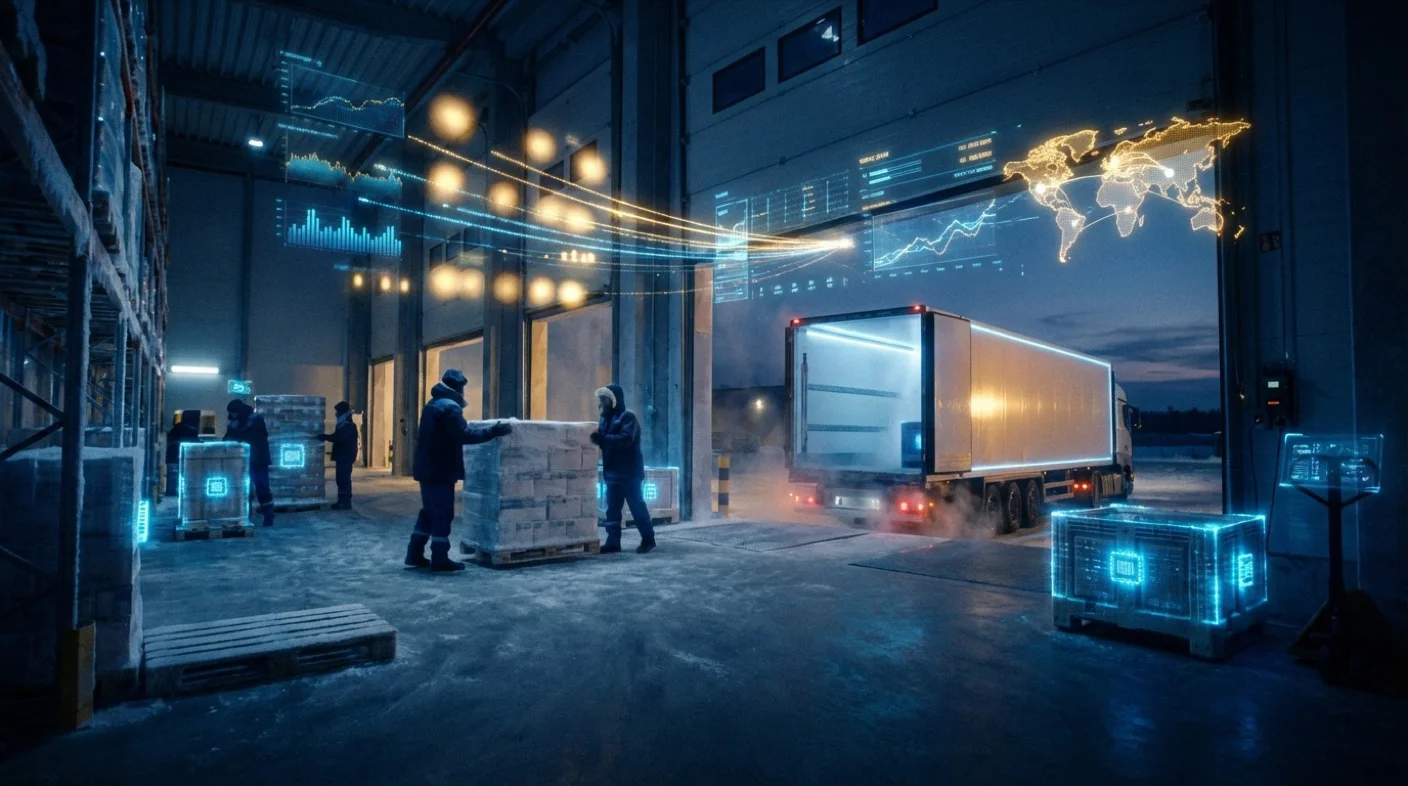
AI temperature control systems deploy dense wireless temperature sensor networks (IoT temperature tags) and combine them with Computational Fluid Dynamics (CFD) simulation-based warehouse airflow models to estimate the three-dimensional temperature field distribution throughout the warehouse in real time. When local hot spots or cold spots are detected, the system automatically adjusts corresponding zone air cooler output volume and air guide angles to achieve dynamic temperature field equalization. For scenarios with frequent inbound/outbound activity (such as picking zones in logistics centers), AI systems can also pre-cool target zones based on predicted upcoming large-volume cargo movements to offset the thermal load impact from door openings and cargo entry[3].
6.2 Defrost Schedule Optimization
Frost buildup on evaporators in cold storage is a significant source of low-temperature warehouse energy consumption. Frost layers covering evaporator surfaces reduce heat exchange efficiency, forcing the system to maintain target temperatures at higher energy consumption; and the defrost process itself (whether electric or hot gas defrost) not only consumes additional energy but causes a brief temperature rise during defrosting. Traditional fixed-interval defrost strategies (such as defrosting every 6 hours) cannot adapt to actual frost formation rates — during dry, low-load nighttime conditions, the evaporator may not need defrosting at all; while during high-humidity, high-traffic daytime conditions, a 6-hour interval may be too long.
AI defrost scheduling systems evaluate evaporator frost levels in real time by monitoring evaporator inlet/outlet air temperature differentials, fan current (reflecting frost layer resistance to airflow), and warehouse humidity, using machine learning models to initiate defrost procedures only when truly needed. Research shows that this on-demand defrost strategy can reduce defrost frequency by 30–40% while improving warehouse temperature stability, with significant benefits for both frozen food quality preservation and energy reduction.
6.3 Food Safety Compliance and HACCP Integration
In food processing and cold chain logistics AI, temperature records are not just operational management tools but HACCP (Hazard Analysis Critical Control Points) compliance legal requirements. AI temperature control systems can integrate with enterprise HACCP management systems, automatically recording all temperature data and anomalous events, issuing real-time alerts when temperatures exceed preset critical limits, and automatically generating complete traceability reports required for compliance audits. This not only reduces food safety risk but significantly relieves the administrative burden on quality control personnel, enabling them to focus their energy on more valuable improvement activities.
7. Remote Monitoring and Smart Service Platforms
Remote monitoring platforms are the vehicles for integrating and delivering all the above AI capabilities to end users. For HVAC&R equipment manufacturers and service providers, cloud-based smart service platforms are not just technical tools but strategic pivot points for business model transformation — from one-time equipment sales to continuous service revenue.
7.1 IoT Gateway and Cloud Architecture
A typical remote monitoring system architecture consists of three layers: edge-layer IoT gateways collect on-site equipment operating data (via BACnet, Modbus, or proprietary protocols), perform initial data cleaning and compression before uploading to the cloud platform; the cloud platform handles data storage, AI model inference, and business logic computation; the application layer presents insight information to different user roles (equipment managers, maintenance technicians, property managers) through web dashboards and mobile apps.
The emergence of commercial HVAC remote monitoring and energy analytics platforms signals the HVAC&R industry's transition from "selling hardware" to "selling data services." However, most current platforms still remain at the level of data visualization and simple alerting, with advanced AI analytics capabilities (predictive maintenance, energy efficiency optimization recommendations, automated refrigerant management) still having enormous room for development.
7.2 Digital Twins and Virtual Commissioning
Digital Twin technology applications in the HVAC&R field are gradually moving from concept to practice. A complete HVAC&R digital twin system comprises: real-time operating data from the physical system, hybrid models based on physical laws and data-driven approaches, and a simulation engine capable of hypothetical scenario analysis. Technicians can simulate scenarios in the digital twin such as "If we raise the chilled water supply temperature from 7°C to 9°C, how much will system energy consumption decrease? Will comfort still be acceptable?" — validating control strategy effects without affecting actual system operations.
For system integrators (SIs), digital twins can also be used for design verification of new project sites — simulating the performance of entire systems under various annual operating conditions before equipment procurement and installation, identifying design defects in advance and optimizing equipment selection and piping configurations. This not only reduces design risk but provides building owners with quantifiable energy efficiency projections, strengthening proposal persuasiveness.
7.3 AR-Assisted On-Site Maintenance
The combination of Augmented Reality (AR) technology with AI diagnostic systems is changing how HVAC technicians work. When a technician arrives at a fault site, through AR glasses or tablets, the system can overlay real-time equipment operating data, AI diagnostic results, and step-by-step repair instructions. This is particularly valuable for small and medium-sized maintenance companies lacking senior technicians — AI systems encode the diagnostic experience of senior technicians into algorithms, enabling junior technicians to complete complex troubleshooting tasks with AI assistance[4].
8. AI Adoption Strategy for the HVAC&R Industry
The HVAC&R industry encompasses the complete value chain of equipment manufacturing, system integration, installation, and after-sales service, with practitioners predominantly being small and medium-sized enterprises. AI adoption strategies need to be tailored to the industry's specific conditions rather than copying the experiences of large foreign enterprises.
8.1 Tiered Adoption by Enterprise Scale
Large Equipment Manufacturers (annual revenue over $30M): Companies with sufficient resources can invest in building their own AI teams and cloud platforms, embedding AI capabilities into products (smart HVAC) and after-sales service systems (remote monitoring platforms). Priority areas include: adaptive control algorithms (DRL) at the product level, predictive maintenance services on cloud platforms, and energy efficiency benchmarking based on large-scale equipment operating data. Afram and Janabi-Sharifi's[1] MPC control research provides the theoretical foundation for product-level smart control algorithm design.
Medium-Sized System Integrators (annual revenue $3M–$30M): System integrators' core value lies in designing, installing, and maintaining complete HVAC systems for clients. Priority AI adoption areas are: establishing remote equipment monitoring capabilities (reducing inspection labor costs), introducing energy efficiency analysis tools (providing clients with energy-saving reports to add service value), and piloting predictive maintenance for critical equipment (such as chillers). We recommend collaborating with professional AI consultants for initial proof of concept rather than building internal AI teams.
Small Installation and Maintenance Providers (annual revenue under $3M): Small providers face the highest AI adoption barriers but also the clearest pain points — aging technicians, knowledge transfer difficulties, and low maintenance efficiency. The most suitable adoption path is using mature SaaS tools — such as mobile AI-assisted diagnostic apps (inputting fault symptoms to receive diagnostic recommendations) and cloud-based customer equipment management platforms (tracking maintenance schedules and repair histories). Monthly fees for these tools typically range from a few hundred to a few thousand dollars, with low investment thresholds and immediate availability.
8.2 Data Infrastructure First
Regardless of enterprise scale, the first step in AI adoption is establishing a data foundation. For the HVAC&R industry, the most critical data includes: equipment operating parameters (temperature, pressure, flow rate, current), environmental data (outdoor temperature, humidity), and maintenance records (fault types, replaced parts, labor hours). The data status of most industry practitioners is: equipment operating data is scattered across various brand controllers in different formats, maintenance records are still managed with paper forms or basic spreadsheets, and there is no unified data platform.
We recommend prioritizing three data infrastructure investments: First, deploying unified IoT gateways to connect existing equipment controllers and collect operating data in standardized formats; Second, establishing a cloud data lake to centrally store all equipment and maintenance data; Third, adopting a digital Computerized Maintenance Management System (CMMS) to convert maintenance records from paper to structured data. These foundational investments not only lay the groundwork for subsequent AI applications but themselves deliver immediate management benefits through data visualization[4].
8.3 Industry-Academia Collaboration and Talent Development
HVAC&R AI requires cross-disciplinary talent with expertise in thermodynamics, fluid mechanics, control engineering, and machine learning simultaneously. Enterprises can leverage industry-academia collaboration programs to combine expertise from both ends and cultivate cross-disciplinary HVAC&R AI talent. Additionally, partnering with AI consulting teams possessing deep research capabilities to complete initial projects, while developing internal personnel's AI literacy and data thinking during the process, is another pragmatic talent development path.
8.4 Policy Resources and Subsidies
Governments typically offer multiple policy tools and subsidy resources for energy saving and carbon reduction that HVAC&R industry players can take advantage of. Energy efficiency management regulations[8] provide enterprises with clear energy efficiency improvement targets and compliance frameworks; smart manufacturing assistance programs can subsidize initial IoT and AI investments for SMEs; greenhouse gas reduction incentives provide economic motivation for refrigerant management and leak reduction. We recommend that enterprises simultaneously inventory available policy resources when planning AI adoption projects to reduce the financial pressure of initial investments.
9. Conclusion: From Equipment Supplier to Smart Energy Service Provider
From smart HVAC control, refrigerant leak detection, and predictive maintenance to energy efficiency optimization, this article has systematically analyzed the core AI application scenarios in the HVAC&R industry. These technologies are not distant future visions but practical solutions that can be implemented today with quantifiable returns.
However, AI's most profound impact on the HVAC&R industry lies not in the efficiency improvement of any single technology but in driving the entire industry's business model transformation. The IEA report[5] signals a clear trend: as global cooling demand doubles over the next 25 years, the industry's value center will shift from "manufacturing and selling equipment" to "operating and optimizing cooling services." Enterprises that master AI capabilities will be able to offer performance-based contracts, continuously reducing energy consumption and maintenance costs for clients through data-driven approaches, establishing long-term stable service revenue.
For the HVAC&R industry, this represents both a challenge and an opportunity. The challenge is that most practitioners are still at the stage of weak data foundations and AI talent shortages, needing to start from the most basic data collection and digitization. The opportunity lies in the ICT industry ecosystem (semiconductors, IoT modules, cloud services) providing an excellent technology supply chain for HVAC&R smart upgrades, and the market size is appropriate to serve as a testing ground for AI solutions, which can then be exported to emerging markets after successful validation.
Wei et al.[2] demonstrated a profound insight in their deep reinforcement learning HVAC control research: AI doesn't need a perfect physical model to learn effective control strategies — it learns directly from data. Similarly, HVAC&R practitioners don't need to wait until they are "perfectly prepared" to begin their AI journey. Start with remote monitoring of one critical piece of equipment, start with energy efficiency analysis at one site — every step of data accumulation lays the foundation for deeper AI applications in the future. For HVAC&R industry players ready to embark on this transformation journey, the Meta Intelligence research team stands ready to assist with deep AI expertise and industry practical experience, guiding you from data infrastructure through to the strategic high ground of becoming a smart energy service provider.