- A McKinsey survey of 100+ COOs at manufacturers with over $1B in revenue found that only 2% of companies have fully embedded AI into operations, with roughly two-thirds still in the exploration or partial adoption phase[1] — most manufacturers' AI journeys are just beginning
- The latest data from the WEF Global Lighthouse Network (189 factories) shows that leading manufacturers have achieved an average 53% improvement in labor productivity and a 26% reduction in conversion costs[8] — AI's value has been validated by the world's top factories
- Deloitte research indicates that predictive maintenance can reduce unplanned downtime by up to 80%, saving approximately $300,000 per machine per year[10] — PdM offers the clearest path to ROI
- Capgemini research shows that only 5% of manufacturers globally have achieved end-to-end digitized operations, yet global factory modernization investment reached $3.4 trillion in 2024[11] — investment is accelerating, and the window for laggards to catch up is narrowing
1. The State of AI in Manufacturing: Investment Surging, but Adoption Still in Early Stages
Manufacturing AI in 2026 finds itself in a paradoxical position: investment is at record highs, but the number of companies actually extracting business value remains small. A McKinsey survey of 100+ COOs at manufacturers with over $1B in annual revenue[1] reveals a sobering reality — only 2% of companies report that AI is fully embedded across all operational functions, and roughly two-thirds acknowledge that they are still in the exploration or partial deployment phase. Some 46% of COOs cite data or IT/OT system limitations as their biggest obstacle.
MIT Technology Review's 2025 manufacturing AI report paints a clearer picture of this trajectory[2]: in 2024, only 35% of manufacturers had deployed AI in production environments, rising to approximately 50% by 2025 — a significant jump, but one that also means the other half of manufacturers have yet to take their first step.
Joint research from Capgemini and Microsoft[11] adds further nuance: only 5% of manufacturers globally have reached an "Industrialized" level of end-to-end digital operations, while 45% remain in their initial adoption phase. Yet global factory modernization investment hit $3.4 trillion in 2024 and is projected to grow to $4.7 trillion within three years.
An HBR analysis[6] identifies the root cause of this "high investment, low adoption" gap: AI transformation happens on "Enterprise Time" — slower, more friction-laden, and requiring more fundamental organizational change than technology enthusiasts expect. Traditional companies that aggressively adopt AI often see only marginal improvements, because they use AI to optimize existing workflows rather than rethinking how work is organized.
For Taiwan's manufacturing sector, this global trend carries a dual significance. On one hand, Taiwan's Industrial Technology Research Institute (ITRI) — the nation's premier applied research organization — projects 2025 manufacturing output at NT$25.9 trillion (up 6.48% year-over-year)[5], reflecting a robust industrial base. On the other hand, Taiwan commands over 60% of global foundry capacity[13], and these high-value-added manufacturing segments are precisely where AI can deliver the greatest impact. The question is not whether to adopt AI, but how to adopt it effectively.
2. Three High-ROI Scenarios: Predictive Maintenance, Quality Inspection, and Production Optimization
McKinsey's survey shows that successful companies tend to focus on 5 to 12 core use cases rather than spreading efforts thin[1]. BCG research further notes that AI can boost production line productivity by more than 20%, but the key to value realization lies in people and processes, not technology alone[7]. The following three scenarios offer the highest ROI with the most manageable adoption barriers.
2.1 Predictive Maintenance (PdM)
Unplanned downtime is the costliest problem in manufacturing — Deloitte estimates that it costs the global industrial sector approximately $50 billion per year[10]. Traditional maintenance strategies present two extremes: fix it when it breaks (reactive maintenance), which costs production capacity; or replace parts on a fixed schedule (preventive maintenance), which wastes money on unnecessary servicing.
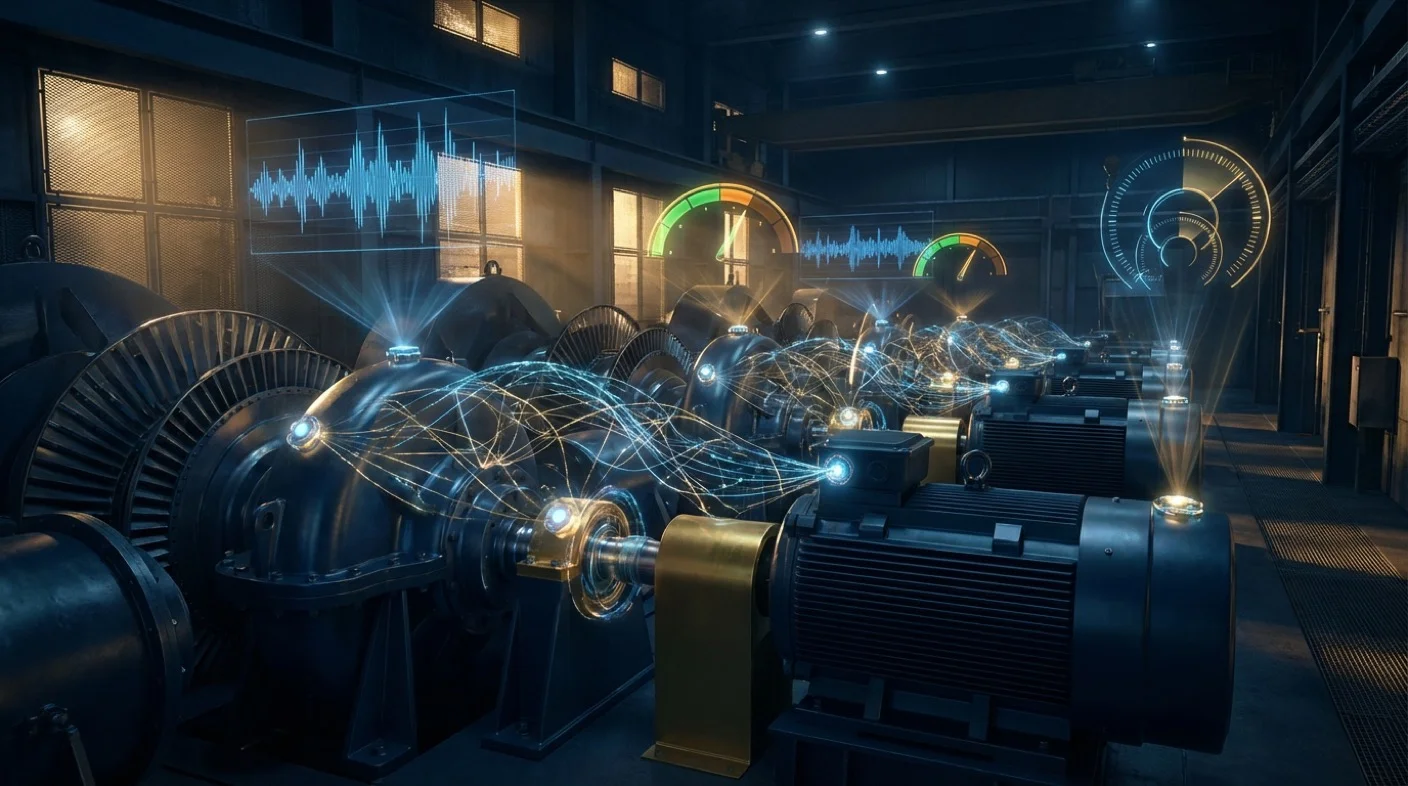
AI-driven predictive maintenance analyzes data from vibration, temperature, current, and acoustic sensors to provide precise early warnings before failures occur. Deloitte's case studies[10] document striking results:
- Up to 80% reduction in unplanned downtime — a single extrusion equipment pilot saved approximately $300,000 per year
- 20-50% reduction in maintenance planning time — shifting from reactive response to proactive scheduling
- 10-20% improvement in equipment availability — translating directly to increased capacity
- 5-10% reduction in overall maintenance costs — eliminating unnecessary preventive replacements
PdM has become the preferred starting point for most companies for three reasons. First, investment is relatively contained — you can validate value starting with a single critical piece of equipment. Second, ROI is quantifiable — downtime and maintenance costs are hard metrics. Third, it does not require changes to existing production processes — PdM is additive, not substitutive.
2.2 AI Quality Inspection (AOI / Machine Vision)
Quality inspection is the manufacturing application where AI has penetrated most deeply and where technology is most mature. Traditional manual visual inspection faces three inherent limitations: inconsistent judgment standards across inspectors, a 15-20% increase in missed defects after two hours of continuous work, and physical bottlenecks as line speeds increase.
Deep learning-based machine vision systems have achieved defect detection rates exceeding 99.5% in semiconductor, PCB, and precision component applications — far surpassing the 85-90% accuracy of manual inspection. More importantly, per-image processing time is measured in milliseconds. A high-speed production line outputting 200 units per minute is easily handled by machine vision, while human inspectors would be overwhelmed.
Capgemini's research[11] notes that advanced AI quality inspection is evolving from defect detection to root cause analysis — not just identifying which products are defective, but pinpointing which process parameter deviations caused the defects, enabling quality issues to be intercepted at their source.
2.3 Production Scheduling and Process Optimization
Production scheduling optimization represents the highest-value but also the most complex AI application in manufacturing. Traditional scheduling relies on the experience and judgment of senior planners, and in the face of modern manufacturing demands — high mix, low volume, rapid changeovers — human cognitive limits have become a bottleneck.
BCG research[14] indicates that end-to-end AI applications in industrial operations can drive over 30% productivity improvement. This encompasses dynamic scheduling (real-time adjustment based on order priority, equipment status, and material availability), process parameter optimization (AI searching multi-dimensional parameter spaces for optimal combinations beyond human cognitive limits), and yield prediction (forecasting quality risks before processes are complete, enabling early intervention).
McKinsey Global Institute's estimates provide a macro perspective: generative AI could create $2.6 trillion to $4.4 trillion in annual value for the global economy, with nearly one-quarter originating from manufacturing and supply chain activities[9].
3. Technology Selection: Edge AI vs. Cloud, Computer Vision vs. Time-Series
3.1 Edge AI: The Preferred Deployment Architecture for Manufacturing
Wevolver's State of Edge AI Report[12] notes that Edge AI is becoming the dominant deployment architecture in manufacturing. The rationale is straightforward: factory production lines demand millisecond-level real-time responses, not the hundreds-of-milliseconds latency that comes with cloud-based inference.
In quality inspection scenarios, the available inspection window for a single product on the line may be just 300 milliseconds — image capture, preprocessing, model inference, and decision-making must all be completed within that window. Edge AI compresses inference latency to under 10 milliseconds with zero dependence on network connectivity, eliminating the risks of cloud latency and network instability.
In predictive maintenance scenarios, vibration sensors generate thousands of data points per second. Edge AI performs real-time feature extraction and anomaly detection at the sensor level, transmitting alerts only when anomalies are detected — dramatically reducing data transmission and storage costs.
Gartner's 2025 AI Hype Cycle[4] identifies AI Agents and AI-Ready Data as the fastest-advancing technologies — in the manufacturing context, their convergence point is Edge AI: making intelligent decisions at the point where data is generated.
3.2 Technology Selection Matrix
(1) Predictive Maintenance → Time-Series AI + Edge Deployment — Vibration/temperature/current data → LSTM/Transformer time-series models → Edge inference → Threshold alerting
(2) Quality Inspection → Computer Vision + Edge Deployment — Industrial cameras → CNN/YOLO defect detection → Edge inference → Real-time rejection
(3) Process Optimization → Multi-variate AI + Cloud/Hybrid — Multi-source process data → Gradient boosting/deep learning → Cloud training → Parameter recommendations
(4) Scheduling Optimization → Operations Research + AI + Cloud — Order/equipment/material data → Reinforcement learning/mixed-integer programming → Cloud computing → Scheduling decisions
The guiding principle is: use Edge for scenarios requiring real-time response, Cloud for scenarios demanding large-scale computation, and Hybrid for most enterprises — Edge handles real-time inference while Cloud handles model training and updates, with new model versions pushed to edge devices periodically via OTA (Over-the-Air) mechanisms.
4. WEF Lighthouse Factories: Evidence from the World's Top Smart Manufacturers
The Global Lighthouse Network, jointly managed by WEF and McKinsey, is the most authoritative benchmark for smart manufacturing worldwide[8]. As of early 2025, 189 Lighthouse factories have been certified (expanding to 201 by September 2025), and the most recent cohort demonstrates impressive average performance:
- 53% improvement in labor productivity
- 26% reduction in conversion costs
- 77% of top use cases are driven by analytical AI, with 9% driven by generative AI
The critical insight from Lighthouse factories is not about which technologies they use, but about how they manage organizational change. The WEF report emphasizes that successful transformation requires mindset shifts, not just technology investment. This echoes HBR's perspective[6] — AI transformation does not happen overnight; it demands long-term commitment from leadership, cross-functional collaboration mechanisms, and fundamental redesign of organizational processes.
BCG's analysis[7] offers more specific guidance: AI can boost production line productivity by over 20%, but the critical success factors are change management, workflow optimization, AI talent, and governance structures — technology is a necessary condition, but organizational capability is the sufficient condition.
5. Structural Advantages and Challenges for Taiwan's Manufacturing AI Adoption
5.1 Taiwan's Structural Advantages
Taiwan's manufacturing sector holds unique structural advantages in the global AI transformation wave. ITRI projects 2025 manufacturing output at NT$25.9 trillion[5], driven by three trends: supply chain restructuring amid heightened geopolitical risk, industry-wide AI adoption demand, and the rising importance of sustainable supply chains.
In semiconductors, Taiwan's position is unmatched. A U.S. International Trade Administration (ITA) report[13] notes that Taiwan accounts for over 60% of global foundry capacity and over 90% of advanced-node manufacturing (7nm and below). The semiconductor industry generated over $165 billion in revenue in 2024, representing approximately 20.7% of GDP. AI chip design now accounts for 15-20% of IC design output.
This means Taiwan's manufacturers are not only users of AI technology but also producers of the global AI computing infrastructure — a dual role that provides unparalleled depth of technical understanding and supply chain advantage.
5.2 Four Key Adoption Challenges
Challenge 1: Budget and talent constraints at SMEs — Taiwan's manufacturing sector is built on a backbone of small and medium-sized enterprises with lean IT teams and limited AI budgets. McKinsey's COO survey[1] shows that 46% of companies are constrained by data or IT/OT system limitations — for resource-constrained Taiwanese SMEs, this proportion would likely be even higher.
Challenge 2: Weak data foundations — Many factories still rely on paper records or isolated spreadsheets for data collection. MIT Technology Review[2] reports that downtime rates on high-speed production lines can reach 40%, yet most factories lack even the data infrastructure to precisely quantify the causes. Before an AI project can begin, significant investment is often required in sensors, communication protocol standardization, and data platforms.
Challenge 3: OT/IT convergence barriers — Deloitte's smart manufacturing survey[3] reveals that 68% of respondents conducted cybersecurity risk assessments for smart manufacturing over the past year — signaling that the convergence of operational technology (OT) and IT systems introduces significant security challenges. For Taiwanese manufacturers handling sensitive process parameters and yield data, cybersecurity concerns represent a major barrier to AI adoption.
Challenge 4: Severe shortage of cross-domain talent — Deloitte's survey also found that 48% of companies face moderate to significant challenges in filling production and operations management roles[3]. In Taiwan, professionals who understand both machine learning algorithms and manufacturing processes are exceptionally rare.
6. A Phased Adoption Roadmap: From PoC to Scale
Drawing on insights from WEF Lighthouse factories[8] and McKinsey's COO survey recommendations[1], we recommend the following four-stage adoption roadmap:
Stage 1: Pain Point Assessment and Use Case Screening (1-2 months)
The first step in AI adoption is not selecting a technology — it is identifying pain points. McKinsey's survey[1] shows that successful companies focus on 5 to 12 core use cases rather than pursuing everything at once. Screening dimensions include:
- Quantified impact: Which processes incur the greatest losses from downtime, quality defects, or labor bottlenecks?
- Data readiness: Does the process already have sensor data or historical records? What is the quality and completeness of that data?
- Risk containment: Early projects should avoid scenarios that require significant changes to production processes. Start with monitoring, not control.
(1) Predictive maintenance for critical equipment — Retrofit the 3-5 machines with the highest downtime costs with vibration/temperature sensors + Edge AI
(2) AI quality inspection at final inspection stations — Replace or augment manual visual inspection, targeting 1-3 percentage point yield improvement
(3) Virtual metrology for process parameters — Predict quality risks before process completion, reducing trial production costs
(4) Energy consumption optimization — Analyze equipment power usage patterns, targeting 5-15% energy savings
Stage 2: Rapid PoC and Value Validation (2-3 months)
The goal of a PoC is not to prove that AI is impressive — it is to answer three questions: Is it technically feasible (does model accuracy meet requirements)? Can it integrate with existing workflows (can AI outputs be seamlessly embedded in current operations)? Will end users accept it (are front-line operators willing to use it)?
BCG[7] emphasizes that the key to PoC success lies not in technical precision but in change management — even a model with 99% accuracy becomes shelf-ware if operators do not trust or know how to use it. We recommend involving operators from the PoC stage, using side-by-side comparisons (AI judgment vs. human judgment) to build trust.
Stage 3: From Single Point to Production Line (3-6 months)
Replicate proven PoC solutions across additional equipment and production lines. The critical factor at this stage is standardization — establishing reusable processes for data collection, model training, and deployment so that the marginal cost of each new implementation decreases. Deloitte's smart manufacturing survey[3] shows that successful companies share a common trait: they build a unified data platform as the foundation for cross-scenario expansion.
Stage 4: System Integration and Continuous Optimization (6-18 months)
Integrate individual AI applications into a cohesive smart manufacturing system: quality inspection results feed back into process optimization models, predictive maintenance schedules integrate into production plans, and digital twins serve as the unified interface for decision support. The WEF Lighthouse factory experience[8] demonstrates that this scaling phase is what truly separates leaders from laggards — 77% of top use cases are driven by analytical AI, not flashy generative AI concepts.
7. Cost-Benefit Analysis: Calculating ROI for Manufacturing AI
McKinsey Global Institute estimates that nearly one-quarter of generative AI's global value — approximately $650 billion to $1.1 trillion — originates from manufacturing and supply chains[9]. But for individual companies, ROI calculations need to be more concrete:
Predictive Maintenance ROI Example: Unplanned downtime on a semiconductor packaging line costs approximately NT$500,000 (roughly $15,000) per hour. If a PdM system reduces unplanned downtime by 50% (a conservative estimate), and the line experiences an average of 4 unplanned stoppages per month (averaging 2 hours each), the annual benefit = 4 events x 2 hours x NT$500,000 x 50% x 12 months = NT$24 million per year (approximately $750,000). Typical PdM system build costs (including sensors, Edge AI hardware, software, and implementation services) range from NT$3-8 million, yielding a payback period of roughly 2-4 months.
Quality Inspection ROI Example: In PCB manufacturing, manual visual inspection miss rates run at 10-15%, resulting in approximately 2-5% of annual customer returns. Deploying AI quality inspection reduces the miss rate to below 1% while eliminating 2-3 inspectors per station. For a mid-sized Taiwanese PCB manufacturer, annual quality cost savings range from NT$5-15 million (approximately $150,000-$470,000).
Deloitte's predictive maintenance research[10] provides international benchmarks: 10-20% improvement in equipment availability, 5-10% reduction in maintenance costs, and 20-50% reduction in maintenance planning time. BCG's analysis[14] notes that end-to-end AI can drive over 30% total productivity improvement in industrial operations — but only if companies can scale effectively rather than remaining stuck at single-point PoCs.
8. How to Select a Manufacturing AI Vendor
Selecting a manufacturing AI vendor differs fundamentally from standard software procurement. Drawing on the industry research cited above, we recommend evaluating vendors across five dimensions:
Manufacturing domain expertise: Does the vendor understand the unique requirements of OT environments — factory network topology, PLC/SCADA integration, explosive-proof area regulations, cleanroom constraints? Pure-play AI startups may excel at algorithms but frequently struggle with the "last mile" of deployment on the factory floor.
Edge AI deployment capability: As discussed throughout this article, most manufacturing scenarios require Edge deployment[12]. Does the vendor offer a complete technology stack from cloud training to edge inference? Do they have hands-on deployment experience with ARM, NVIDIA Jetson, Intel OpenVINO, and other edge hardware platforms?
Data integration capability: 46% of manufacturing COOs identify data or IT/OT system limitations as their biggest obstacle[1]. A strong vendor does not just build models — they help enterprises break down data silos across MES, SCADA, ERP, and other heterogeneous systems.
Incremental adoption methodology: Does the vendor have a proven methodology for scaling from PoC to production line to factory to enterprise? The WEF Lighthouse factory experience[8] demonstrates that a scaling methodology matters more than any single PoC's technical prowess.
Ongoing operations and model management: AI model performance degrades over time (model drift). Does the vendor provide continuous model monitoring, retraining, and update services? Does the contract include at least 12 months of operational support?
9. Conclusion: The Investment Window Is Closing
Global manufacturing in 2026 stands at a critical inflection point in AI transformation. Capgemini's report[11] shows that global factory modernization investment is accelerating from $3.4 trillion to $4.7 trillion — signaling that leading companies are widening their competitive advantage. The WEF Lighthouse Network[8] continues to expand, growing from 189 to 201 certified factories, with each new Lighthouse factory resetting the industry's efficiency benchmarks.
For Taiwan's manufacturing sector, structural advantages — NT$25.9 trillion in industrial output[5] and a central role in the global semiconductor supply chain[13] — provide a solid foundation for AI transformation. But McKinsey's data also reminds us[1] that 98% of manufacturers have yet to fully embed AI into operations — this is both a challenge and a first-mover opportunity.
The Meta Intelligence team combines PhD-level AI expertise with hands-on manufacturing experience, offering end-to-end services from pain point assessment, PoC validation, and Edge AI deployment through to enterprise-wide scaling. Whether you are a COO evaluating AI feasibility, a technology director architecting a smart factory blueprint, or a plant manager driving digital transformation — we can provide comprehensive support from strategy to execution.