- Global construction industry productivity has grown at an average of only 1% per year over the past 20 years, far behind manufacturing's 3.6%, earning it McKinsey's designation as "one of the least digitized industries"[4]
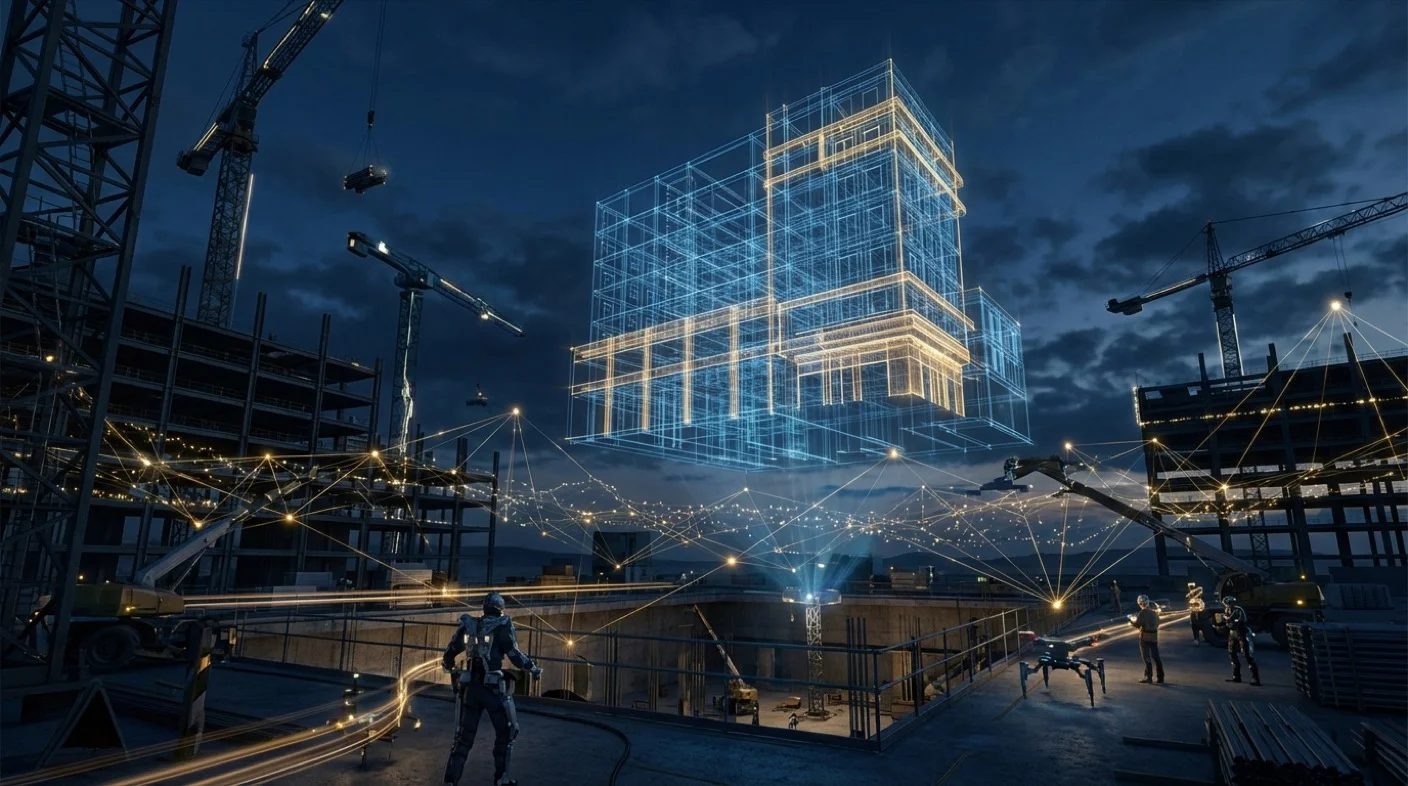
- BIM combined with AI can automatically detect over 85% of pipe clashes and structural interference during the design phase, reducing the number of design changes (RFIs) by 40–60%[3]
- Deep learning-based jobsite safety computer vision systems can detect violations such as missing hard hats and unauthorized entry into hazardous zones in real time, with recognition accuracy of 92–96%[2]
- Machine learning-driven construction scheduling and duration prediction models improve forecast accuracy by 25–35% compared to traditional CPM methods, effectively reducing schedule delay risks[1]
1. Why the Construction Industry Is the Last Blue Ocean for AI Transformation
While industries like semiconductors, finance, and healthcare have embraced the AI wave, the construction industry has long been viewed as a "latecomer" to digital transformation. McKinsey Global Institute's landmark report[4] noted that global construction industry productivity has grown at an average annual rate of only about 1% over the past two decades, far behind manufacturing's 3.6% and the overall economy's 2.8%. This phenomenon is not coincidental — the unique characteristics of the construction industry create distinctive structural barriers to digital transformation.
1.1 Structural Reasons for Construction's Digitization Lag
First, every project is a prototype. Unlike manufacturing's standardized mass production, every building is unique — different site conditions, owner requirements, regulatory constraints, and design vocabularies. This dramatically reduces data transferability; an AI model trained on one project may not apply to the next. Second, a highly fragmented value chain. A mid-sized construction project typically involves the owner, architect, structural engineer, MEP consultant, general contractor, and dozens of subcontractors, each using different software tools and data formats, creating severe data silo problems[6]. Third, labor-intensive and highly dynamic site environments. Unlike factories with fixed production lines, standardized sensor layouts, and stable network environments, construction sites make data collection significantly more costly and difficult than in manufacturing.
1.2 Additional Challenges Facing Taiwan's Construction Industry
For Taiwan's construction industry, these structural barriers are compounded by several localized urgent pain points. First is a severe labor shortage — the construction workforce is aging significantly, with younger generations showing declining willingness to work on construction sites. According to the Directorate-General of Budget, Accounting and Statistics, the construction industry's labor shortage rate consistently exceeds 3–4%, with certain trades such as rebar tying and formwork assembly experiencing even more acute shortages. Second, the Executive Yuan's Public Construction Commission[8] has actively promoted BIM adoption in public works in recent years, establishing a policy foundation for construction digitalization, but a significant technology gap remains between BIM models and AI applications. Third, Taiwan's location in the Pacific Ring of Fire with frequent typhoons creates extremely stringent requirements for structural safety and construction quality, which in turn creates strong demand for AI quality monitoring and structural health monitoring.
Pan and Zhang's systematic review in Automation in Construction[1] identified seven major AI application areas in construction engineering: design optimization, construction planning, safety management, quality control, schedule management, cost estimation, and facility operations. These seven areas span the entire lifecycle of a building from design to demolition, demonstrating that AI's potential value in construction is far broader than most people imagine. The following sections will explore these core application scenarios in depth, covering their technical principles, practical approaches, and Taiwan-specific context.
2. BIM + AI: From 3D Models to Intelligent Decision-Making
Building Information Modeling (BIM) is the cornerstone of construction industry digital transformation. Sacks et al. in their classic work BIM Handbook[3] thoroughly describe BIM's core concept — digitizing all physical and functional characteristics of a building into a parametric 3D model, using it as the "Single Source of Truth" across design, construction, and operation phases. When BIM meets AI, this static digital model transforms into an intelligent decision platform capable of learning, reasoning, and optimization.
2.1 Clash Detection and Automated Design Conflict Resolution
Traditional BIM clash detection can already automatically identify geometric conflicts such as pipe crossings and structural interference, but this rule-based detection often generates large numbers of "false positives" — many detected clashes do not constitute real problems in construction practice (for example, two pipes may geometrically intersect, but the construction sequence already allows space for the later-installed pipe). AI can learn from the processing outcomes of clash reports from past projects, automatically classify clash severity, and suggest solutions, reducing engineers' clash review time by over 60%[3].
2.2 Generative Design and Spatial Configuration Optimization
Generative Design is one of the most forward-looking AI applications in architectural design. Designers define spatial requirements (room counts, areas, adjacency relationships), regulatory constraints (building coverage ratio, floor area ratio, sunlight hours), and performance objectives (energy efficiency, natural lighting, circulation efficiency), and AI algorithms can generate hundreds or even thousands of spatial configuration solutions meeting all constraints in very short time, ranking them by multi-objective functions. Pan and Zhang[1] note that these algorithms have evolved from early genetic algorithms to deep reinforcement learning-based methods, capable of handling more complex constraints and higher-dimensional design spaces.
2.3 Automated Cost Estimation and Quantity Calculation
BIM models inherently contain rich component quantity information, but bridging from BIM quantities to accurate cost estimates still requires significant human judgment — seasonal fluctuations in material unit prices, regional differences, and trade-offs between specification alternatives. Machine learning models can learn from historical project cost data, combined with current material market conditions and project characteristics, to provide more accurate early cost estimates. Xu et al.'s[5] review shows that gradient boosting and random forest-based cost prediction models can control prediction error to within 10–15% during conceptual design, far better than the 25–30% error range of traditional unit area cost methods.
In Taiwan, the Executive Yuan's Public Construction Commission[8] has since 2021 gradually made BIM mandatory for public works above certain budgets, meaning BIM adoption rates are accelerating. However, most enterprises' BIM applications still remain at the "3D modeling and drawing" level, not yet advancing to "data-driven intelligent decision-making." The leap from BIM to BIM + AI requires two critical investments: first, BIM model information completeness (LOD level must reach LOD 350 or above to support most AI applications); and second, structured organization of historical project data — this is the fuel for training AI models.
Experience How AI Detects BIM Clashes and Optimizes Scheduling
Drag the controls to observe how AI analyzes clashes and optimizes construction decisions in real time
3. Jobsite Safety Monitoring: Integrating Computer Vision and IoT
The construction industry is one of the industries with the highest occupational injury rates globally. In Taiwan, serious occupational accidents on construction sites account for over 40% of all industries, with falls, collapses, falling objects, and electrocution being the four major causes. Traditional safety management relies heavily on manual inspections — safety officers patrol the site, record violations, and provide verbal corrections. However, large construction sites can span tens of thousands of square meters, with hundreds of workers simultaneously working on different floors and in different zones, making manual inspection coverage and timeliness severely inadequate.
3.1 Deep Learning-Driven Safety Violation Detection
Fang et al.'s research in Advanced Engineering Informatics[2] was pioneering work in jobsite safety computer vision. They demonstrated how deep learning-based object detection models can automatically identify workers and heavy equipment from site surveillance camera footage and perform spatial relationship reasoning — for example, determining whether a worker has entered the dangerous zone within a crane's operating radius. The system achieved over 92% detection accuracy in real jobsite scenarios and can complete single-frame image analysis within 200 milliseconds, meeting near-real-time monitoring requirements.
Ding et al.[7] further expanded this concept to "unsafe behavior detection" — not just identifying "people" and "objects," but recognizing whether human behavior complies with safety regulations. Their proposed deep hybrid learning model integrates convolutional neural networks (CNN) for spatial feature extraction with Long Short-Term Memory networks (LSTM) for temporal behavior analysis, capable of detecting dangerous behaviors such as climbing unguarded scaffolding, working at heights without safety harnesses, and lingering in equipment travel paths. The model achieved 94.3% behavior recognition accuracy on real jobsite datasets, an improvement of over 20 percentage points compared to traditional rule-based systems.
3.2 Collaborative Architecture of IoT Sensors and AI
Computer vision is not the only pathway for jobsite safety AI. Integrating data from wearable IoT devices (such as smart hard hats with built-in accelerometers and gyroscopes, safety vests with positioning capabilities) and environmental sensors (gas detectors, noise meters, dust sensors) can build a multimodal safety monitoring network. Pan and Zhang[1] note in their review that multimodal AI systems fusing image data and sensor data significantly outperform any single-source model in safety event prediction.
3.3 Safety Risk Prediction Models
Beyond real-time violation detection, AI's more strategically valuable application is predicting safety incident risks. By analyzing historical accident records, weather conditions, construction phase progress, subcontractor safety scores, worker fatigue levels (estimated from attendance records), and other multi-dimensional data, machine learning models can calculate a safety risk index for each day's construction activities and issue early warnings for high-risk time periods and zones. Xu et al.[5] note that random forest and gradient boosting models excel in construction site safety event prediction, achieving AUC values above 0.85. This shift from "reactive response" to "proactive prevention" represents the fundamental paradigm shift that AI brings to jobsite safety management.
In Taiwan's context, there is a unique advantage for jobsite safety AI adoption: Taiwan's labor inspection agencies maintain strict safety regulations for construction sites (such as periodic and surprise inspections by the Occupational Safety and Health Administration under the Ministry of Labor), creating strong compliance-driven demand for AI safety monitoring. Meanwhile, Taiwan's ICT industry's hardware supply chain advantages — from cameras and edge computing devices to IoT sensors — keep the hardware costs of building jobsite safety AI systems relatively manageable.
4. Construction Scheduling Optimization and Duration Prediction
Schedule delays are one of the most common and costly risks in construction projects. Traditional construction schedule management relies on the Critical Path Method (CPM) and senior engineers' experience, but this approach has two fundamental flaws: first, CPM assumes activity durations are deterministic, unable to effectively handle uncertainties such as weather, material delays, and workforce fluctuations; second, when project scale grows to hundreds of activities, the cognitive load of manually adjusting schedules exceeds human limits.
4.1 Machine Learning-Driven Duration Prediction
Pan and Zhang[1] outline three major AI application modes in construction scheduling: first, historical data-driven duration prediction — using data from completed projects (project type, scale, number of floors, structural type, season, region, etc.) to train regression models or neural networks, providing reliable duration estimates early in a project. This is particularly valuable for owners during budget planning and project feasibility assessments. Second, construction progress tracking and deviation alerts — combining jobsite camera image analysis, drone aerial photography, and BIM model comparison to automatically determine deviations between actual construction progress and plans, issuing warnings before deviations widen. Third, resource allocation optimization — using optimization algorithms (such as particle swarm optimization, genetic algorithms) to find optimal allocation plans for labor, equipment, and materials while meeting schedule constraints, minimizing idle time and waste.
4.2 Quantitative Weather Impact Modeling
In Taiwan, one of the biggest uncertainty factors for construction scheduling is weather. Rainy days during the plum rain season and typhoon season directly affect workable days for outdoor operations. The traditional approach is to reserve a fixed percentage of "rain day buffer" in the schedule, but this one-size-fits-all method is neither precise nor economical. AI can integrate historical meteorological data, climate prediction models, and specific site microclimate characteristics to build probabilistic weather impact models for each construction activity. For example, concrete pouring is more sensitive to temperature and humidity than steel structure erection, while exterior tile installation is more affected by rainfall than interior finishing. Xu et al.[5] note that incorporating weather variables into machine learning models can improve duration prediction accuracy by 15–20%.
4.3 Automated Progress Tracking: From Drones to Computer Vision
Traditional construction progress tracking involves engineers visiting the site weekly for visual inspection, photographing, and manually updating progress reports — a time-consuming, subjective, and easily delayed process. In recent years, regular drone aerial photography combined with photogrammetry point cloud generation and automatic comparison with BIM models are fundamentally changing progress tracking methods. AI algorithms can automatically compare aerial photography-generated 3D point clouds with the planned state at corresponding time points in the BIM model, quantifying the completion percentage of each component. Fang et al.'s[2] deep learning object detection technology is equally applicable here — models can automatically identify completed structural components (columns, beams, slabs), installed MEP equipment, and temporary construction facilities from aerial images, enabling real-time comparison with scheduled progress.
5. Building Material Cost Prediction and Procurement Optimization
Building material costs typically account for 50–60% of total construction project costs, and material price volatility has significantly increased in recent years — global supply chain disruptions, geopolitical conflicts, and carbon pricing policies have made price trends for steel, cement, copper, and other bulk building materials increasingly difficult to predict. For construction companies, the ability to accurately forecast material cost trends and optimize procurement strategies accordingly directly impacts project profitability.
5.1 Time Series and External Factor Fusion Price Prediction Models
Traditional building material price prediction relies on simple moving averages or industry rules of thumb, but these methods cannot capture complex nonlinear trends and sudden fluctuations. Xu et al.[5] note in their review that LSTM and Transformer deep learning time series models can integrate multiple external factors — international iron ore and coke futures prices, exchange rate trends, domestic construction starts area trends, government infrastructure bidding volumes — to build multivariate price prediction models, controlling the Mean Absolute Percentage Error (MAPE) for 3–6 month medium-term forecasts to within 5–8%, far superior to the 15–20% of traditional methods.
5.2 Intelligent Procurement Scheduling and Inventory Management
The value of price prediction lies not just in "foreseeing" but in "acting" accordingly. AI-powered intelligent procurement systems based on price predictions can recommend early purchasing and increased safety stock when an upward price trend is anticipated, and delayed purchasing or phased delivery when a downward trend is expected. Combined with Material Requirement Planning from the construction schedule, AI can calculate the optimal procurement timing and quantity for each building material, minimizing procurement costs and inventory holding costs while ensuring no material shortages on site[1].
5.3 Alternative Material Suggestions and Supplier Risk Assessment
When specific building materials face supply shortages or price spikes, AI systems can automatically search for alternative materials meeting design specifications and evaluate each alternative's cost, delivery time, constructability, and quality risks. Additionally, by analyzing suppliers' historical delivery performance (on-time delivery rate, quality rejection rate, price stability) and external risk signals (financial reports, industry news, natural disaster warnings), machine learning models can build dynamic risk scores for each supplier to support procurement decisions. Zhong et al.[6] emphasize in their research on construction ontologies that structured knowledge graphs of building materials and suppliers are the key data infrastructure supporting these AI applications.
6. Structural Health Monitoring and Defect Detection
Taiwan sits at the boundary of the Eurasian and Philippine Sea plates, with extremely high seismic risk. The 1999 Chi-Chi earthquake killed over two thousand people and profoundly changed Taiwan's emphasis on building structural safety. During both construction and building operation phases, AI-driven Structural Health Monitoring (SHM) and defect detection are becoming new tools for ensuring structural safety.
6.1 Real-Time AI Detection of Construction Quality
Construction phase quality control traditionally relies on visual inspection and sampling — supervision personnel check rebar spacing, formwork positioning accuracy, and concrete placement quality. However, manual inspection has limited coverage and inconsistent standards. Fang et al.'s[2] deep learning object detection technology can be extended to construction quality: after cameras photograph rebar placement images, AI models can automatically determine whether rebar spacing complies with design drawings, whether lap lengths are adequate, and whether cover thickness meets requirements. Ding et al.'s[7] deep hybrid learning method can similarly be applied to identify common defects such as honeycombing, voids, and cracks in concrete placement.
6.2 AI-Assisted Structural Assessment of Existing Buildings
Taiwan has a large number of older buildings constructed in the 1980s–1990s that were not subject to new seismic design codes. The demand for structural safety assessment of these buildings is enormous, but qualified structural engineers are limited in number. AI can assist structural assessment from multiple dimensions: first, using image recognition technology to analyze crack patterns on building facades — crack direction, width, and density distribution can provide preliminary clues about the degree of structural damage; second, analyzing accelerometer data deployed at critical locations on buildings to infer whether structural stiffness has degraded from changes in vibration characteristics (natural frequency shifts, damping ratio changes)[5]. Pan and Zhang[1] specifically note that AI models' advantage in structural health monitoring lies in their ability to process high-frequency data from numerous sensors, extracting subtle damage signals that humans cannot detect.
6.3 Drone-Assisted Bridge and Infrastructure Inspection
Taiwan has over twenty thousand bridges, many of which have been in service for over 30 years. Traditional bridge inspection requires temporary scaffolding or inspection vehicles, which is time-consuming, labor-intensive, and poses safety risks. Drones equipped with high-resolution cameras can photograph various bridge components, with AI image recognition models automatically marking cracks, corrosion, spalling, and other damage, dramatically improving inspection efficiency and coverage. Deep learning semantic segmentation models can precisely delineate the location and width of each crack in images, combined with GIS positioning information to build spatiotemporal databases of bridge damage, providing data support for maintenance priority decisions[7].
7. Digital Twins Across the Building Lifecycle
If BIM is a building's digital "birth certificate," then the Digital Twin is a building's lifelong "digital avatar." Construction industry digital twins differ fundamentally from manufacturing — buildings have lifecycles spanning 50–100 years, with the operation phase occupying the vast majority of time and cost. Therefore, construction digital twins must particularly emphasize data continuity across the design-construction-operation phases.
7.1 Digital Twins During Construction
During the construction phase, digital twins integrate BIM models, construction schedules, jobsite sensor data, and progress tracking information, forming a virtual mirror that reflects the real-time status of the jobsite. Sacks et al.[3] describe the evolution of BIM's role in construction management — from a static design information carrier to a dynamic construction management platform. When AI is layered on top, the digital twin gains the ability to "foresee": predicting schedule trajectories for the coming weeks based on current progress, resource inputs, and historical patterns; anticipating potential risk windows based on weather forecasts and material delivery status; and identifying weak points in safety management based on jobsite safety monitoring data. This integrated foresight capability enables project managers to shift from "firefighting" mode to "prevention" mode.
7.2 Intelligent Facility Management During Operations
After building completion and handover, the digital twin's value does not diminish — it enters the longest and most economically beneficial application phase. The operations phase digital twin integrates the as-built BIM model, Building Automation System (BAS), Energy Management System (EMS), and real-time data from various IoT sensors. AI applications at this stage include: energy usage prediction and HVAC AI system optimization, space utilization analysis and configuration optimization, equipment manufacturing AI scheduling, and Indoor Air Quality (IAQ) monitoring and automated adjustment[6].
7.3 From Individual Buildings to Smart Cities
When the digital twin concept expands from individual buildings to neighborhoods or even entire cities, its value undergoes a qualitative leap. City-level digital twins integrate building clusters, transportation systems, public utilities, and environmental monitoring data, providing unprecedented decision support capabilities for urban planning, disaster simulation, and emergency management. Pan and Zhang[1] foresee that as 5G communications, edge computing, and federated learning technologies mature, city-level digital twins will become the ultimate application scenario for construction AI — each building's digital twin is both an independent intelligent entity and a node in a larger smart city system. Taiwan's smart city promotion programs have already begun pilot projects in several counties and cities, laying an early foundation for this vision.
8. Challenges and Opportunities for AI Adoption in Taiwan's Construction Industry
After understanding the technological possibilities, we must squarely face the practical challenges Taiwan's construction industry faces in AI adoption. The construction industry differs from semiconductors or finance — its industry structure, work culture, and data environment have unique characteristics, and AI strategy must be tailored accordingly.
8.1 Data Infrastructure Gaps
McKinsey's[4] report directly identifies one of the core reasons for the construction industry's digitization lag: the primitive state of data collection and management. In Taiwan, many small and medium construction firms' project management still heavily relies on Excel spreadsheets, paper daily reports, and individual engineers' experience. Construction logs, quality inspection records, and safety patrol reports, even when they exist, are mostly unstructured text and photos that are difficult to directly use for AI models. Zhong et al.'s[6] research emphasizes that building construction domain ontologies and unified data standards is a prerequisite for AI applications. Enterprises often need to go through a "data cleaning and standardization" preparation period before launching AI projects — this work is not glamorous but is critically important.
8.2 Industry Ecosystem and Business Model Constraints
Taiwan's construction industry business model is dominated by "lowest bid" procurement — public works tenders are primarily awarded based on price. This competitive ecosystem compresses profit margins, making enterprises extremely conservative about technology investments. Additionally, the one-off nature of construction projects makes ROI calculation for AI investments less straightforward than in manufacturing — in manufacturing, AI deployed on a production line can continuously generate value for years; but in construction, whether an AI system can transfer to the next project is an important but often overlooked question[4].
8.3 Talent Gaps and Organizational Change
Construction AI requires cross-disciplinary talent who simultaneously understand structural engineering, construction management, and machine learning, and such talent is extremely scarce in Taiwan. A deeper challenge is organizational culture — construction's apprenticeship-based site management experience has long been viewed as irreplaceable tacit knowledge, and senior engineers' acceptance of AI systems varies widely. Pan and Zhang[1] specifically emphasize in their research conclusions that successful AI adoption in construction is not just a technology issue, but a challenge of organizational change management.
8.4 Unique Opportunities for Taiwan's Construction Industry
Despite significant challenges, Taiwan's construction industry also has several unique advantages for AI adoption. First, policy momentum: the Executive Yuan's Public Construction Commission's[8] BIM policy push has laid the tracks for digital transformation, and subsequent layering of AI on top of BIM is a natural evolution. Second, hardware supply chain advantages: Taiwan has global competitiveness in manufacturing sensors, cameras, edge computing devices, and IoT communication modules, making the hardware infrastructure costs for jobsite AI lower than in many other countries. Third, seismic-driven structural safety needs: Taiwan's high seismic risk creates strong market demand for structural health monitoring and seismic assessment AI that many non-seismic zone countries lack. Fourth, forward-looking infrastructure programs: Government investments in rail construction, offshore wind power, and social housing provide ideal venues for piloting AI in large-scale infrastructure projects.
9. Conclusion: From Labor-Intensive to Smart Construction
This article systematically analyzes seven major AI application areas across the full building lifecycle — from BIM intelligence, jobsite safety monitoring, construction scheduling optimization, building material cost prediction, and structural health monitoring to digital twins. These technologies are not distant future concepts, but practical tools that are being progressively validated in advanced international construction markets[1].
However, AI transformation in construction cannot happen overnight. Based on our industry observations and consulting experience, we recommend that Taiwan's construction enterprises adopt the following three-phase advancement strategy.
Phase 1 (0–6 months) — Data Foundation and Single-Point Validation: The primary task in this phase is not building AI models, but inventorying existing data assets, establishing data collection standards, and selecting a high-value scenario for proof-of-concept (PoC). The recommended entry scenario varies by enterprise type: for general contractors, jobsite safety computer vision is the highest-ROI starting point (low hardware investment, clear compliance benefits); for design-oriented firms, BIM + AI clash detection optimization is a natural extension; for enterprises excelling in project management, AI tracking and prediction of construction progress can directly enhance core competitiveness.
Phase 2 (6–18 months) — Platform Construction and Horizontal Expansion: After PoC validation, enterprises should invest in building a unified data platform, integrating heterogeneous data sources such as construction logs, BIM models, safety records, and cost data. The concept emphasized by Sacks et al.[3] of BIM as the "Single Source of Truth" should expand at this stage to become a "data-driven decision hub." Simultaneously, replicate successfully validated AI applications to more projects and establish reusable model training and deployment workflows.
Phase 3 (18–36 months) — System Integration and Ecosystem Collaboration: At this stage, individual AI applications should be integrated into a collaboratively operating smart construction system — safety monitoring data feeds into scheduling optimization, cost prediction results influence procurement decisions, and progress tracking deviations trigger resource reallocation. Further, enterprises should explore data collaboration mechanisms with upstream and downstream value chain partners (owners, design firms, subcontractors, material suppliers)[6], gradually building a construction industry data ecosystem.
McKinsey[4] predicts that construction companies fully embracing digitalization and AI can improve productivity by 50–60%, representing a global value creation opportunity worth trillions of dollars. Taiwan's construction industry stands at the starting point of this transformation — the convergence of labor shortage pressures, policy momentum, and technology maturity makes now the ideal time to launch AI transformation. For construction companies aspiring to embark on this journey, Meta Intelligence's research team will leverage PhD-level technical depth and cross-industry AI implementation experience to guide you through the entire paradigm shift from labor-intensive to smart construction — from selecting the first PoC scenario to system integration architecture design.