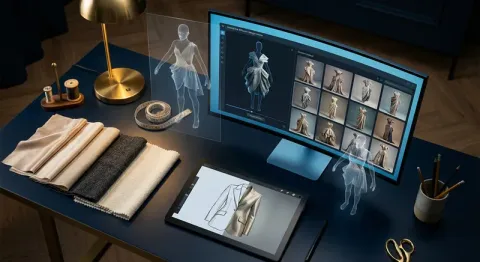
- From diffusion models to Flux.2 to Nano Banana Pro, image generation models have undergone five generational leaps in three years — each redefining the boundaries of what is feasible in fashion AI applications
- Rapid model parameter growth has spawned a complete acceleration technology stack: DeepCache achieves 2-5x inference speedup for diffusion models, HQQ/GPTQ quantization compresses memory by up to 4x, and frameworks like Pruna AI can deliver over 10x acceleration through multi-technique combination optimization
- ChatGPT's Ghibli-style image generation attracted over one million new users within an hour, proving that consumer-grade AI creation has reached the mass market — LINE stickers and social media content have become the new battleground for fashion brand AI marketing
- Video generation models such as Veo 3 and Kling O1 now support native audio synchronization and 4K output, moving fashion brands from the era of "AI-generated images" to "AI-generated videos," with runway video and product short-form video production costs potentially reduced by 60-80%
1. A Model Arms Race Faster Than Anyone Expected
In the summer of 2022, the open-source release of Stable Diffusion[1] sent the first shockwave through the fashion industry. Designers suddenly discovered that a simple text description could generate high-quality garment concept images within seconds. But at the time, most industry insiders still regarded it as "an interesting toy" — the generated images were noticeably lacking in detail: finger counts were frequently wrong, fabric textures were distorted, and the geometric structures of complex tailoring would collapse.
Three years later, the pace of evolution in this field has exceeded everyone's expectations. From Stable Diffusion 1.5 to SDXL, then to Flux and Nano Banana Pro, image generation models have gone through at least five generational leaps. Meanwhile, video generation has progressed from "impossible" to "commercially viable," ChatGPT's Ghibli-style images have swept global social media, and KV Cache and quantization technologies are quietly addressing the fundamental problem of compute bottlenecks.
For the fashion industry, this is no longer a question of "whether to embrace AI," but rather "how to make the right technology bets amid the speed of model iteration." McKinsey estimates[2] that generative AI can create $150-275 billion in annual operational value for the fashion industry — but only if enterprises understand the underlying logic of this arms race.
2. The Evolution of Image Generation Models: From Stable Diffusion to Flux to Nano Banana Pro
2.1 Stable Diffusion: The Open-Source Ignition Point (2022-2023)
The Latent Diffusion Model (LDM) proposed by Rombach et al. in 2022[1] was where it all began. Its core breakthrough was moving the denoising process from pixel space to a compressed latent space, enabling high-quality image generation to move from the laboratory to consumer laptops. Stability AI open-sourced it as Stable Diffusion, instantly catalyzing a massive community ecosystem.
The impact on the fashion industry was immediate: LoRA fine-tuning allowed brands to train proprietary style models with just a few hundred of their own design images, ControlNet provided precise control over poses and composition, and IP-Adapter made style transfer possible. However, SD 1.5's 860M parameter count and 512x512 default resolution remained a hard limitation for commercial applications. SDXL pushed the resolution to 1024x1024, with model parameters expanding to 6.6B — better quality, but also higher compute demands.
2.2 Flux: The Stable Diffusion Founders Surpass Themselves (2024-2025)
In 2024, the original authors of Stable Diffusion — Robin Rombach, Andreas Blattmann, and Patrick Esser — left Stability AI, founded Black Forest Labs (BFL), and released the Flux model series[3]. This was a thorough architectural overhaul — Flux adopted a Transformer architecture-based DiT (Diffusion Transformer) architecture, replacing the traditional UNet backbone, and comprehensively surpassed the previous generation in image quality, text rendering, and prompt adherence.
The FLUX.2 series released in November 2025 further differentiated into four versions — Pro, Flex, Dev, and Klein — providing full coverage from 4-megapixel professional-grade output to ultra-fast inference. BFL secured a $140 million multi-year partnership with Meta, reached a $3.25 billion valuation, and Adobe Photoshop even integrated FLUX.1 Kontext directly into its Generative Fill feature[3]. This means Flux is no longer just an open-source model — it has been formally embedded into the core workflow of designers worldwide.
For the fashion industry, Flux's breakthroughs lie in two areas: first, significantly improved human body structure generation — with greatly enhanced physical plausibility of fingers, joints, and fabric draping; second, FLUX.2 Klein's ultra-fast inference mode has moved real-time virtual try-on on e-commerce platforms from concept to production-scale deployment.
2.3 Nano Banana Pro: Google's Overwhelming Entry (November 2025)
In the same week that FLUX.2 was released, Google DeepMind launched Nano Banana Pro[4] — an image generation model based on Gemini 3 Pro. This model overwhelmed existing competitors across multiple dimensions: reasoning-guided 4K resolution output, generation speeds under 10 seconds, and unprecedented text rendering accuracy — correctly rendering everything from short taglines to complete paragraphs.
The key to Nano Banana Pro's dominance lies in Google's unique stacking of advantages: Gemini 3 Pro's multimodal reasoning capabilities provide semantic understanding depth beyond that of purely visual models, TPU v5e compute infrastructure supports large-scale inference, and Google Search integration allows the model to reference real-world visual knowledge in real time.
The impact on the fashion industry is particularly direct: Nano Banana Pro's text rendering capability means that AI-generated fashion advertising images can directly include brand taglines, price tags, and calls-to-action (CTAs), eliminating the need for post-production manual typesetting. The 4K output also means generated images meet print-quality requirements for the first time — from e-commerce product shots to full-page magazine advertisements, end-to-end AI generation has become a reality.
3. Compute Bottlenecks and Engineering Breakthroughs: Why Quantization and Caching Technologies Matter
The flip side of model iteration is the explosive growth in parameter counts. From SD 1.5's 860M to SDXL's 6.6B, to the billions of parameters behind Flux Pro and Nano Banana Pro, compute demands are scaling exponentially. For brands looking to deploy AI fashion design tools locally, this poses a serious practical challenge — a single high-quality image generation may require over 16GB of VRAM, which is nearly impossible on consumer-grade hardware.
It is precisely this contradiction — models becoming ever more powerful while compute resources become increasingly scarce — that has spawned an entire "model acceleration" technology ecosystem. Among them, caching and model quantization are the two most critical technical paths.
3.1 Caching Technologies: From KV Cache to Diffusion Model-Specific Caching
KV Cache (Key-Value Cache) is a core optimization technique in Transformer architecture inference. During autoregressive generation, the model needs to repeatedly compute the Key and Value vectors of all preceding tokens. KV Cache stores these intermediate results to avoid redundant computation, theoretically reducing inference time from O(n²) to O(n).
However, KV Cache itself consumes significant memory. The KVQuant research by Hooper et al. published at NeurIPS 2024[5] proposed a KV Cache quantization scheme for ultra-long contexts, successfully compressing cache memory requirements to one-quarter of the original, enabling inference with million-level token contexts. NVIDIA subsequently released the NVFP4 format[6], which further compresses KV Cache from 16-bit to 4-bit, reducing memory usage by 50% with precision loss controlled to within 1%.
The caching approach has also begun to demonstrate its power in the diffusion model domain. Unlike LLM KV Cache, caching strategies for diffusion models focus on reusing intermediate features between denoising steps. Pruna AI integrated multiple diffusion model-specific caching technologies into its model optimization framework[7]: DeepCache reuses intermediate features of UNet blocks to achieve 2-5x inference speedup with virtually no loss in image quality; FORA reuses Transformer block outputs at configurable intervals; FasterCache further skips computation of the unconditional branch and reuses attention states across denoising steps; PAB (Pyramid Attention Broadcast) systematically skips attention computation between steps.
What does this mean for fashion AI? Take a 50-step Flux image generation as an example: DeepCache can compress it to the equivalent of 10-25 steps of computation, meaning what originally took 8 seconds can be completed in 2-3 seconds. When the latency of virtual try-on or real-time design generation drops to a consumer-acceptable range, edge devices (such as in-store smart mirrors and consumer smartphones) can perform real-time inference locally without relying on cloud round-trips. This is the technical prerequisite for AI fashion experiences to move from "online showcase" to "offline physical retail."
3.2 Model Quantization: Running Giant Models on Consumer-Grade Hardware
Complementing caching is model weight quantization technology. QLoRA, proposed by Dettmers et al.[8], demonstrated an exciting possibility: quantizing large models to 4-bit (NF4 format) and then performing LoRA fine-tuning, enabling models that originally required 40GB of VRAM to run on consumer-grade GPUs with 12GB, with virtually no quality loss.
The selection of quantization techniques has itself become a specialized discipline. In their Hugging Face technical blog post[9], Pruna AI systematically surveyed the current mainstream quantization methods: GPTQ performs post-training quantization using second-order information, compressing weights to INT4 and achieving nearly 4x memory savings; AWQ (Activation Aware Quantization) derives scaling factors using calibration data, minimizing precision loss on significant weights; HQQ (Half-Quadratic Quantization) enables rapid 2-8 bit quantization without calibration data, and is especially well-suited for diffusion models — Pruna's framework has already adapted HQQ for Stable Diffusion and Flux models, and combined with torch.compile optimization, can achieve additional inference acceleration while maintaining visual quality.
3.3 Combined Optimization: The Multiplier Effect of Caching + Quantization + Compilation
True engineering breakthroughs often come from combining multiple optimization techniques. Pruna AI's framework[7] demonstrates an important practical insight: quantization (compressing model size), caching (reducing redundant computation), compilation (optimizing instructions for specific hardware), and pruning (removing redundant connections) are not mutually exclusive options but stackable acceleration layers. Structured pruning can reduce model size by 80-90%, and when stacked with INT4 quantization and DeepCache caching, the final inference speed can reach over 10x that of the original model.
For fashion brands, this means the barrier to building proprietary AI design tools has been dramatically lowered. A mid-sized fashion brand does not need a multi-million-dollar GPU cluster — a single workstation equipped with an RTX 4090 is sufficient to run a quantized and cache-optimized Flux Dev model, and with LoRA fine-tuning on the brand's own design dataset, it can produce design proposals that align with the brand's aesthetic. From open-source frameworks like Pruna to commercial solutions like NVIDIA TensorRT, the maturation of model optimization toolchains is transforming AI fashion design from "a privilege of large corporations" into "an everyday tool for small and medium brands."
4. The Ghibli Storm and LINE Stickers: When AI Generation Reaches the Mass Market
If the model iterations and engineering optimizations described above belong to the "supply side" of technological evolution, then a social media storm in March 2025 proved that the "demand side" was ready.
On March 25, 2025, OpenAI launched GPT-4o-based image generation capabilities for ChatGPT[10]. Almost overnight, "transforming your photos into Ghibli anime style" became the number one topic on global social media. Users converted family photos, pet photos, and even food photos into Miyazaki-esque dreamlike images — over one million new users flooded in within an hour, servers temporarily crashed, and ChatGPT's total user base quickly surpassed 150 million.
This storm quickly spilled over into the fashion and consumer goods sectors. Social media saw a flood of AI-generated Ghibli-style outfit illustrations, brand images, and even product showcase images. More commercially significant, large numbers of users began using ChatGPT to generate customized LINE stickers and WhatsApp emoji packs — transforming themselves or brand IPs into digital goods in various artistic styles.
For the fashion industry, this revealed several signals that cannot be ignored:
- AI creation has been democratized: Anyone can generate high-quality visual content using natural language, and the visual monopoly of fashion brands is being dismantled. An AI-generated marketing image from a street-level emerging brand can match the visual quality of a luxury brand's professional photography.
- Consumers have established AI aesthetics: The Ghibli storm proved that consumers not only accept AI-generated visual content but actively seek it out. This provides powerful market validation for brands' AI marketing strategies.
- A new market for personalized digital goods: AI-generated LINE stickers, emoji packs, and virtual outfit showcases are creating an entirely new digital fashion derivative market. Brands can let consumers use AI to generate "themselves wearing brand clothing," creating an unprecedented interactive marketing experience.
5. The Flourishing of Video Generation: From "AI-Generated Images" to "AI-Generated Videos"
If 2024 was the year of maturation for image generation, then 2025 is undoubtedly the breakout year for video generation. The release of multiple heavyweight models has elevated AI video generation from "experimental demo" to "commercially viable tool."
5.1 Veo 3 / Veo 3.1: Google Defines a New Standard for Video
In May 2025, Google DeepMind released Veo 3[11], achieving for the first time the synchronized generation of video with native audio — including dialogue, sound effects, and ambient atmosphere. This represents a fundamental shift: AI is no longer just "generating visuals" but "generating complete audiovisual experiences." Veo 3.1, released in October of the same year, further supports native portrait-mode output (optimized for short-form video platforms like YouTube Shorts), 1080p to 4K super-resolution upscaling, and dynamic video generation based on image input.
5.2 Kling O1: Kuaishou's Unified Multi-Modal Engine
Kuaishou Technology's Kling AI followed a remarkable trajectory in 2025. From Kling 2.0 to 2.5 Turbo to 2.6[12], the model underwent four major iterations in less than a year. Kling O1, released in December 2025, was positioned as "the world's first unified multimodal video model" — integrating reference image generation, text-to-video, first/last frame control, video inpainting, style transfer, and shot extension into a single engine. Within ten months of launch, annualized revenue exceeded $100 million.
5.3 Impact on the Fashion Industry
The maturation of video generation has a far more profound impact on the fashion industry than image generation. Consider the following scenarios:
- AI runway videos: Brands can use AI to generate virtual models wearing new season garments in runway videos, complete with native audio background music and ambient sound effects, reducing production costs from hundreds of thousands of dollars to just a few thousand.
- E-commerce short-form videos: Veo 3.1's native portrait-mode output and Kling O1's reference image generation enable brands to create multiple versions of short-form video content for each product within minutes, allowing A/B testing across different platforms and audiences.
- Virtual try-on 2.0: Static virtual try-on is no longer enough — consumers want to see how garments look in motion: walking, turning, sitting down. The static try-on foundation laid by TryOnDiffusion[13] is being extended by video generation models into dynamic try-on experiences.
- Dynamic fabric simulation: Video models can simulate the lustrous flow of silk, the fluffy elasticity of wool, and the rigid texture of denim, allowing consumers to "feel" the dynamic properties of fabrics before placing an order.
6. Underestimated Systemic Challenges
However, behind the industry's optimism lie several seriously underestimated structural obstacles:
6.1 The Gap Between Visual Generation and Manufacturability
AI-generated garment design images may be visually stunning, but they do not contain the technical information that pattern makers need — seam allowances, fabric stretch compensation, and manufacturing tolerances. Converting AI-generated 2D designs into 3D manufacturable specifications still requires significant human intervention. This is an engineering problem that has not yet received adequate academic attention.
6.2 The Legal Gray Zone of Intellectual Property
The Ghibli storm exposed an acute legal issue. Hayao Miyazaki himself has long publicly opposed the use of AI in animation creation, calling it "an insult to life itself." Yet hundreds of millions of users are using AI to mass-produce derivative works in his visual style. When an AI-generated design closely resembles the iconic styles of a well-known brand, how is legal liability assigned? Multiple copyright lawsuits against OpenAI are still being adjudicated, and these issues currently lack a clear regulatory framework.
6.3 Decision Paralysis in Model Selection
Stable Diffusion, Flux, Nano Banana Pro, Midjourney, DALL-E — when there are more than ten models to choose from, each with different strengths and weaknesses, fashion brands' technical teams (if they have one) face severe decision paralysis. McKinsey's survey shows[14] that 73% of fashion brands admit they lack the internal capability to evaluate and select AI models. Blind selection can lead to massive sunk costs — workflows built on the wrong model will become entirely obsolete when the next generation is released.
7. Strategic Recommendations for Enterprises: Staying Lucid in the Model Arms Race
In the face of an accelerating model ecosystem, we recommend that fashion enterprises adopt the following strategic framework:
- Abstract the model dependency layer: Do not lock workflows to a specific model. Build a model-agnostic AI design pipeline that allows the underlying model to be seamlessly swapped between Flux, Nano Banana Pro, or future new models. This requires a carefully designed API abstraction layer and standardized prompt engineering templates.
- Prioritize investment in data assets: Models become obsolete, but a brand's proprietary design datasets, fabric texture libraries, and customer preference data do not. Regardless of how the underlying model evolves, high-quality proprietary data will always be the foundation for differentiation. Use quantized fine-tuning techniques (such as QLoRA[8]) to reduce fine-tuning costs and continuously accumulate brand-specific AI capabilities.
- Distinguish between "quick applications" and "deep investments": AI-generated social media graphics, LINE stickers, and short-form videos fall under "quick applications" — simply call the latest API without deep customization. Core systems such as virtual try-on, AI-assisted pattern making, and trend prediction engines require "deep investment" — building proprietary model pipelines, accumulating evaluation benchmarks, and cultivating or recruiting technically capable research teams.
- Embrace the early dividend of video generation: Most competitors are still at the image generation stage. Brands that are first to integrate Veo 3 or Kling into their content production workflows will gain significant cost and speed advantages on short-form video platforms.
8. Why This Requires Research-Level Technical Judgment
The technical breadth covered in this article — from diffusion model architectures to Transformer inference optimization, from KV Cache quantization to multimodal video generation — illustrates precisely why fashion enterprises cannot address this transformation by simply "hiring one AI-savvy engineer." Every technical choice involves deep understanding of underlying principles: Should you choose Flux or Nano Banana Pro? Is NVFP4 quantization appropriate for your inference scenario? Does Veo 3's audio synchronization quality meet your brand's tonal requirements?
These judgments require not API usage experience, but a systematic understanding of model architectures, training mechanisms, and inference engineering. Meta Intelligence's research team continuously tracks the latest breakthroughs from top conferences such as CVPR, NeurIPS, and ICLR, and translates cutting-edge methodologies into actionable technology roadmaps for enterprises.
If your fashion brand is evaluating AI technology investments, we invite you to have an in-depth technical conversation with our research team and our partner PortalM. When facing the speed of the model arms race, seeing the direction clearly is more important than starting the race blindly.