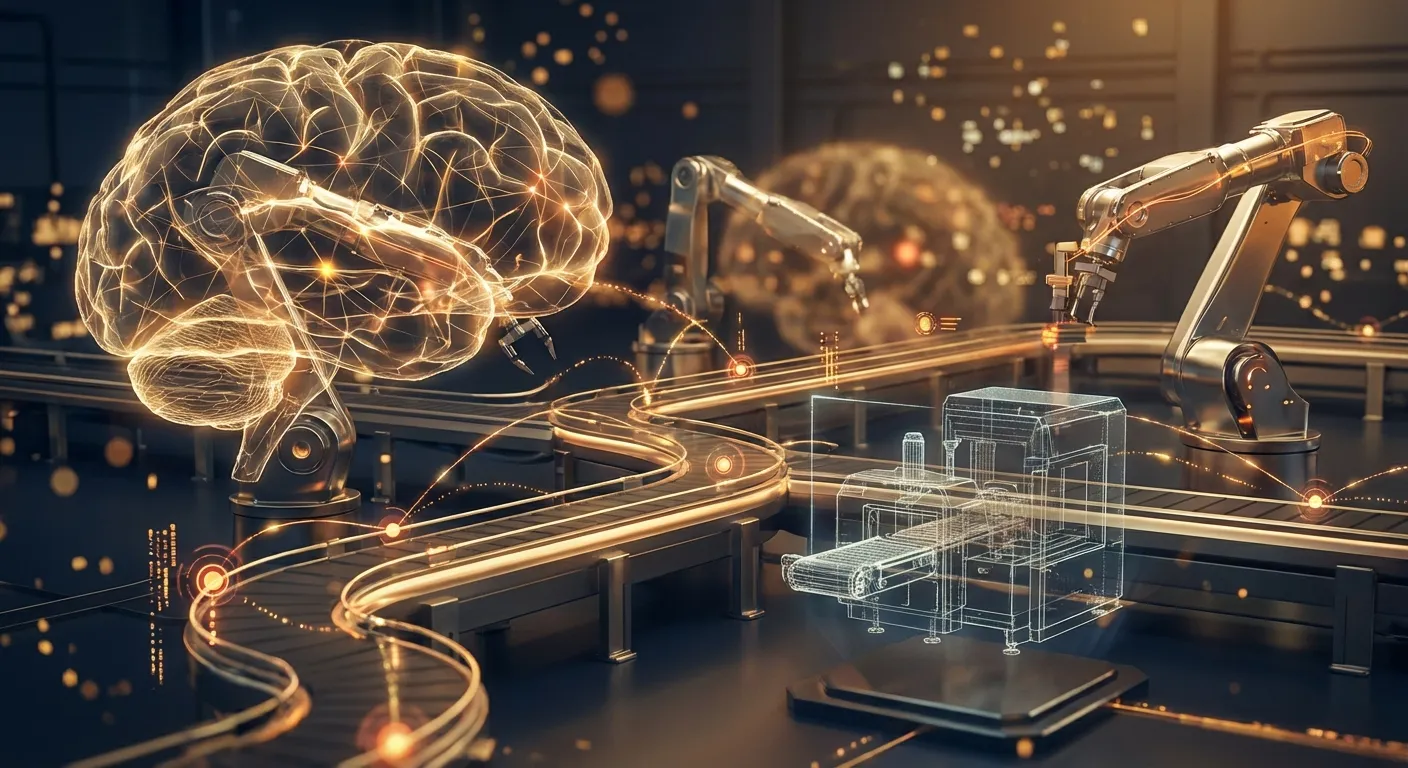
- Physical AI is moving from the lab to the production line — NVIDIA's Isaac platform combines GPU-accelerated simulation with robot foundation models, enabling developers to train robot policies at 1,000x real-world speed in digital twin environments, dramatically shortening the cycle from concept to deployment[1]
- The humanoid robot market is projected to reach $38 billion by 2035[7]; Figure 02, Tesla Optimus Gen 2, and Boston Dynamics Electric Atlas are already conducting commercial pilots in logistics warehousing and manufacturing environments[2][3][4]
- Breakthroughs in Robot Foundation Models are the key driving force behind Physical AI's accelerated deployment — RT-2 and other Vision-Language-Action models (VLA) achieved, for the first time, "commanding robots with natural language to complete previously unseen tasks"[5], while the Open X-Embodiment dataset makes cross-robot transfer learning possible[6]
- McKinsey estimates that deploying Physical AI in manufacturing scenarios can improve overall production line efficiency by 20-30% and reduce labor costs by 40-60%[9]; Taiwan's ITRI projects that domestic smart robotics output will exceed NT$80 billion by 2028[8]
1. What Is Physical AI? The Leap from Digital Intelligence to the Physical World
Over the past decade, AI's explosive growth has occurred almost entirely in the "digital world" — large language models can generate sophisticated text, diffusion models can create photorealistic images, and reasoning models can solve complex mathematical problems. But all these capabilities are confined within screens — AI cannot move a box, tighten a screw, or navigate a warehouse picking items. Physical AI is precisely about bridging this gap — enabling artificial intelligence to not only "think" but also "act"; to no longer just process tokens and pixels, but directly manipulate objects, tools, and environments in the physical world.
NVIDIA CEO Jensen Huang defined Physical AI as "AI systems that understand physical laws and interact with the physical world" in his 2025 CES keynote address, and announced that Physical AI is the core of NVIDIA's next-decade strategy[1]. This is no rhetorical exaggeration — from the Isaac robotics platform and the Omniverse digital twin engine to the Jetson Thor SoC designed specifically for robots, NVIDIA is building a complete Physical AI technology stack.
The core challenge of Physical AI lies in this: the physical world is far more complex than the digital world. In the digital world, a flawed inference at most produces imperfect text; in the physical world, one wrong movement can damage equipment, ruin products, or even injure personnel. Robots must make millisecond-level decisions in uncertain environments — perceiving object positions and materials, planning arm trajectories, applying precisely the right amount of force, and adjusting in real time when encountering unexpected situations. This requires AI to simultaneously possess visual understanding, spatial reasoning, force control, and real-time response capabilities — technical complexity far exceeding purely digital scenarios.
Between 2025 and 2026, three major technological breakthroughs transformed Physical AI from a "long-term vision" into a "deployable technology": First, Robot Foundation Models enable robots to complete diverse tasks through natural language instructions[5]; Second, GPU-accelerated simulation allows robots to train at high speed in virtual environments, no longer constrained by real-world physical time[1]; Third, the maturation of humanoid robot hardware is bringing the mass production cost of general-purpose robots close to commercial viability[7]. This article will analyze each of these breakthroughs in depth and provide practical adoption strategies for Taiwan's enterprises.
2. Deep Dive into Major Humanoid Robot Platforms
The reason humanoid robots have become the most watched vehicles for Physical AI is intuitive: the world humans have built — factories, warehouses, hospitals, homes — is designed for the human form. Stairs, door handles, tools, switches — these interfaces all assume the user has two hands, two legs, and an upright torso. A humanoid robot can enter these environments and work directly, without costly modifications to the environment. Goldman Sachs estimates the humanoid robot market will reach $38 billion by 2035[7], and 2025-2026 is the critical transition period from prototype validation to commercial piloting.
Figure 02: Language-Driven Robots Powered by OpenAI
Figure AI was the most capital-pursued humanoid robot startup during 2024-2025, backed by an investor lineup including OpenAI, Microsoft, NVIDIA, and Jeff Bezos. Figure 02 is its second-generation humanoid robot[2], achieving qualitative leaps over the first generation across multiple key dimensions.
Figure 02's most unique technical advantage lies in its deep integration with OpenAI. The robot has a built-in multimodal model based on the GPT architecture, enabling it to: receive task instructions via natural language (e.g., "place the red box on the third shelf"), understand objects and spatial relationships in the environment through vision, and communicate with human colleagues in real time via voice. This end-to-end "language-vision-action" capability was validated in a 2025 pilot at BMW's South Carolina plant — Figure 02 successfully completed body part classification, transport, and shelving operations, running continuously for over 8 hours.
Key specifications of Figure 02 include: height 167cm, weight 60kg, 16 degrees of freedom in each hand (each hand can independently control 8 joints), maximum payload of 20kg, and approximately 5 hours of battery life. Its fourth-generation Dexterous Hand v4 can perform operations requiring fine force control, such as assembling miniature electronic components or handling fragile items.
Tesla Optimus Gen 2: Built on Large-Scale Manufacturing DNA
Tesla Optimus's greatest advantage lies not in any single technical metric, but in Tesla's core competency in large-scale hardware manufacturing[3]. Elon Musk has repeatedly stated that Optimus's ultimate goal is to bring the per-unit cost below $20,000, which would transform humanoid robots from "high-end equipment" to a "general labor commodity."
Optimus Gen 2 demonstrated significant progress in 2025: walking speed increased to 5 km/h, fingertip tactile sensor precision reached millimeter level, and coordination control across 28 full-body degrees of freedom became more fluid. More critically, Tesla transferred its accumulated autonomous driving visual AI capabilities (particularly Occupancy Networks and end-to-end neural networks) to Optimus, giving it a natural advantage in environmental perception and path planning.
Tesla has already deployed dozens of Optimus prototypes in its Fremont and Austin Gigafactories, performing battery component transport, sorting, and initial quality screening tasks. In early 2026, Tesla announced plans to expand the number of Optimus units on production lines to several thousand by year-end, and begin external sales in 2027. For Taiwan's manufacturing industry, Tesla Optimus's mass production timeline and pricing strategy will directly impact the accessibility of humanoid robots.
Boston Dynamics Electric Atlas: The Benchmark for Motion Control
Boston Dynamics made a historic pivot in 2024 — retiring its hydraulic-driven Atlas prototype and launching the all-new Electric Atlas[4]. This was not merely a power source switch but represented a strategic shift from "research demonstration platform" to "commercial product." Electric Atlas's design philosophy is: maintain Boston Dynamics' legendary motion control capabilities while dramatically improving practical deployability in industrial environments.
Electric Atlas remains the industry benchmark in motion capabilities: it can walk stably on uneven surfaces, maintain balance while carrying heavy loads, maneuver in tight spaces, and even self-recover from falls. Its 360-degree rotating head and torso design breaks the joint limitations of traditional humanoid robots, making operations between warehouse shelves more flexible. Boston Dynamics' parent company relationship with Hyundai gives Atlas a unique field validation advantage in automotive manufacturing scenarios.
Other Notable Platforms: Agility Digit, Unitree H1, 1X NEO
Beyond the three major platforms, several humanoid robots focused on specific scenarios are also worth attention. Agility Robotics' Digit has been conducting transport testing in Amazon warehouses, with its design optimized for logistics scenarios excelling at box handling efficiency. China's Unitree H1, priced at approximately $90,000, offers the lowest-cost research-grade humanoid robot platform currently available. Norway's 1X Technologies' NEO targets home care and service scenarios, emphasizing safety and friendly human-robot interaction.
Major Humanoid Robot Platform Comparison
| Platform | Developer | Height/Weight | Payload | DOF | Primary Scenarios | Est. Price (USD) | Commercialization Stage |
|---|---|---|---|---|---|---|---|
| Figure 02 | Figure AI | 167cm / 60kg | 20kg | 40+ | Manufacturing, Logistics | $50,000–80,000 | Commercial Pilot |
| Optimus Gen 2 | Tesla | 173cm / 57kg | 20kg | 28 | Manufacturing, General | $20,000–30,000 (target) | Internal Testing |
| Electric Atlas | Boston Dynamics | 150cm / 89kg | 25kg | 28+ | Automotive Mfg., Logistics | $100,000+ (est.) | Limited Pilot |
| Digit | Agility Robotics | 175cm / 65kg | 16kg | 20+ | Warehouse Logistics | $50,000–75,000 | Commercial Pilot |
| H1 | Unitree | 180cm / 47kg | 15kg | 19 | Research, Light Industry | $90,000 | Shipping |
| NEO Beta | 1X Technologies | 162cm / 30kg | 10kg | 20+ | Home Care | TBD | Beta Testing |
3. Robot Foundation Models: Enabling Robots to Truly "Understand" Tasks
Hardware advances are only half the Physical AI story. What truly upgrades humanoid robots from "expensive remote-controlled toys" to "autonomous labor" is the breakthrough in Robot Foundation Models. Just as large language models enabled computers to understand human language, robot foundation models enable robots to understand the operational logic of the physical world.
From RT-1 to RT-2: The Birth of Vision-Language-Action Models
Google DeepMind's RT (Robotics Transformer architecture) series is a milestone in robot foundation models. RT-2, published in 2023[5], was the world's first large-scale Vision-Language-Action Model (VLA) — it can not only understand images and language, but also directly translate that understanding into robot motion commands.
RT-2's core breakthrough lies in "knowledge transfer": built on pre-trained vision-language models (such as PaLI-X), it transfers broad world knowledge learned from the internet to the robot control domain. This means RT-2 can understand concepts that never appeared in its training data. For example, even without any robot operation examples of "throw trash in the trash can," RT-2 can correctly execute the task based on its semantic understanding of "trash" and "trash can." In Google's tests, RT-2 achieved a more than 3x improvement in success rates on previously unseen tasks compared to its predecessor RT-1.
Open X-Embodiment: A Shared Knowledge Repository Across Robots
A fundamental problem long facing robot AI is data fragmentation — each robot type has a different form (arm length, joint count, sensor configuration all differ), meaning training data collected for Robot A cannot be directly used for Robot B. The Open X-Embodiment Collaboration[6], led by Google DeepMind with 21 participating research institutions, aims to break this bottleneck.
Open X-Embodiment established a standardized dataset covering 22 different robot forms and over 1 million operational trajectories. The RT-X model trained on this dataset demonstrated remarkable cross-robot transfer capabilities — on robots never seen before, RT-X's task success rate exceeded the robot's original dedicated model by 50%. The implications are profound: it proves robot AI can adopt the "foundation model" paradigm — training one general large model, then fine-tuning for different robot forms, just as GPT can be fine-tuned for text generation in different languages.
NVIDIA GR00T and Isaac Lab: The Development Platform for Physical AI
NVIDIA's Physical AI strategy is not just about providing GPU compute power, but about becoming the infrastructure provider for the entire ecosystem[1]. Its core product matrix includes:
- Project GR00T (Generalist Robot 00 Technology): NVIDIA's in-house humanoid robot foundation model, designed to enable robots to learn new tasks by watching videos and simulation data. GR00T is based on the Transformer architecture, accepting multimodal inputs (language, images, force sensing) and outputting robot joint control commands
- Isaac Lab / Isaac Sim: A robot simulation platform built on Omniverse. Developers can train robot policies in physically precise virtual environments at up to 1,000x real-world speed, dramatically reducing the cost and risk of real-world training. Isaac Lab supports domain randomization — randomizing lighting, friction, object shapes, and other parameters in simulation to improve strategy transfer to real environments
- Jetson Thor: An SoC designed specifically for humanoid robots, integrating NVIDIA's GPU architecture with a Transformer inference engine, enabling robots to run large AI models at the edge in real time without relying on cloud connectivity
- Isaac Manipulator / Isaac Perceptor: Pre-trained model suites for robotic arm manipulation and environmental perception, respectively. Enterprises can use them directly or fine-tune them, significantly shortening development cycles
Robot Foundation Model Technology Comparison
| Model/Platform | Developer | Architecture Type | Core Capability | Open Source Status | Applicable Scenarios |
|---|---|---|---|---|---|
| RT-2 | Google DeepMind | VLA (Vision-Language-Action) | Natural language to robot action[5] | Paper public / Model closed | General manipulation |
| RT-X | Open X-Embodiment | Cross-robot Transformer | Cross-embodiment transfer learning[6] | Dataset open / Model partially open | Multi-robot deployment |
| GR00T | NVIDIA | Multimodal Transformer | Humanoid robot general foundation model[1] | Closed (Isaac ecosystem) | Humanoid robots |
| Octo | UC Berkeley | Transformer | Generalizable robot manipulation policy | Fully open source | Research / Robotic arms |
| Pi-Zero | Physical Intelligence | VLA + Diffusion policy | Complex dexterous manipulation | Closed source | Precision assembly |
| RoboCasa / MimicGen | NVIDIA / UT Austin | Simulated data generation | Large-scale robot training data synthesis | Open source | Training data augmentation |
4. Core Application Scenarios for Physical AI
The commercial value of Physical AI lies not in "how cool the technology is" but in "which previously unautomatable problems it can solve." McKinsey's industry report[9] indicates that approximately 1.2 billion jobs globally require physical labor, of which roughly 350 million could be partially or fully replaced by Physical AI within the next decade. Below are the four most commercially viable application scenarios.
Scenario 1: Manufacturing — Flexible Production Lines and Human-Robot Collaboration
Traditional industrial robots (such as six-axis robotic arms) excel at high-volume, repetitive, fixed-path tasks, but struggle with mixed-model production and small-batch, high-variety manufacturing trends — each product switch requires reprogramming and recalibration, with expensive downtime costs. Physical AI-driven humanoid or collaborative robots (Cobots) are designed to solve the "flexibility" problem.
In BMW's pilot case[2], Figure 02 was deployed at body parts material handling stations. Traditional solutions require writing specialized handling programs for each part type, while Figure 02 only needs a language instruction like "Place the B-pillar trim panel onto the welding fixture" to autonomously complete the full process of identification, grasping, transport, and positioning. When the production line switches to a different vehicle model, operators simply change the language instruction — no reprogramming needed. This "zero switching cost" flexibility is exactly what mixed-model manufacturing has long desired.
For Taiwan's manufacturing industry, semiconductor back-end packaging, precision machinery assembly, and PCB assembly are particularly suitable scenarios for Physical AI adoption. These scenarios share common characteristics: many task types with high structural regularity, requiring fine hand operations without extreme speed, frequent product changes within relatively controlled environments. ITRI IEK's[8] white paper recommends that Taiwan manufacturers prioritize Physical AI pilots on "high-mix, medium-volume" production lines.
Scenario 2: Logistics and Warehousing — Full-Process Automation from Picking to Palletizing
E-commerce's explosive growth has made logistics warehousing one of the most urgent application scenarios for Physical AI. According to Goldman Sachs' estimates[7], the global warehousing industry faces an approximately 40% labor gap, with labor costs rising at 5-8% annually. Traditional warehouse automation (such as AGVs and sorting machines) can only handle standardized logistics units, and still requires significant manual labor for irregularly shaped packages and products.
Humanoid robots' advantage in warehousing lies in their "versatility" — the same robot can: walk between shelves to pick products (picking), pack products of varying sizes into boxes (packing), and carry boxes to the shipping dock for palletizing. Agility Robotics' Digit has completed over 10,000 hours of box transport testing in Amazon warehouses, processing approximately 300 standard boxes per hour — approaching 70% of human worker efficiency, but capable of running 24/7 without interruption.
Scenario 3: Healthcare — Bridging the Labor Gap in an Aging Society
Taiwan entered a super-aged society in 2025 (population aged 65+ exceeding 20%), with an estimated care workforce gap of over 200,000 people. Physical AI in healthcare is not about replacing caregivers, but about extending each caregiver's service capacity — having robots handle transport, delivery, environmental cleaning, and other physical labor so human caregivers can focus on interactions requiring emotional connection and professional judgment.
Specific applications include: in-hospital medication and specimen delivery (freeing nurses from walking several kilometers daily), patient transfer assistance (reducing occupational injury risks for caregivers), patrol monitoring and anomaly alerts in long-term care facilities, and basic living assistance (serving water, passing objects, assisting with walking). 1X Technologies' NEO robot is designed for such scenarios, with compliant control technology ensuring safety during human contact.
Scenario 4: Hazardous Environment Operations — Replacing Humans in High-Risk Zones
In scenarios such as nuclear plant decommissioning, chemical handling, post-disaster search and rescue, and high-altitude work, the cost of exposing humans to physical risk is extremely high. Physical AI can send robots into these dangerous environments to perform inspection, repair, cleanup, and rescue tasks. Boston Dynamics' Atlas was originally developed for DARPA's post-disaster rescue challenge[4], and its motion capabilities in unstructured environments make it particularly suited to these extreme scenarios.
5. Strategic Framework for Taiwan Manufacturing to Adopt Physical AI
For Taiwan's manufacturing industry, Physical AI is not a distant future concept but a strategic issue requiring planning that starts now. ITRI IEK[8] noted in its 2026 white paper that Taiwan's manufacturing sector faces three-fold pressure: labor shortages driven by declining birth rates, customer demands for shorter lead times and product diversification, and intensified competition from global supply chain restructuring. Physical AI is the key technology that simultaneously addresses all three pressures.
Phase 1: Site Assessment and Rapid Proof of Concept (0-6 months)
The first step is not purchasing robots, but systematically assessing which workstations are best suited for Physical AI. Assessment dimensions include: task repeatability and structural regularity (higher is better), labor cost and severity of worker shortages, safety risk levels, and spatial and workflow conditions. Enterprises should form cross-functional assessment teams (manufacturing, IT, finance, safety) and use NVIDIA Isaac Sim[1] to build digital twin models of the site, simulating robot workflows and efficiency in virtual environments before deciding whether to proceed with physical pilots.
During the proof of concept phase, we recommend a collaborative robot (Cobot) + AI vision combination as the starting point, rather than directly deploying humanoid robots. The reasons: Cobots have higher technology maturity, shorter deployment cycles (typically 2-4 weeks), lower costs (approximately NT$1-2 million), and well-established safety certifications. Through Cobot pilots, enterprises can validate the feasibility and ROI of AI-driven automation in their specific settings at low risk.
Phase 2: Expanded Deployment and System Integration (6-18 months)
After successful proof of concept, enterprises should expand Physical AI from a single workstation to entire production lines or warehouse sections. The key challenge at this stage is not the robots themselves but system integration — robots need to interface with existing MES (Manufacturing Execution Systems), WMS (Warehouse Management Systems), ERP, and other systems to truly integrate into production processes. Safety measures must also be upgraded from single-machine level to production line level, including inter-robot coordination control, human-robot collaboration zone safety monitoring, and emergency stop mechanisms during failures.
At this stage, enterprises should begin evaluating the timing for humanoid robot adoption. If site assessments show that multiple workstations require different types of physical operations (transport + assembly + quality inspection), a humanoid robot's "one machine, multiple uses" characteristic may be more cost-effective than deploying multiple specialized devices. We recommend contacting platform vendors such as Figure AI or Tesla to discuss commercial pilot programs.
Phase 3: Scale-Up and Continuous Optimization (18-36 months)
The third phase's goal is transforming Physical AI from a "pilot project" into a "core operational capability." This includes: establishing an internal Robot Operations (RobOps) team, accumulating site-specific AI training data to continuously improve model performance, building a factory-wide robot scheduling and monitoring platform, and establishing long-term technical cooperation and maintenance service agreements with suppliers. McKinsey's[9] research indicates that enterprises reaching scaled deployment typically begin achieving positive ROI in Year 3.
ROI Analysis Framework
Physical AI ROI analysis should not only consider the direct cost replacement of "robot vs. human" but also incorporate the following indirect benefits:
- Opportunity cost of labor gaps: When worker shortages are severe, being unable to find people means lost orders. Robots fill not just labor costs but also "previously unachievable capacity"
- Quality consistency improvement: Robots are unaffected by fatigue or emotional fluctuations, and defect rates in precision assembly scenarios are typically 30-60% lower than manual operations
- 24/7 continuous operation: On a three-shift basis, one robot provides equivalent time coverage of 3-4 workers, with no overtime pay, labor insurance, or vacation costs
- Reduced occupational safety costs: Decreased transport-related musculoskeletal injuries, lowering workers' compensation and insurance expenses
- Flexible production premium: The ability to quickly switch production lines enables enterprises to take on more small-batch, high-value customized orders
6. NVIDIA Isaac Ecosystem: The Complete Toolchain for Physical AI Development
The NVIDIA Isaac platform deserves its own dedicated section because it is becoming the de facto standard toolchain for Physical AI development[1] — just as CUDA defined the development paradigm for GPU computing, Isaac is defining the development paradigm for robot AI. For Taiwan enterprises, understanding the Isaac ecosystem means understanding the full picture of the Physical AI technology stack.
Isaac Sim + Omniverse: A Physically Precise Simulation Training Ground
Isaac Sim is built on NVIDIA Omniverse and provides a robot training environment supporting precise physics simulation (PhysX engine), ray-traced rendering (RTX technology), and massive parallelization. Developers can: build complete digital twins of factories or warehouses (imported directly from CAD files), deploy robots in virtual environments and train AI policies, use domain randomization to ensure policies transfer to real environments, and simulate various edge scenarios (such as dropped objects, sudden human appearances, and lighting changes) to validate safety.
Isaac Lab is a reinforcement learning and imitation learning framework built on top of Isaac Sim, with built-in training workflows for robot manipulation (grasping, placing, assembly) and locomotion (walking, navigation, obstacle avoidance). Developers can train a robot policy that performs excellently in virtual environments within hours, equivalent to thousands of hours of trial and error in the real world. This "train in simulation, transfer to real environments" Sim-to-Real workflow is the core technical path enabling Physical AI's accelerated deployment.
Isaac Manipulator + Perceptor: Ready-to-Use AI Modules
For enterprises lacking deep AI R&D capabilities, Isaac Manipulator and Isaac Perceptor provide higher-level ready-to-use solutions. Isaac Manipulator includes pre-trained grasping policies, path planning algorithms, and collision avoidance modules — enterprises simply define task objectives (e.g., "pick up parts from the conveyor belt and place them on the tray"), and the system automatically generates viable action sequences. Isaac Perceptor provides 3D scene understanding, object recognition, and pose estimation AI models, enabling robots to "see and understand" objects and spatial relationships in their work environment.
Jetson Thor + Isaac ROS: Edge Inference and ROS Integration
Jetson Thor is NVIDIA's TinyML computing platform designed for humanoid robots, integrating GPU, deep learning accelerators, and robot-specific I/O interfaces. It enables robots to run large AI model inference locally, without relying on cloud connectivity — critical for industrial scenarios requiring millisecond-level response. Isaac ROS integrates NVIDIA's GPU-accelerated AI modules into the ROS 2 (Robot Operating System 2) ecosystem, enabling development teams already using ROS to seamlessly plug into NVIDIA's Physical AI toolchain.
7. Risks, Challenges, and Mitigation Strategies
While Physical AI's prospects are exciting, enterprises must also soberly face the technical and business risks during adoption. IEEE Robotics' survey report[10] systematically outlined the major challenges currently facing Physical AI.
Technical Challenges
- Sim-to-Real Gap: Policies trained in simulated environments typically underperform in the real world because simulation cannot perfectly reproduce all physical details of reality (friction variations, deformation of flexible objects, subtle lighting differences, etc.). Narrowing the Sim-to-Real Gap remains an active research topic
- Long Tail Problems: Robots can operate normally in 95% of common scenarios, but the remaining 5% of rare situations (irregular objects, unexpected obstacles, equipment failures) may cause failures or dangerous behaviors. Addressing long tail problems requires continuous data collection and model updates
- Dexterous Manipulation Precision Limits: Current robot hands are still far from matching human hands when handling soft, tiny, or complex-shaped objects. For example, in electronic component insertion operations, robot precision and force control capabilities cannot yet fully replace experienced assembly workers
- Battery Life: Humanoid robot battery life is typically 2-5 hours, insufficient to cover a full 8-hour shift, and charging time also causes capacity idle time
Safety and Regulatory Challenges
- Human-Robot Collaboration Safety: When robots share workspace with humans, it must be ensured that no harm comes to humans under any circumstances. ISO 10218 and ISO/TS 15066 define safety requirements for collaborative robots, but safety standards specifically for humanoid robots are still being developed
- Liability Attribution: When an AI-driven robot makes an incorrect decision causing loss or injury, should responsibility fall on the robot manufacturer, AI model developer, or deploying enterprise? Taiwan currently lacks a clear legal framework
- Labor Regulation Adaptation: Large-scale robot replacement of human labor will involve labor rights protection, reskilling programs, and social security system adjustments
Business Challenges
- Total Cost of Ownership (TCO) Uncertainty: Humanoid robots are still in the early commercialization stage, with long-term costs such as maintenance expenses, component lifespans, and software upgrade fees still unclear
- Talent Gap: Cross-disciplinary talent capable of integrating robot hardware, AI models, and production line systems is extremely scarce. ITRI estimates[8] Taiwan's talent gap in the Physical AI field at approximately 5,000-8,000 people
- Vendor Lock-in Risk: The robot platform ecosystem is not yet standardized, and choosing a specific platform may result in long-term vendor dependency
8. Physical AI Trends Outlook: 2026-2030
Physical AI is at the starting point of an exponential growth curve. Drawing on research from Goldman Sachs[7], McKinsey[9], and IEEE[10], we can outline the key trends for the next five years:
- Robot foundation models will reach their "GPT-3 moment": By 2027-2028, robot foundation models' generalization capabilities are expected to reach a level sufficient to handle most structured physical tasks — just as GPT-3 demonstrated the generality of language models in 2020. This will be the true starting point for Physical AI's large-scale commercialization
- Humanoid robot per-unit prices will drop below $30,000 by 2028: Tesla Optimus's mass production strategy plus price competition from Chinese manufacturers (Unitree, Fourier Intelligence, etc.) will drive rapid cost reduction. When per-unit prices fall below one worker's annual salary, the ROI equation will fundamentally flip
- "Robot as a Service" (RaaS) will become mainstream: Enterprises won't need to buy robots but will pay per use. This will dramatically lower adoption barriers, enabling SMEs to benefit from Physical AI. Mature RaaS platforms are expected to emerge by 2027
- Multi-robot collaboration will unlock new value: Evolving from single robots executing independent tasks to multiple robots collaboratively completing complex workflows — like human team division of labor. NVIDIA's Isaac platform already supports multi-robot coordination simulation, with enterprise field validation cases expected by late 2026
- Taiwan will become a key node in the Physical AI supply chain: Core robot components (servo motors, reducers, force sensors, edge AI chips) overlap significantly with Taiwan's precision machinery and semiconductor industries. ITRI[8] projects Taiwan's role in the Physical AI supply chain will upgrade from "component supplier" to "system integrator"
9. Conclusion: Physical AI Is the Next Paradigm Shift for Manufacturing
Reviewing the technological evolution of manufacturing: steam engines freed human physical limits, electricity enabled mass production, computers brought automation and precision control, and software AI provided data analysis and decision-making capabilities. Physical AI is the next link in this evolutionary chain — it frees AI from being trapped inside screens, allowing it to truly enter workshops, warehouses, and living spaces as a physical presence that can perceive, think, and act.
For Taiwan enterprises, Physical AI is both a challenge and an opportunity. The challenge lies in: requiring enterprises to upgrade from "adopting software tools" thinking to "redesigning workflows" systems thinking, involving cross-departmental collaboration, long-term talent development, and organizational culture adjustment. The opportunity lies in: Taiwan manufacturing's deep experience in precision manufacturing, rapid line changes, and high customization is precisely the field knowledge that Physical AI needs most. Enterprises that master Physical AI will simultaneously solve workforce shortages and flexible production demands, securing a more favorable position in global supply chain restructuring.
The time to act is now. There is no need to wait until humanoid robots are fully mature — start with collaborative robot + AI vision proofs of concept, accumulate data and experience, build organizational capabilities, and prepare for humanoid robot mass production in the next 2-3 years. As Goldman Sachs' report[7] states, the commercial value of Physical AI will follow a "J-curve" — early investment appears flat, but once the technology maturity threshold is crossed, value will grow explosively. Enterprises that position early will secure first-mover advantage on this curve.
Launch Your Physical AI Strategy
Meta Intelligence's AI strategy team possesses end-to-end consulting capabilities spanning site assessment, NVIDIA Isaac technology integration, and ROI modeling. We have helped multiple Taiwan manufacturing enterprises complete Physical AI feasibility assessments and proof of concept planning — from semiconductor packaging to precision machinery, from logistics warehousing to healthcare. Whether you are at the stage of initial understanding, site assessment, or preparing to launch a pilot, we can provide tailored strategic recommendations.
Contact Us