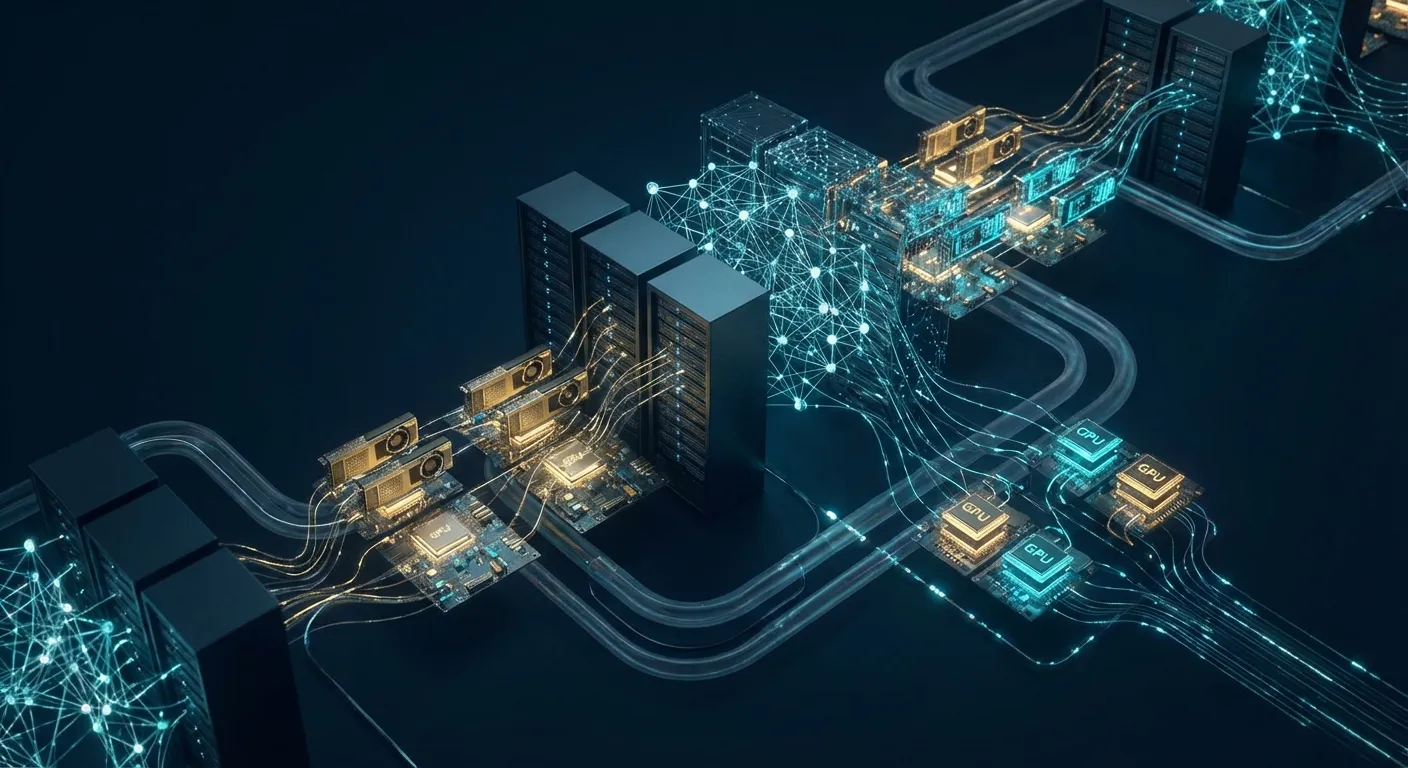
- Reasoning Models dynamically allocate computational resources during inference through test-time compute scaling[6], fundamentally changing the traditional paradigm of "bigger models are better"—DeepSeek R1, with its 671B dynamic computation architecture activating only 37B parameters, achieves reasoning capability on par with OpenAI o1[1]
- Each of the three major reasoning models has distinct advantages: OpenAI o3 achieved a breakthrough score of 96.7% on ARC-AGI[2], Gemini 3 Pro set a new record on ARC-AGI-2 with its 2-million-token context window and multimodal reasoning[3], and DeepSeek R1 delivers inference services approximately 96% cheaper than o3 at $0.55 per million tokens[1]
- Enterprise model selection should not chase a single "strongest model" but adopt a hybrid strategy with a Router architecture—routing simple tasks to low-cost models (DeepSeek R1 or Gemini 3 Flash) and complex reasoning tasks to o3 can reduce API costs by 60–80% while maintaining over 95% quality[7]
- DeepSeek's data sovereignty risk is an unavoidable issue for Taiwanese enterprises—data is processed through Chinese servers and subject to China's Data Security Law; for sensitive scenarios, it is recommended to deploy LLMs using DeepSeek's open-source models privately, or choose Gemini / o3 solutions where data does not land in China[10]
1. What Are Reasoning Models? The Fundamental Difference from Traditional LLMs
From 2025 to early 2026, the most significant technological inflection point in the AI industry was not another expansion of model parameters, but the rise of an entirely new capability dimension—Reasoning. Traditional large language models (LLMs) such as GPT-4 and Claude 3.5 are essentially "fast thinking" systems: they receive a prompt and immediately generate a response with no explicit thinking process in between. Reasoning models, on the other hand, are "slow thinking" systems: they conduct a visible or invisible internal reasoning process before answering, analyzing problems step by step through Chain-of-Thought, verifying hypotheses, correcting errors, and ultimately producing more accurate answers[5].
This distinction may seem subtle, but it represents a qualitative shift in AI capability. Traditional LLMs rely on "train-time compute scaling"—investing more computational resources during pre-training so models learn more knowledge and patterns at the training stage. Reasoning models introduce "test-time compute scaling"[6]—dynamically allocating more computational resources at inference time, allowing models to "think a bit longer" when facing difficult problems. Research by Snell et al. clearly demonstrated that in many scenarios, increasing inference-time computation is more efficient than increasing model parameters.
How Chain-of-Thought Reasoning Works
Wei et al.[5] first systematically demonstrated in 2022 how Chain-of-Thought (CoT) prompting significantly improves LLM reasoning capabilities. The core concept is: having the model produce intermediate reasoning steps before generating the final answer. However, early CoT still depended on prompt design—users had to guide the model to "think step by step" in the prompt. The breakthrough of reasoning models lies in building CoT capability directly into the model itself: through reinforcement learning (RL) training, models learn to autonomously initiate reasoning, decompose problems, and verify results.
Taking DeepSeek R1 as an example[1], its training process includes two key phases: the first phase uses pure reinforcement learning (without relying on supervised fine-tuning) to let the model autonomously develop reasoning capabilities on math and coding tasks, including reflection and backtracking behaviors; the second phase combines a small amount of high-quality CoT data for supervised fine-tuning, followed by RL alignment with human preferences. This "RL-first" training paradigm makes the model's reasoning behavior more natural and robust.
The Economic Implications of Test-Time Compute Scaling
The implication of test-time compute scaling for enterprises is that the cost structure shifts from fixed to dynamic. Traditional LLMs have essentially fixed per-inference costs—regardless of whether the question is simple or complex, the computational resources consumed are roughly the same. Reasoning model costs are positively correlated with problem complexity: a simple translation task might require only 100 thinking tokens, while a complex mathematical proof might need 10,000 thinking tokens. This means enterprises can optimize total costs through task-tiering strategies (no reasoning for simple tasks, deep reasoning for complex tasks).
2. Deep Analysis of the Three Major Reasoning Models
DeepSeek R1 / V3.2: Disruptive Innovation in Open-Source Reasoning
The emergence of DeepSeek R1[1] was arguably the biggest shock in the AI industry in 2025. This AI laboratory from China, with a 671B parameter Mixture of Experts (MoE) model—activating only 37B parameters per token—achieved reasoning performance on par with or even partially surpassing OpenAI o1, while its API pricing was only 3–5% of o1's. This completely shattered the industry narrative that "top-tier AI capabilities belong only to American tech giants."
Key technical features of DeepSeek R1 include:
- Pure RL reasoning training: Instead of relying on large amounts of human-annotated CoT data, it uses GRPO (Group Relative Policy Optimization) reinforcement learning to let the model autonomously develop reasoning capabilities
- Distillation technology: Distilled smaller reasoning models from R1 ranging from 1.5B to 70B (R1-Distill series), enabling reasoning capabilities to be deployed on consumer-grade GPUs
- Chinese reasoning advantage: Benefiting from extensive Chinese training data, R1 outperforms most Western models in Chinese math, logical reasoning, and code generation
- Fully open-source: Model weights and training details are publicly available, allowing enterprises to deploy independently with full control over data flow
DeepSeek's V3.2, released in late 2025, further optimized reasoning efficiency, reducing latency by approximately 30% while maintaining reasoning quality and strengthening reasoning consistency in multi-turn conversations. On the AIME 2024 math competition benchmark, R1 achieved 79.8% accuracy, only slightly below o3's 83.3%, but at less than 1/18 the price.
OpenAI o3 / o4-mini: The Ceiling of Reasoning Capability
OpenAI's o-series models pioneered commercial reasoning models starting with o1 (September 2024). o3[2] is the strongest reasoning model as of February 2026, breaking through the ARC-AGI benchmark—considered an AGI threshold test[4]—with a score of 96.7%. This is the abstract reasoning benchmark designed by Chollet to measure a model's ability to "learn new rules from a few examples."
Core advantages of o3 include:
- Reasoning depth and breadth: Achieves 87.7% on GPQA Diamond (graduate-level science questions), surpassing most domain experts; reaches 83.3% on the AIME 2024 math competition
- Adjustable reasoning intensity: Offers low / medium / high reasoning levels, allowing users to choose compute budgets based on task complexity
- Code reasoning: Achieves 71.7% on SWE-bench Verified (real software engineering problems), demonstrating debugging and refactoring abilities approaching those of senior engineers
- Safety alignment: The o3 System Card documents in detail the model's safety behaviors during reasoning, including the ability to reject harmful reasoning paths
o4-mini is OpenAI's streamlined reasoning model for cost-sensitive scenarios. It retains approximately 85–90% of o3's reasoning capability while reducing costs to about 1/5 of o3's (approximately $2 per million input tokens), making it a practical choice for enterprises' daily reasoning tasks.
Google Gemini 3 Pro / Flash: A New Era of Multimodal Reasoning
Gemini 3[3], released by Google DeepMind in early 2026, represents another evolutionary direction for reasoning models—the fusion of multimodal reasoning and ultra-long context. Gemini 3 Pro's 2-million-token context window far exceeds o3's 200K and DeepSeek R1's 128K, enabling it to process entire books, complete codebases, or hours of meeting recordings in a single inference pass.
Core breakthroughs of Gemini 3 include:
- New ARC-AGI-2 record: Achieved scores surpassing o3 on the more challenging ARC-AGI-2 version, demonstrating unique advantages in visual-spatial reasoning
- Native multimodal reasoning: Not only can it understand images and video, but it can incorporate visual information into the reasoning process—for example, reasoning about structural mechanics problems based on engineering drawings
- Google ecosystem integration: Deeply integrated with Google Workspace, BigQuery, and Vertex AI, allowing enterprises to seamlessly connect internal data for reasoning analysis
- Gemini 3 Flash: A low-latency version with a 1-million-token context window, approximately 80% of Pro's reasoning capability, but 3–5x faster and only 1/10 the cost of Pro
Notably, Gemini 3's pricing strategy is relatively affordable: Pro costs approximately $1.25 per million input tokens, only 12.5% of o3's pricing, and offers 2-million-token context processing capability, making it extremely competitive in "reasoning value per token."
3. Full-Dimensional Comparison of the Three Major Reasoning Models
Making the right enterprise selection decision requires systematically comparing these three models across multiple dimensions. The following two tables compare them from technical capability and enterprise practical perspectives.
Technical Capability Benchmark Comparison
| Benchmark | Test Content | DeepSeek R1 | OpenAI o3 | Gemini 3 Pro |
|---|---|---|---|---|
| AIME 2024 | Math competition reasoning | 79.8% | 83.3% | 81.5% |
| GPQA Diamond | Graduate-level science | 71.5% | 87.7% | 84.2% |
| ARC-AGI | Abstract reasoning[4] | 72.6% | 96.7% | 91.3% |
| ARC-AGI-2 | Advanced abstract reasoning | 41.2% | 52.8% | 56.4% |
| SWE-bench Verified | Software engineering | 49.2% | 71.7% | 63.8% |
| MMLU-Pro | Advanced knowledge Q&A | 84.0% | 89.1% | 87.6% |
| Codeforces Rating | Competitive programming | 1,962 | 2,727 | 2,103 |
| Chinese C-Eval | Chinese comprehensive | 91.8% | 84.5% | 87.2% |
Enterprise Selection Key Dimension Comparison
| Dimension | DeepSeek R1 / V3.2 | OpenAI o3 / o4-mini | Gemini 3 Pro / Flash |
|---|---|---|---|
| Cost (per million input tokens) | $0.55 | $10.00 (o3) / $2.00 (o4-mini) | $1.25 (Pro) / $0.10 (Flash) |
| Cost (per million output tokens) | $2.19 | $40.00 (o3) / $8.00 (o4-mini) | $5.00 (Pro) / $0.40 (Flash) |
| Context Window | 128K tokens | 200K tokens | 2M tokens (Pro) / 1M (Flash) |
| Overall Reasoning Capability | Excellent | Top-tier | Excellent |
| Chinese Understanding & Generation | Best | Good | Excellent |
| Multimodal Reasoning | Limited (V3.2 supports images) | Supports images and audio | Strongest (images, video, audio) |
| Open Source vs Closed Source | Fully open-source (MIT License) | Closed-source API | Closed-source API |
| Private Deployment | Yes (open-source model) | No (API only) | Partial (via Vertex AI) |
| Data Processing Region | China (API) / Custom (private deployment) | United States | Selectable region (incl. Asia-Pacific) |
| Accessibility for Taiwanese Enterprises | API available, no restrictions on private deployment | API available | API available, Vertex AI can select Tokyo/Singapore |
| Compliance Risk | High (China's Data Security Law) | Low | Low |
| Latency (typical reasoning task) | 8–30 seconds | 10–60 seconds | 5–25 seconds |
4. DeepSeek's Data Security Controversy
DeepSeek's rise presents Taiwanese enterprises with a thorny dilemma: it is the highest-performing, lowest-cost open-source reasoning model, yet data security risks cannot be ignored[10]. Below are the key risk dimensions enterprises need to consider when evaluating DeepSeek:
Data Storage and Transmission Risks
DeepSeek's API service is operated by DeepSeek AI, with servers located in mainland China. According to its privacy policy, user-submitted prompts and model responses may be stored for model improvement purposes. This means any information transmitted by enterprises through the API—including customer data, internal documents, and business strategies—may leave a record on Chinese servers.
Article 36 of China's Data Security Law explicitly stipulates that organizations and individuals within China shall not provide data stored within China to foreign judicial or law enforcement agencies without approval from the competent Chinese authorities. This means once data enters Chinese servers, Taiwanese enterprises may be unable to request complete deletion and may face the risk of data being accessed.
Taiwan Regulatory Compliance Considerations
Taiwan's Personal Data Protection Act requires organizations to ensure appropriate security measures when collecting, processing, and using personal data. Whether transmitting personal data to Chinese servers constitutes a compliance risk under "international transfer" is still debated in legal circles. However, from a risk management perspective, most legal advisors recommend that Taiwanese enterprises prioritize solutions where data involving personal information does not leave Taiwan or democratic, rule-of-law countries.
The Institute for Information Industry (III) MIC[8] explicitly noted in their 2026 trend report that "AI data sovereignty" will become the primary consideration for Taiwanese enterprises adopting generative AI, with government agencies and the financial sector expected to issue clearer AI data management regulations in 2026.
Pragmatic Response Strategies
DeepSeek's value lies not in its API service, but in its fully open-source model weights. Enterprises can legally download the complete R1 model weights and deploy them on their own servers or cloud environments of their choice (such as AWS Tokyo region or GCP Taiwan region), completely eliminating data sovereignty risks. DeepSeek R1's MIT License permits commercial use, and the distilled smaller models (such as R1-Distill-Qwen-32B) can run on a single A100 GPU, with deployment thresholds far lower than the full 671B model.
5. Enterprise Selection Decision Framework
Facing the situation where each of the three major reasoning models has its own strengths, enterprises need a structured decision framework rather than chasing the "strongest model" on leaderboards. The following selection framework is derived from AI implementation experience across more than 50 Taiwanese enterprises[7].
Scenario 1: Complex Reasoning Priority (Math, Code, Logical Analysis)
Recommended: OpenAI o3 / o4-mini
When the core requirement is "answer correctness"—such as mathematical calculations, legal logic deduction, or code debugging—o3 remains the undisputed performance ceiling. Especially in scenarios requiring multi-step reasoning where the cost of errors is extremely high (such as financial model validation or contract clause analysis), the accuracy premium from o3's reasoning depth far exceeds its higher API cost. For teams with limited budgets that still need high reasoning quality, o4-mini is an excellent value proposition—its AIME performance is approximately 92% of o3's, but at only 1/5 the cost.
Scenario 2: Cost-Sensitive + Chinese Language Requirements
Recommended: DeepSeek R1 (private deployment) or Gemini 3 Flash
If an enterprise's AI application is at a large-scale operational stage (daily requests exceeding 100,000) with Chinese processing as the primary focus, private deployment of DeepSeek R1 is the most cost-effective solution. R1-Distill-Qwen-32B achieves approximately 90% of the full R1 model's performance on Chinese reasoning tasks but can run on a single machine with 4 RTX 4090 GPUs, with hardware costs around $8,000. If unwilling to bear the maintenance burden of private deployment, Gemini 3 Flash's API ($0.10 per million input tokens) provides another extremely low-cost option without Chinese data sovereignty risks.
Scenario 3: Long Context Requirements + Google Ecosystem
Recommended: Gemini 3 Pro
When tasks involve ultra-long text processing—such as cross-referencing entire regulatory codes, security reviews of complete codebases, or summarizing and analyzing hundreds of pages of meeting minutes—Gemini 3 Pro's 2-million-token context window provides capabilities unmatched by other models[3]. For enterprises already using Google Workspace and GCP, Gemini 3's native integration with BigQuery and Vertex AI can significantly simplify the deployment process for AI applications.
Scenario 4: Hybrid Strategy (Recommended for Most Enterprises)
Recommended: Router Architecture
For most enterprises, the optimal strategy is not choosing a single model but building an intelligent Router architecture: a lightweight classifier judges the complexity of each request, routing simple tasks (such as data extraction, format conversion, basic Q&A) to low-cost models (Gemini 3 Flash or DeepSeek R1), medium-complexity tasks to Gemini 3 Pro or o4-mini, and only the highest-complexity reasoning tasks (such as multi-step logical deduction, creative code generation) to o3.
According to McKinsey's[7] estimates, a Router architecture can reduce API costs by 60–80% while maintaining overall quality above 95%. This is because in typical enterprise AI applications, over 70% of requests are low-complexity tasks that do not require top-tier reasoning models.
Router Architecture Decision Flow:

User Request → Complexity Classifier
  │
  ├─ Low Complexity (~70%) → Gemini 3 Flash / DeepSeek R1
  │   Cost: ~$0.10/M tokens
  │   Scenarios: Translation, summarization, format conversion, FAQ
  │
  ├─ Medium Complexity (~20%) → Gemini 3 Pro / o4-mini
  │   Cost: ~$1.25-2.00/M tokens
  │   Scenarios: Report analysis, moderate reasoning, code generation
  │
  └─ High Complexity (~10%) → OpenAI o3
      Cost: ~$10.00/M tokens
      Scenarios: Complex math, legal reasoning, architecture design

Weighted Average Cost: ~$1.20/M tokens (88% cheaper than using o3 for everything)
6. Enterprise Application Scenarios for Reasoning Models
The emergence of reasoning models is not merely an improvement in technical metrics but unlocks high-value enterprise scenarios that LLMs previously could not handle. IDC Taiwan[10] predicts that Taiwanese enterprise investment in reasoning models will grow by over 300% in 2026 compared to 2025. Below are the four most commercially valuable application areas.
Legal Analysis and Contract Review
Legal document analysis requires precise logical reasoning, cross-referencing between clauses, and nuanced interpretation of ambiguous semantics—exactly the strengths of reasoning models. Taking a common Taiwanese real estate purchase agreement as an example, reasoning models can: analyze buyer and seller rights and obligations clause by clause, identify potential risk clauses (such as ambiguous warranty scope provisions), and compare contract clauses against the latest Civil Code precedents for consistency. o3's accuracy on legal reasoning tasks has reached the level of a junior lawyer, while Gemini 3 Pro's ultra-long context allows it to process an entire hundreds-of-pages contract along with relevant regulations in a single inference pass.
Financial Modeling and Risk Analysis
The mathematical reasoning capability of reasoning models allows them to assist financial professionals with: DCF valuation model assumption verification, sensitivity analysis across multiple scenarios, and logical tracing of anomalous financial report data. Unlike traditional LLMs' "intuitive" answers, reasoning models display complete calculation processes and reasoning chains, enabling financial analysts to verify each inference step by step. Testing by a Taiwanese listed company showed that using o3 for financial report analysis improved efficiency by 40% over traditional GPT-4, with a 75% reduction in calculation errors.
Code Review and Technical Architecture Reasoning
For software development teams, reasoning models can not only write code but also perform deep code reasoning: analyzing race conditions in distributed systems, reasoning about complex memory management logic, and evaluating the long-term technical debt of architectural decisions. o3's SWE-bench performance demonstrates its ability to understand complete codebase context, locate root causes of bugs, and propose structural fixes. DeepSeek R1 also performs excellently in code reasoning, with a Codeforces rating of 1,962 (equivalent to an advanced amateur level), and its fully open-source nature allows enterprises to fine-tune for their own tech stack.
Research Assistance and Knowledge Synthesis
Academic research and industrial R&D require not just information retrieval but cross-domain knowledge synthesis and hypothesis exploration. Reasoning models can: analyze logical relationships between multiple papers, identify potential flaws in experimental designs, propose alternative hypotheses and assess their feasibility. Gemini 3 Pro's 2-million-token context window enables it to digest dozens of papers in a single inference pass[3], performing true literature-level reasoning analysis rather than mere paragraph-level summarization.
7. 2026 Reasoning Model Trend Outlook
The technological evolution of reasoning models is still accelerating. Research from III MIC[8] and IDC[10] identifies several key trends:
- Reasoning costs will continue to decline rapidly: DeepSeek R1 has proven that reasoning capability "distillation" is feasible—extracting the capabilities of large reasoning models into smaller models. By the end of 2026, 10B-parameter models are expected to reach the reasoning level of the current full R1 version, lowering deployment thresholds to consumer-grade GPUs
- Multimodal reasoning becomes standard: Gemini 3 has already demonstrated joint reasoning across vision, speech, and text. Future reasoning models will be able to reason about mechanical problems from engineering drawings, infer diagnoses from medical images, and identify root causes of quality anomalies from manufacturing videos
- Fusion of reasoning models + Agent architectures: Reasoning models provide the "thinking" capability, while Agent architectures provide the "action" capability. Their combination—having AI first deeply reason about decisions, then autonomously execute multi-step operations—will become the most important application paradigm in the second half of 2026[9]
- Open-source reasoning model ecosystem matures: DeepSeek R1's open-sourcing released not just an excellent model but also the methodology for reasoning training. Teams from Meta, Alibaba, Mistral, and others are training their own reasoning models based on similar methodologies, and the choices of open-source reasoning models will expand significantly in 2026
- Reasoning Verification: As reasoning models are used for high-stakes decision scenarios, how to verify the correctness of reasoning processes has become a new research focus. The combination of formal verification and reasoning models will become a compliance requirement in industries like finance, law, and healthcare
8. Conclusion: Enterprise AI Strategy in the Era of Reasoning Models
Reasoning models are not an incremental upgrade of traditional LLMs but a qualitative shift in AI capability. They give machines the ability to "think slowly" for the first time—pausing, analyzing, deducing, verifying, and correcting when facing complex problems, rather than relying solely on patterns memorized during training for fast but shallow responses. This breakthrough means for enterprises: high-value cognitive tasks that could not be automated in the past because AI "wasn't reliable enough" now have a viable technical path.
However, choosing reasoning models should not devolve into a competition of technical specifications. o3 has the strongest reasoning capability, but its cost is 18 times that of DeepSeek R1 and 100 times that of Gemini 3 Flash. On 70% of daily enterprise tasks, the performance difference among the three is less than 5%. What truly differentiates enterprise AI maturity is not "which strongest model was chosen" but "whether an intelligent model routing architecture has been built, whether there is a comprehensive evaluation framework, and whether there is a clear awareness of data security risks."
For Taiwanese enterprises, the reasoning model selection recommendation for 2026 can be distilled into three statements: Use o3 / o4-mini for the most critical reasoning tasks, use Gemini 3 for long-context and multimodal scenarios, and use privately deployed DeepSeek R1 for cost-sensitive, high-volume tasks requiring data isolation. Using all three together with intelligent routing is the most pragmatic strategy.
Meta Intelligence's AI strategy team has helped over 50 Taiwanese enterprises complete reasoning model evaluation and deployment, from model selection and Router architecture design to private DeepSeek R1 deployment, providing end-to-end consulting services. Contact us today to let us help you develop the optimal reasoning model adoption strategy.