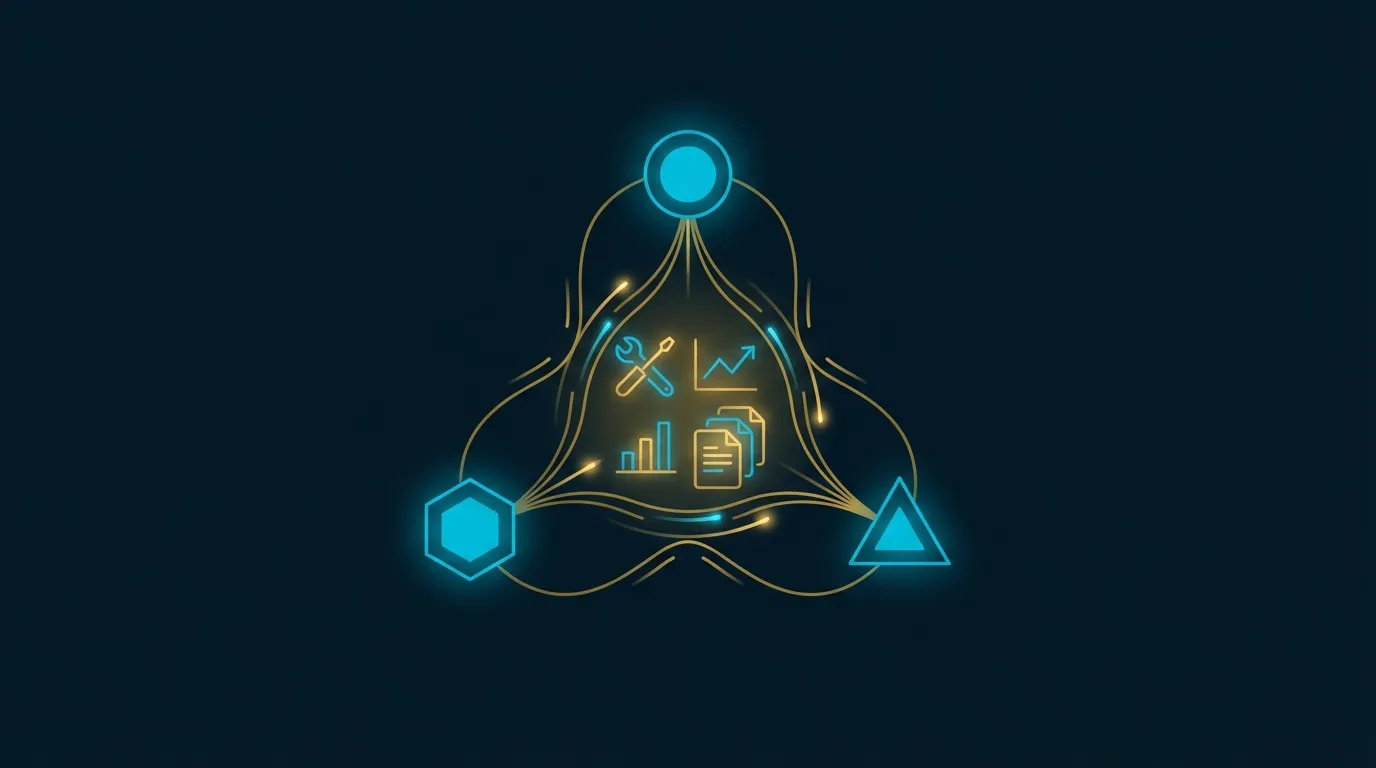
- Agentic Workflow represents a paradigm shift in AI from "passive response" to "autonomous decision-making" — Agents can independently perceive their environment, formulate plans, call tools, and iteratively correct based on results, achieving end-to-end task automation
- The ReAct framework unifies Reasoning and Acting in an alternating loop and is currently the most widely adopted single-agent design pattern; Plan-and-Execute decouples high-level planning from low-level execution through a layered architecture, making it better suited for long-horizon complex tasks
- Memory management (short-term, long-term, working memory) and tool usage (Function Calling, MCP protocol) are the two foundational infrastructures of Agent systems, determining the agent's contextual coherence and real-world operational capability
- Multi-Agent Collaboration extends single-agent capability boundaries to team level through role division, message passing, and consensus mechanisms. Frameworks like MetaGPT and ChatDev have demonstrated initial results in software engineering
I. From Conversation to Action: The Paradigm Shift of Agentic AI
Over the past three years, large language model (LLM) applications have rapidly evolved from simple question-and-answer conversations to Agent systems capable of autonomously completing complex tasks. The core of this transformation is: traditional LLM applications are reactive — the user asks, the model answers, and the interaction ends; whereas Agentic Workflow is autonomous — the Agent receives a high-level goal and can independently plan steps, call tools, evaluate intermediate results, and dynamically adjust strategies based on feedback until the task is complete[2].
Wang et al. in their survey research[2] summarize the core architecture of LLM-based Agents into four modules: Perception, Planning, Action, and Memory. These four modules work together to form a complete cognitive loop. The Perception module receives and understands inputs from users and the environment; the Planning module decomposes complex tasks into executable sub-steps; the Action module interacts with the external world through tool calls; and the Memory module ensures the Agent maintains contextual coherence throughout multi-step execution.
Xi et al.'s research[3] further points out that the rise of Agentic AI is not coincidental — it is the convergence of LLM capability breakthroughs, tool ecosystem maturity, and engineering framework refinement. When LLM reasoning capabilities are sufficient for multi-step planning, Function Calling becomes a native model capability, and frameworks like AI Agent frameworks and CrewAI lower the barrier to Agent development, Agentic Workflow naturally becomes the mainstream paradigm for AI applications.
From a business value perspective, the core appeal of Agentic Workflow lies in its ability to automate "cognitively intensive" workflows. Market research that previously required analysts to spend hours, code reviews that needed iterative engineering effort, and contract analysis requiring legal specialists to compare clause by clause can now be completed by Agent systems within minutes for initial results. This is not about replacing humans, but about liberating humans from repetitive cognitive labor, allowing professionals to focus on higher-level decisions and creativity.
II. The ReAct Framework: Unifying Reasoning and Action
ReAct (Reasoning + Acting) is an Agent design pattern proposed by Yao et al. in 2023[1], with a core insight that is both simple and profound: let the LLM alternate between "thinking" and "acting" rather than completing all thinking before taking action at once. This interleaved architecture enables the Agent to adjust subsequent reasoning based on the actual results of each action, significantly improving robustness in uncertain environments.
Specifically, the ReAct loop consists of three phases: Thought — the Agent analyzes the current state and decides what to do next; Action — the Agent calls an external tool to execute a specific operation; Observation — the Agent receives the tool's returned result and incorporates it into subsequent thinking. These three phases cycle repeatedly until the Agent determines it has gathered sufficient information to produce a final answer.
ReAct's technical advantage is that it simultaneously solves two problems[1]. First, pure reasoning (like Chain-of-Thought) lacks the ability to interact with the external world and is prone to hallucinations — the Agent might "imagine" facts that don't exist. ReAct introduces real-world signals through tool calls, providing a factual foundation for the reasoning process. Second, pure action (like traditional API orchestration) lacks flexible reasoning ability — the system can only execute pre-defined flows and cannot handle unexpected situations. ReAct's thinking phase allows the Agent to dynamically adjust strategies based on observed anomalies.
Here is a typical ReAct execution trace:
Goal: Analyze a company's 2025 Q4 earnings and compare with industry peers

[Thought] I need to first obtain the company's Q4 earnings data.
[Action] search("Company Name 2025 Q4 earnings revenue net income")
[Observation] Revenue $12B, net income $1.8B, YoY growth 15%.
[Thought] I have the target company's data, now I need peer data for comparison.
[Action] search("Peer companies 2025 Q4 earnings revenue")
[Observation] Peer A revenue $9.5B, Peer B revenue $14B.
[Thought] I can calculate market share and produce a comparative analysis.
[Action] calculator("120 / (120 + 95 + 140) * 100")
[Observation] 33.8%
[Final Answer] The company's Q4 revenue was $12B, with approximately 33.8% market share...
In engineering practice, ReAct has become the default mode for most Agent frameworks — LangGraph's create_react_agent, LangChain's AgentExecutor, and CrewAI's internal execution engine all follow the ReAct think-act-observe loop at their core. The widespread adoption of this framework signals broad consensus in the AI community that reasoning and action should be unified.
III. Plan-and-Execute: Layered Planning Architecture
ReAct's step-by-step reasoning performs excellently in short-range tasks, but when facing long-range tasks requiring dozens of steps, it often exhibits goal drift — the Agent gradually deviates from the original objective after multiple rounds of interaction. The Plan-and-Execute architecture was proposed precisely to address this problem[10].
The core idea of Plan-and-Execute is to separate Planning and Execution into two independent layers. The high-level Planner receives the user's goal and generates a structured plan (typically a series of ordered subtasks); the low-level Executor sequentially executes each subtask, reporting results back to the Planner after each step. The Planner then decides whether to proceed with the next step, modify the subsequent plan, or re-plan the entire strategy based on the reported results.
This layered architecture brings three key advantages. First is global consistency — the Planner always maintains a view of the overall plan and won't lose sight of the big picture due to local tool call results. Second is plan correctability — when a subtask fails or produces unexpected results, the Planner can dynamically modify subsequent steps without starting from scratch. Finally, explainability — structured plans enable human reviewers to inspect and modify the plan before the Agent executes, which is critical for enterprise applications.
Sumers et al. in their cognitive architecture research[10] draw an analogy between Plan-and-Execute and the human "prefrontal cortex" function — responsible for setting goals, decomposing tasks, and monitoring execution progress. This cognitive-level separation enables the Agent to operate effectively at both the abstract level (strategic thinking) and the concrete level (operational execution) simultaneously.
At the implementation level, LangGraph provides native Plan-and-Execute mode: developers can create a "Planner node" for generating plans, an "Executor node" for executing subtasks, and a "Replanner node" for adjusting plans based on execution results. The loop formed by these three nodes is better suited than pure ReAct for handling enterprise tasks requiring long-term strategic planning, such as multi-stage due diligence, cross-departmental project management, or multi-step data analysis pipelines.
IV. Memory Management: Short-Term, Long-Term, and Working Memory
Memory is the most easily underestimated yet most profoundly impactful module in Agent systems. An Agent without effective memory management is like an assistant who loses memory every few minutes — it might repeatedly ask the same questions, forget previously collected information, or fail to learn from past mistakes[3].
Borrowing from cognitive science frameworks, Agent memory can be divided into three categories[10]:
Short-term Memory corresponds to the LLM's Context Window. It stores immediate information from the current conversation or task, including user instructions, tool call results, and the Agent's intermediate reasoning. The main limitation of short-term memory is capacity — even the most advanced models have finite context windows. When a complex task's execution trace exceeds the context window, early information gets truncated, causing the Agent to lose critical context.
Long-term Memory is the Agent's persistent knowledge base across sessions and tasks. Implementation typically uses vector databases (like Pinecone, Weaviate) or structured databases. Agents can write important observations, learned patterns, and user preferences to long-term memory, retrieving relevant knowledge via semantic retrieval in subsequent tasks. Park et al.'s generative agents research[5] demonstrated an elegant long-term memory system — each agent maintains a "memory stream," with the system ranking and retrieving memories along three dimensions: recency, importance, and relevance.
Working Memory is a refined version of short-term memory. Rather than storing all raw conversation history, it maintains a compressed and structured "task state summary." For example, a research Agent's working memory might contain: "list of collected data points," "hypotheses to verify," and "current analysis progress." The purpose of working memory is to maximize the information density available to the Agent within limited context space.
In engineering practice, effective memory management strategies typically combine all three: using short-term memory for immediate interactions, working memory for maintaining task state, and long-term memory for accumulating cross-task knowledge. LangGraph's Checkpointer mechanism provides good support at the working memory level, while vector database integration addresses long-term memory needs.
V. Tool Usage: Enabling Agents to Operate in the Real World
If the LLM is the Agent's "brain," then Tools are the Agent's "hands and feet." An Agent without tools can only reason based on training data, unable to obtain real-time information, perform calculations, or operate external systems. Tool usage capability is the critical turning point where an Agent transforms from a "language model" into an "autonomous system"[2].
From a technical implementation perspective, tool usage involves three core aspects. Tool Selection — the Agent must choose the most suitable tool from the available set based on current task requirements. When tools are few, the LLM can directly list all tool descriptions in the prompt; when tools exceed dozens, a semantic index of tools is needed, dynamically loading relevant tools through retrieval matching. Parameter Generation — the Agent must produce structured inputs conforming to tool schemas (typically JSON format). Modern LLMs' Function Calling capabilities have significantly improved parameter generation accuracy, but errors still occur with complex nested structures or ambiguous user instructions. Result Parsing — the Agent must understand tool return results and integrate them into subsequent reasoning.
AutoGPT[7] was one of the earliest autonomous Agent experiments to attract widespread attention, demonstrating how an Agent could autonomously complete complex tasks by chaining web search, file operations, code execution, and other tools. While AutoGPT still has reliability shortcomings, it validated the central role of tool usage in Agentic Workflow.
In recent years, Anthropic's Model Context Protocol (MCP) is bringing standardization to the Agent tool ecosystem. MCP defines a universal protocol that allows any tool provider to expose functionality to Agents through a unified interface, while Agents can discover, call, and manage tools through standardized methods. This protocol-level standardization promises to resolve the current incompatibility between different frameworks' tool interfaces, significantly reducing the engineering cost of tool integration.
In enterprise scenarios, tool usage security is a critical concern. Tools called by Agents may involve irreversible operations such as database writes, API calls, or even financial transactions. Therefore, production-grade Agent systems must establish strict permission control mechanisms — defining which tools require human review before execution, which operations need secondary confirmation, and rollback strategies when anomalies occur.
VI. Multi-Agent Collaboration: Division of Labor, Communication, and Consensus
A single Agent's capability ultimately has its limits — when task complexity exceeds what one Agent can handle, distributing the task among multiple specialized Agents for collaborative completion becomes a natural extension. Multi-Agent Collaboration is the critical step in Agentic Workflow's evolution from "individual intelligence" to "collective intelligence"[4].
The design space of multi-agent collaboration can be understood along three dimensions. Division of Labor defines how tasks are distributed among Agents. The most direct approach is static division — each Agent is pre-assigned to handle specific types of subtasks (e.g., researcher for data collection, analyst for data analysis, writer for report writing). A more advanced approach is dynamic division — a "manager Agent" decides task allocation in real-time based on task characteristics and each Agent's current state. MetaGPT[8] adopted an interesting hybrid strategy: borrowing from standardized software engineering processes, organizing Agents into roles such as product manager, architect, engineer, and tester, each with clearly defined responsibilities and deliverable specifications.
Communication Mechanisms determine how Agents exchange information. Wu et al. in AutoGen[4] adopted a conversation-driven communication model — Agents share observations, raise questions, and reach consensus through natural language dialogue. This approach is intuitive and flexible but may lead to lengthy conversations and token consumption. MetaGPT[8] introduced the concept of "structured messages" — Agents exchange not free-form dialogue but pre-defined format documents (such as requirement documents, design documents, code), significantly improving communication efficiency.
Consensus and Conflict Resolution is the most challenging aspect of multi-agent systems. When two Agents reach contradictory conclusions about the same problem, the system needs a mechanism to adjudicate the conflict. Common strategies include: voting (majority rule), authority-based (a designated arbitrating Agent decides), and debate-based (conflicting parties present their arguments, then a third-party Agent judges). ChatDev[9] demonstrated a conversational consensus mechanism in its software development process, where designers and engineers gradually aligned their understanding of requirements through multiple rounds of communication, effectively reducing rework caused by poor communication.
From practical experience, the design principle for multi-agent systems is "don't use multiple Agents for a problem that a single Agent can solve." Introducing multiple Agents brings significant increases in communication overhead, coordination complexity, and debugging difficulty. Only when a task truly requires the integration of multiple specialized capabilities, and a single Agent cannot complete it within a reasonable context length, is multi-agent collaboration the justified choice.
VII. Reflexion: Self-Reflection and Learning
A large part of why humans can continuously improve depends on the ability to learn from failure — we review our mistakes, analyze causes of failure, and avoid repeating them in subsequent attempts. The Reflexion framework proposed by Shinn et al.[6] is a systematic attempt to introduce this self-reflection capability into AI Agents.
Reflexion's operating mechanism contains three key components. The Actor is the Agent responsible for executing the task, generating actions based on the current environment state and memory. The Evaluator assesses the Actor's execution results — determining whether the task was successfully completed, what was done well, and what needs improvement. The Self-Reflection module is the core innovation — it converts the Evaluator's feedback into natural language reflection summaries (e.g., "I made a mistake in my last attempt: I directly searched for the entire question, I should have first decomposed the question into sub-questions and searched each one"), and stores these reflections in long-term memory. In subsequent task executions, the Agent retrieves relevant reflections from memory to avoid repeating the same mistakes.
The most striking feature of Reflexion is that it doesn't require updating model weights — all learning is accomplished through natural language reflection summaries stored in external memory. This means the Agent can continue learning after deployment without expensive model fine-tuning or retraining. Shinn et al.'s experiments showed[6] that in code generation tasks, Agents that went through three to five rounds of reflective iteration improved their success rate from a baseline of 67% to 91%, demonstrating the enormous potential of the self-reflection mechanism.
In the context of Agentic Workflow, Reflexion can be integrated into the outer loop of ReAct or Plan-and-Execute. Specifically, the Agent first attempts to complete the task using ReAct; if it fails, the Reflexion module intervenes to analyze the cause of failure and generate a reflection summary; the Agent incorporates the reflection into its next attempt and adjusts its strategy. This "attempt → reflect → retry" loop enables the Agent to gradually converge to the correct solution in subsequent iterations even if the initial attempt fails.
However, Reflexion also faces some limitations. First, the quality of self-reflection is highly dependent on the LLM's metacognitive ability — the model needs to accurately identify its own mistakes rather than producing erroneous reflections. Second, too many reflection memories may introduce noise and interfere with subsequent decisions. In engineering practice, we recommend setting capacity limits on reflection memory and performing periodic cleanup and consolidation.
VIII. Design Principles for Enterprise-Grade Agent Systems
From laboratory AI PoC proof-of-concept to reliable production deployment, Agent systems need to cross an engineering chasm. Based on our experience at Meta Intelligence helping enterprise clients adopt Agent technology, the following design principles are key to building enterprise-grade Agent systems[2][3].
Principle 1: Graduated Autonomy. Don't try to build a fully autonomous Agent in one shot. Start with a human-led, Agent-assisted mode (e.g., the Agent generates suggestions, humans confirm before execution), gradually expanding the Agent's autonomous authority. The benefit is that teams can progressively build trust in the Agent in a low-risk environment while continuously collecting real execution data to improve the system.
Principle 2: Guardrails First. When designing the Agent's action space, prioritize defining "what it cannot do" over "what it can do." This includes: input validation (rejecting clearly unreasonable task instructions), output filtering (intercepting responses that may contain sensitive information), action restrictions (setting human review gates for high-risk operations), and cost controls (setting maximum token consumption or API call limits per task). The design principle for guardrails is "better too strict than too loose" — you can gradually relax after verifying safety, but an overly permissive initial design may lead to irreversible consequences.
Principle 3: Observability. Production-grade Agent systems must have complete observability — every step of the reasoning process, tool call inputs and outputs, and the basis and results of decisions all need to be recorded and tracked. This is not only for debugging (quickly locating problems when the Agent behaves unexpectedly) but also for compliance (in regulated industries, enterprises need to be able to explain AI system decision logic to regulators). Tools like LangSmith and Phoenix provide Agent-level observability platforms worth adopting in production environments.
Principle 4: Fault Tolerance and Graceful Degradation. Every external dependency of the Agent system (LLM API, search services, databases) can fail. Design must account for: retry strategies and exponential backoff for API call failures, parsing tolerance when LLM response formats don't match expectations, degradation options when tool calls time out (such as skipping the step or using cached results), and rollback mechanisms when the overall task fails.
Principle 5: Cost-Efficiency Optimization. Token consumption in multi-Agent systems can be substantial — every round of conversation between Agents consumes prompt and completion tokens. Engineering optimization strategies include: using smaller models (like GPT-4o-mini) for simple subtasks, invoking top-tier models only when deep reasoning is needed; caching tool call results to avoid redundant queries; and setting conversation round limits to prevent Agents from falling into infinite loops.
IX. Conclusion and Outlook
Agentic Workflow represents a fundamental transformation in AI applications from "conversational" to "action-oriented." From ReAct's reasoning-action loop, to Plan-and-Execute's layered planning, to multi-agent collaboration's collective intelligence, the capability boundaries of Agent systems are expanding at a remarkable pace[2]. Reflexion's self-reflection mechanism further provides an elegant solution for continuous Agent learning[6].
However, we must also soberly recognize current limitations. Agent system reliability is still not sufficiently stable — in long-range tasks, LLM reasoning biases accumulate progressively, leading to unpredictable behavior. Debugging multi-agent systems is extremely difficult — when multiple Agents interact in complex topologies, tracing root causes often requires extensive log analysis. Security and compliance challenges also grow more severe as Agent autonomy expands.
Looking ahead, we see three converging trends reshaping the Agentic AI landscape. First, the rise of agent-native models — next-generation LLMs will be optimized for Agent scenarios from the pre-training stage, including more precise tool calling, more robust multi-step planning, and native memory management capabilities. Second, tool ecosystem standardization — open protocols like MCP are establishing universal standards for Agent tool usage, which will foster a thriving tool marketplace where Agents can gain new capabilities in a plug-and-play manner. Third, Agent-as-a-Service business models — enterprises won't need to build Agent systems from scratch but can complete specific tasks by calling pre-built professional Agents via APIs.
For enterprises, Agentic Workflow provides an unprecedented opportunity — automating knowledge-intensive workflows through Agent systems, significantly improving operational efficiency and decision quality without substantially increasing labor costs. Whether you start with a simple ReAct tool-calling Agent or directly tackle the complexity of multi-agent collaboration, the key is to start building now. In this period of rapid Agent technology evolution, the accumulation of hands-on experience is far more valuable than the accumulation of theoretical knowledge.
If your team is evaluating Agentic Workflow adoption plans or would like to learn more about specific Agent design patterns, feel free to contact us. Our research team continuously tracks the latest developments in Agent architecture and can assist you through the entire journey from proof-of-concept to production deployment.