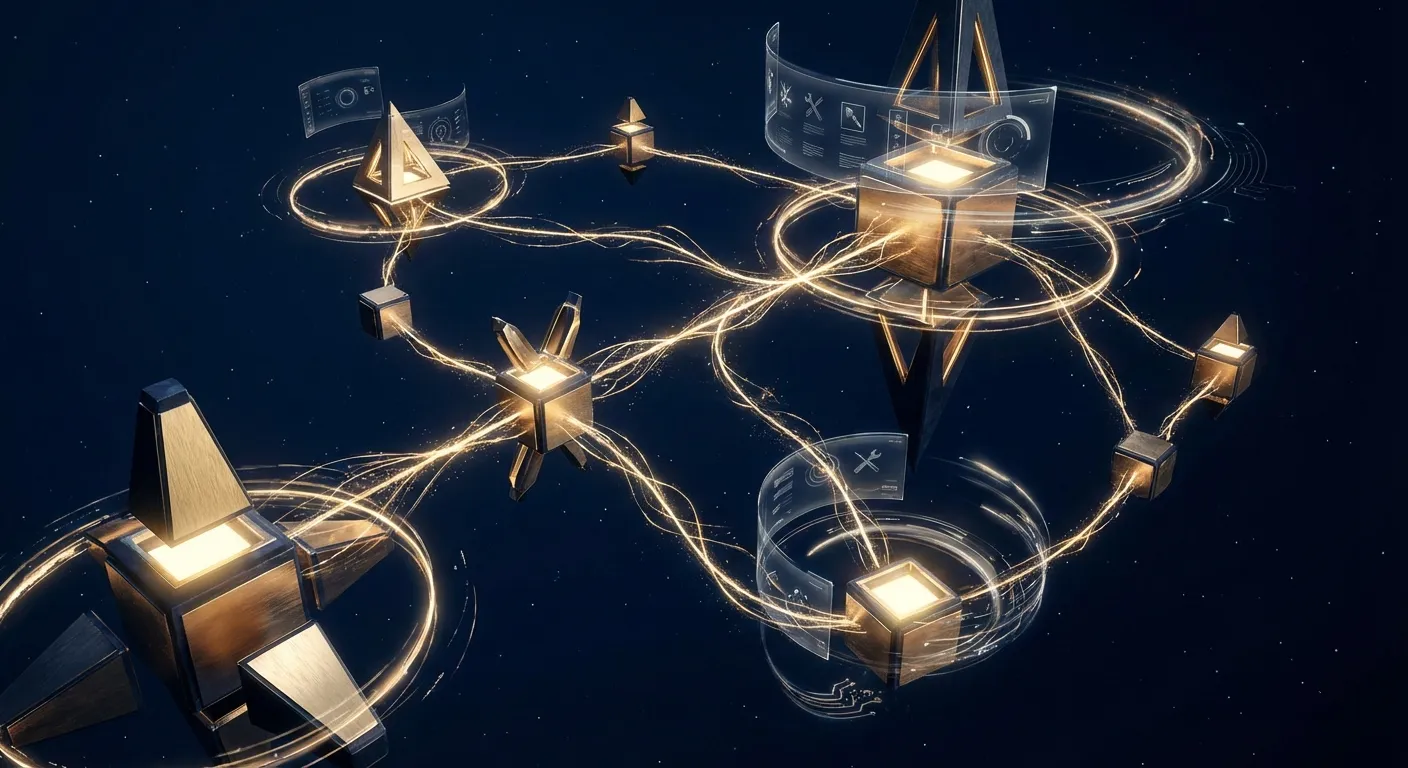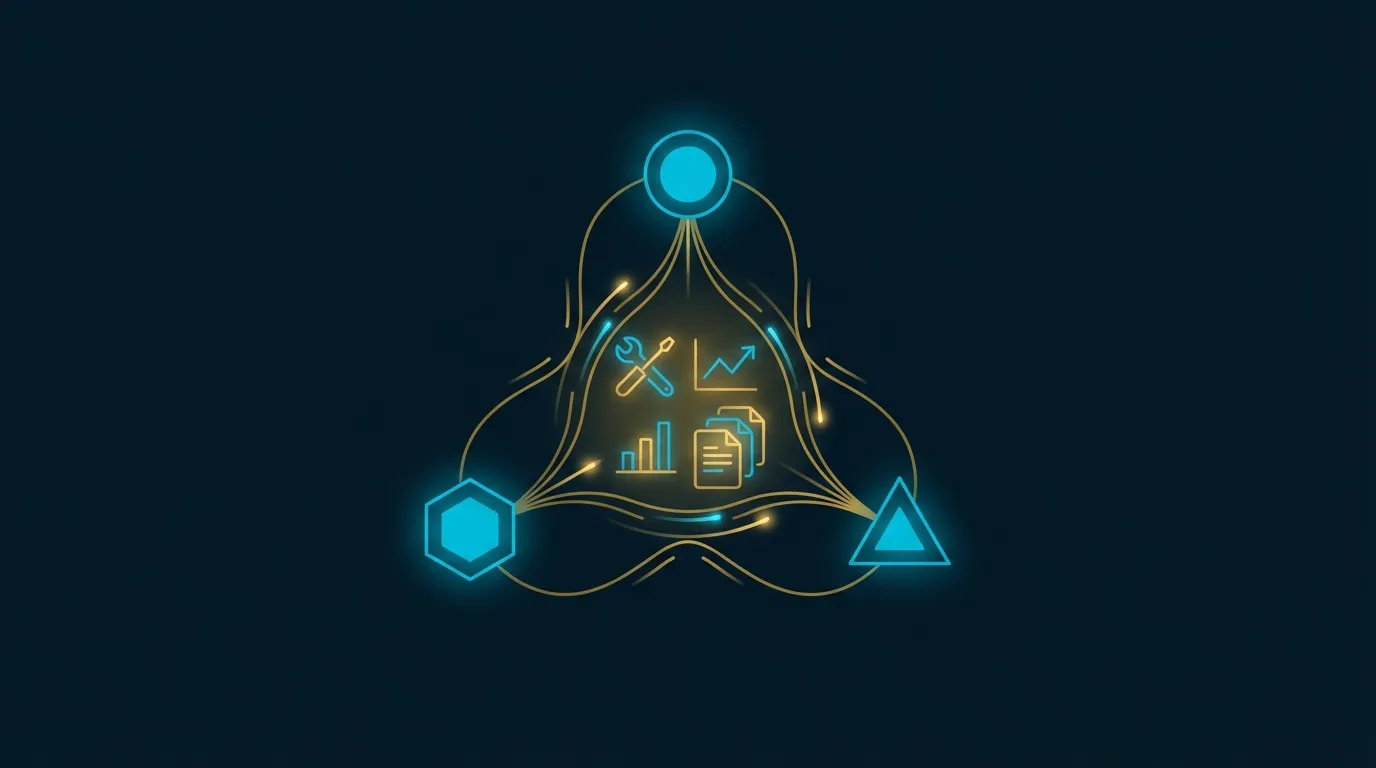
- A2A (Agent-to-Agent) and MCP (Model Context Protocol) are two fundamentally different yet highly complementary protocols — A2A handles communication and task delegation between agents, while MCP standardizes agent connections to external tools and data sources
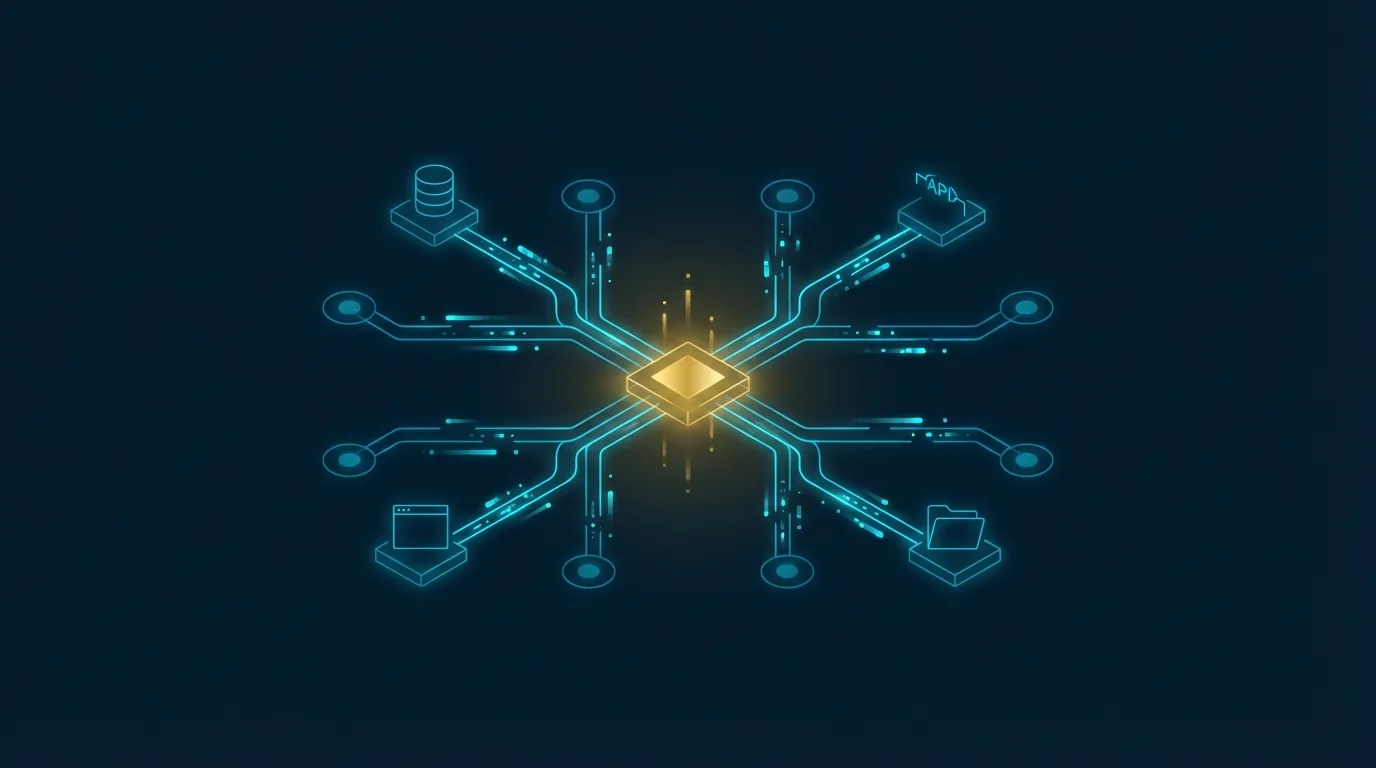
- Together they form a complete AI Agent interoperability architecture: MCP handles "vertical integration" (agents connecting downward to the tool layer), while A2A handles "horizontal integration" (lateral collaboration between agents), jointly eliminating fragmentation in enterprise multi-agent systems
- The Linux Foundation incorporated both A2A and MCP into open standard governance by late 2025. Major vendors including Google, Anthropic, Microsoft, and Salesforce have committed to jointly advancing protocol evolution, with the first joint interoperability specification expected in Q3 2026
- Enterprises can adopt a "MCP first, A2A gradually" approach — starting with MCP to integrate internal tools and knowledge bases, then using A2A to enable cross-departmental and cross-organizational agent collaboration, reducing deployment risk while accelerating value realization
I. The Core Challenge of AI Agent Interoperability: Why Standardized Protocols Are Needed
From 2025 to 2026, Agentic AI has moved from proof-of-concept to enterprise-grade deployment. Gartner predicts that by 2028, over 33% of enterprise software interactions will be completed through AI Agents[4]. However, as the number of agents deployed by enterprises grows from single digits to dozens or even hundreds, a fundamental challenge emerges: these agents cannot communicate efficiently with each other, nor do they have a unified way to connect with external tools and data sources.
McKinsey's global survey shows that over 72% of enterprise AI projects encounter bottlenecks during the integration phase[9]. This is not because individual agents lack capability, but because each agent uses different frameworks, different communication formats, and different tool connection methods. When a customer service agent built with an AI Agent framework needs to request a report from an analytics agent built with CrewAI, engineers must write extensive glue code to bridge the two — this is the cost of fragmentation.
1.1 Two Layers of Fragmentation: Horizontal Communication and Vertical Connection
Upon deeper analysis, we can categorize agent system fragmentation into two dimensions:
Horizontal Fragmentation (Agent-to-Agent): There is no standardized communication protocol between different agents. Team A's agent uses REST API, Team B's agent uses gRPC, and Team C's agent uses a custom WebSocket protocol. Each pair of agents requires a custom adapter layer, creating N×N integration complexity.
Vertical Fragmentation (Agent-to-Tool): Each agent connects to external tools (databases, APIs, file systems) differently. Even when two agents need to query the same CRM system, they may use entirely different access logic — one calls the REST API directly, another goes through an SDK wrapper, and a third connects via SQL directly.
Agent System Fragmentation Diagram:

Horizontal Fragmentation (Inter-Agent Communication):
  Agent A ───[Custom REST]──→ Agent B
  Agent A ───[gRPC Adapter]───→ Agent C
  Agent B ───[WebSocket]────→ Agent C
  (Each agent pair requires independent adaptation)

Vertical Fragmentation (Agent-Tool Connection):
  Agent A ──→ CRM (REST API v1)
  Agent B ──→ CRM (SDK Wrapper)
  Agent C ──→ CRM (Direct SQL)
  (Same tool, three different access methods)
Google's A2A protocol[1] and Anthropic's MCP protocol[2] address these two dimensions respectively, offering standardized solutions. Understanding the positioning differences and complementary nature of these two protocols is foundational for designing enterprise-grade multi-agent systems.
1.2 Why One Protocol Cannot Solve Everything
A common misconception in the industry is that A2A and MCP are competitors, and ultimately only one "winner" will remain. The truth is precisely the opposite — they solve different dimensional problems, just as TCP/IP handles network transport while HTTP handles application-layer communication. The two not only do not conflict but are both indispensable.
Agent-tool interactions (vertical connections) have strongly structured characteristics: input parameters have explicit schemas, return values have fixed formats, and operations are atomic. This is exactly MCP's forte. Agent-to-agent communication (horizontal connections), however, more closely resembles human collaboration: requiring negotiation of task allocation, synchronization of progress status, handling long-running asynchronous tasks, and even streaming intermediate results. These requirements exceed MCP's design scope, which is precisely where A2A's core capabilities shine.
II. Deep Dive into the A2A Protocol: A Universal Language for Agent Communication
Google publicly released the A2A (Agent-to-Agent) protocol in April 2025[1], quickly gaining support from over 50 technology companies, including Atlassian, Box, Cohere, Intuit, MongoDB, PayPal, Salesforce, and SAP. A2A's design goal is clear: to establish a universal communication standard for heterogeneous agent systems, enabling agents built with different frameworks and by different vendors to collaborate seamlessly.
2.1 Core Concepts: Agent Card, Task, and Message
A2A's architecture revolves around three core concepts:
Agent Card: Each agent publishes a "business card" in JSON format, describing its capabilities, supported input/output formats, authentication requirements, and service endpoint. Agent Cards are similar to the service discovery mechanism in microservice architectures — when an agent needs assistance, it can query registered Agent Cards to find suitable collaborators.
Task: The core work unit in A2A. A Task represents a work item delegated from one agent to another, with a clear lifecycle (submitted → working → input-required → completed / failed / canceled). Task design supports long-running operations: agents can progressively complete tasks over seconds, minutes, or even days, synchronizing with the delegating party through status updates.
Message: The carrier for exchanging information between agents. Each Message contains one or more Parts (text, files, structured data), supporting multimodal content. The Message design allows agents to engage in multi-turn conversations like human colleagues — asking questions, requesting clarification, providing intermediate results, and reporting final outputs.
A2A Protocol Core Architecture:

┌─────────────────────────────────────────────┐
│                 Agent Card                   │
│  ┌─────────────────────────────────────────┐│
│  │ name: "market-research-agent"           ││
│  │ description: "Market analysis & research"││
│  │ capabilities: [research, report, chart] ││
│  │ endpoint: "https://agent.example/a2a"   ││
│  │ auth: {scheme: "bearer", ...}           ││
│  └─────────────────────────────────────────┘│
└─────────────────────────────────────────────┘

Client Agent                    Remote Agent
     │                               │
     │──── POST /tasks/send ────────→│  Create Task
     │                               │
     │←── status: "working" ─────────│  Report progress
     │                               │
     │←── status: "input-required" ──│  Need additional info
     │──── Provide supplementary data→│
     │                               │
     │←── SSE: artifact (stream) ────│  Stream intermediate results
     │                               │
     │←── status: "completed" ───────│  Task complete
     │    + final artifacts           │
     └───────────────────────────────┘
2.2 Transport Layer Design: HTTP + JSON-RPC + SSE
A2A's transport layer is built on a combination of three mature Web standards. The underlying communication uses HTTP/HTTPS, ensuring enterprise firewall friendliness and broad infrastructure compatibility. The message format follows the JSON-RPC 2.0 specification, providing structured request-response patterns. For long-running tasks and streaming intermediate results, A2A uses Server-Sent Events (SSE), allowing remote agents to push real-time status updates and incremental outputs.
The elegance of this technical choice lies in its complete reliance on existing Web infrastructure, requiring no additional message queues or dedicated transport layers. Any environment capable of sending HTTP requests — whether cloud services, on-premises deployments, or edge devices — can participate as an A2A participant.
2.3 Five Design Principles
A2A's official documentation[1] explicitly reveals five design principles that directly reflect its positioning difference from MCP:
- Agentic: A2A is built for collaboration between agents — not tool calls, not function execution, but peer-to-peer communication between agents with autonomous decision-making capabilities
- Built on existing standards: Rather than inventing new transport protocols, it combines mature technologies like HTTP, JSON-RPC, and SSE
- Secure by default: Supports enterprise-grade authentication mechanisms such as OAuth 2.0 and API Keys; Agent Cards can declare required authentication methods
- Support for long-running tasks: Tasks are not limited to synchronous request-response patterns and can span minutes to days
- Modality agnostic: Supports multimodal exchange of text, images, audio, video, and structured data
III. MCP Protocol's Role in the Agent Interoperability Architecture
If A2A is the "diplomatic protocol" of the agent world, then MCP is each agent's "toolbox standard." Anthropic open-sourced the Model Context Protocol in late 2024[2], with the core mission of standardizing the connection between AI models (and their derived agents) and external tools and data sources.
3.1 MCP's Three-Layer Architecture Review
MCP adopts a Host → Client → Server three-layer architecture:
- Host: The AI application itself, such as Claude Desktop, Cursor, Windsurf, or enterprise-built agent systems
- Client: The protocol layer, responsible for establishing connections with MCP Servers, managing sessions, and handling security authorization
- Server: The provider of tools and data. Each Server can expose three types of capabilities — Tools (executable operations), Resources (readable data), and Prompts (reusable prompt templates)
The key design difference is that MCP connects to tools and data, not to another agent with decision-making capabilities. When your agent needs to query a database, read files, or call a third-party API, it does so through MCP. But when your agent needs to delegate a subtask to another agent, negotiate strategy with another agent, or receive a streaming analysis report from another agent, these scenarios exceed MCP's design scope — this is precisely where A2A comes into play.
3.2 A2A vs MCP: Comprehensive Positioning Comparison
| Comparison Dimension | A2A (Agent-to-Agent) | MCP (Model Context Protocol) |
|---|---|---|
| Originator | Google (April 2025) | Anthropic (November 2024) |
| Core Objective | Standardized communication between agents | Standardized connection between agents and tools/data sources |
| Communication Direction | Horizontal — Agent ↔ Agent | Vertical — Agent ↔ Tool/Data |
| Connection Target | Remote agents with autonomous decision-making | Passive tools and data sources |
| Core Concepts | Agent Card, Task, Message, Artifact | Host, Client, Server, Tool, Resource, Prompt |
| Transport Method | HTTP + JSON-RPC + SSE | stdio / Streamable HTTP |
| State Management | Task lifecycle state machine | Stateful persistent connection |
| Long-Running Tasks | Native support (SSE streaming + async state) | Not a primary design scenario |
| Multimodal | Native support (Parts can contain text/files/data) | Primarily text and structured data |
| Service Discovery | Agent Card (JSON format capability declaration) | tools/list, resources/list |
| Authentication & Security | OAuth 2.0, API Key, Enterprise SSO | Client-side guard + Human-in-the-Loop |
| Typical Scenarios | Cross-department agent collaboration, external agent delegation | Database queries, API calls, file read/write |
| Ecosystem Maturity | Rapidly growing (50+ enterprise supporters) | High maturity (1000+ open-source MCP Servers) |
The relationship between A2A and MCP is not "choose A or B" but rather "use A2A at the upper layer and MCP at the lower layer." In a mature multi-agent system, each agent internally connects to its required tools and data sources via MCP, while agents communicate with each other for task delegation and collaboration via A2A. This is entirely consistent with modern microservice architecture thinking: each microservice internally manages its own database connections (analogous to MCP), while microservices communicate through an API Gateway (analogous to A2A).
IV. A2A + MCP Integration Architecture: From Theory to Practice
Having understood the positioning differences between the two protocols, the next critical question is: how do A2A and MCP work together in an actual enterprise multi-agent system? Below we illustrate with a complete architecture design.
4.1 Reference Architecture: Enterprise-Grade Multi-Agent System
Enterprise Multi-Agent System Integration Architecture:

┌─────────────────────────────────────────────────────────────┐
│                    User Interface / API Gateway                │
└──────────────────────────┬──────────────────────────────────┘
                           │
┌──────────────────────────▼──────────────────────────────────┐
│                  Orchestrator Agent (Dispatch Center)          │
│               ┌─────────────────────────┐                    │
│               │  A2A Client (Delegate)  │                    │
│               └────┬───────────┬────────┘                    │
│                    │           │                              │
│  ┌─ MCP Client ──┐│           │┌── MCP Client ──┐           │
│  │ Knowledge Base ││           ││ CRM Server     │           │
│  │ Log Server     ││           ││ Permission Srv │           │
│  └────────────────┘│           │└────────────────┘           │
└────────────────────┼───────────┼─────────────────────────────┘
           A2A Protocol │           │  A2A Protocol
┌────────────────────▼──┐  ┌────▼─────────────────────────────┐
│   Research Agent       │  │   Report Agent                    │
│  ┌── MCP Client ──┐   │  │  ┌── MCP Client ──┐              │
│  │ Web Search Srv  │   │  │  │ Chart Gen Srv   │              │
│  │ News API Srv    │   │  │  │ Template Srv    │              │
│  │ DB Query Srv    │   │  │  │ PDF Export Srv  │              │
│  └─────────────────┘   │  │  └─────────────────┘              │
└─────────────────────────┘  └──────────────────────────────────┘
           A2A Protocol                      A2A Protocol
                │                              │
┌───────────────▼──────────────────────────────▼───────────────┐
│                    Review Agent                                │
│  ┌── MCP Client ──┐                                          │
│  │ Compliance Srv  │  ← Compliance checking tool              │
│  │ Email Srv       │  ← Notification delivery tool            │
│  └─────────────────┘                                          │
└──────────────────────────────────────────────────────────────┘
In this architecture, each agent is an independent service with dual capabilities:
- Downward: Via MCP connecting to required tools and data sources. The Research Agent accesses search engines, news APIs, and databases via MCP; the Report Agent accesses chart generators, template engines, and PDF export tools via MCP
- Outward: Via A2A communicating with other agents. The Orchestrator delegates "market research" tasks to the Research Agent, "report generation" tasks to the Report Agent, and ultimately "compliance review" tasks to the Review Agent via A2A
4.2 Task Flow Example: From User Request to Multi-Agent Collaboration
Using "produce a Taiwan semiconductor market analysis report" as an example, the complete task flow is as follows:
Step 1 — User initiates request: The user enters requirements through the enterprise portal interface. The Orchestrator Agent receives the request, performs intent parsing and task decomposition.
Step 2 — A2A task delegation: The Orchestrator queries registered Agent Cards, finding the Research Agent (with market research capabilities) and Report Agent (with report generation capabilities). It sends the research task to the Research Agent via A2A's tasks/send endpoint.
Step 3 — MCP tool calls: Upon receiving the task, the Research Agent calls the Web Search Server via MCP to search for the latest market data, calls the DB Query Server to query internal historical data, and calls the News API Server to retrieve industry news. All tool interactions follow MCP's standardized interface.
Step 4 — A2A streaming reports: The Research Agent streams analysis progress and intermediate results to the Orchestrator in real time via A2A's SSE channel. If additional information is needed, the Research Agent can set the Task status to input-required, requesting supplementary instructions from the Orchestrator.
Step 5 — Task handoff: After the Research Agent completes its research, the Orchestrator sends the research results as input to the Report Agent via A2A for report generation. The Report Agent calls chart generation tools, template engines, and PDF export tools via MCP to produce the final report.
Step 6 — Compliance review: After the report is produced, the Orchestrator delegates it to the Review Agent. The Review Agent calls compliance checking tools via MCP to scan the report content, confirms there is no risk of sensitive information leakage, reports review approval via A2A, and notifies the user that the report is ready via MCP's Email Server.
4.3 Practical Guidelines for Protocol Boundary Decisions
In architecture design, a common practical question is: "Should this interaction scenario use A2A or MCP?" Below are the decision principles we have validated across multiple enterprise projects:
| Decision Criteria | Use MCP | Use A2A |
|---|---|---|
| Does the counterpart have autonomous decision-making? | No (passive tool) | Yes (autonomous agent) |
| Interaction pattern | Synchronous request-response | Asynchronous, multi-turn conversation |
| Execution duration | Milliseconds to seconds | Seconds to days |
| Output predictability | High (structured returns) | Low (agent autonomously determines output) |
| Failure handling | Retry or fallback | Negotiate, reassign, escalate |
| Typical cases | Query database, call API, read/write files | Delegate subtasks, cross-team collaboration, aggregate analysis |
Some scenarios can seemingly be implemented with either protocol. For example, a "document summarization service" can be packaged as an MCP Server (toolified) or deployed as an independent A2A Agent. The key criterion is: if the service only needs to receive input and return output without "thinking" or "negotiating," MCP is more appropriate; if the service needs to autonomously determine summarization strategy based on context, may request supplementary data, or proactively offers suggestions, A2A is more appropriate. As systems evolve, a service originally deployed as an MCP Server may need to be upgraded to an A2A Agent — architecture design should anticipate this evolution path.
V. Integration with Mainstream Agent Frameworks
A2A and MCP are protocol-layer standards, while LangChain / LangGraph, CrewAI, and AutoGen (AG2) are development frameworks. The relationship between protocols and frameworks is that of "interface specifications" and "implementation engines" — frameworks need to implement protocols to participate in the interoperability ecosystem. As of early 2026, the integration progress of the three major frameworks with both protocols is as follows[7][8]:
5.1 Framework Integration Status Overview
| Agent Framework | MCP Integration Status | A2A Integration Status | Integration Method | Maturity |
|---|---|---|---|---|
| LangChain / LangGraph | Native support (v0.3+) | Official adapter (beta) | MCP tools auto-convert to LangChain Tool; A2A adapter exposes LangGraph agent as A2A endpoint | High |
| CrewAI | Native support (v0.80+) | Community adapter | MCP Server directly serves as Crew tool; A2A exposes Crew agent via HTTP wrapper | Medium |
| AutoGen / AG2 | Community integration | Official support (AG2 v0.4+) | AG2 natively supports A2A Server/Client; MCP converted to AutoGen tool via adapter | Medium-High |
| Google ADK | Native support | Native support | Google Agent Development Kit has built-in A2A and MCP support | High |
| Semantic Kernel | Native support (v1.x) | Official adapter | Microsoft Semantic Kernel native MCP Client; A2A adapter preview | Medium |
5.2 LangGraph + A2A + MCP Integration Example
Below is a conceptual architecture that connects a LangGraph agent to both MCP (tool connection) and A2A (agent communication):
# LangGraph Agent Integrating A2A + MCP — Conceptual Architecture

# 1. MCP Layer: Connect to tools and data sources
MCP_SERVERS = {
  "database": MCPClient("stdio", "npx @mcp/postgres-server"),
  "search":   MCPClient("stdio", "npx @mcp/web-search-server"),
  "email":    MCPClient("http",  "https://mcp.internal/email"),
}

# 2. Convert MCP tools to LangChain Tools
tools = []
for name, client in MCP_SERVERS.items():
  mcp_tools = client.list_tools()      # MCP tools/list
  tools.extend(convert_to_langchain(mcp_tools))

# 3. Build LangGraph Agent
graph = StateGraph(AgentState)
graph.add_node("agent",    create_react_agent(llm, tools))
graph.add_node("tools",    ToolNode(tools))
graph.add_edge("agent",    "tools")
graph.add_edge("tools",    "agent")
agent = graph.compile()

# 4. A2A Layer: Expose LangGraph agent as A2A endpoint
a2a_server = A2AServer(
  agent_card=AgentCard(
    name="data-analyst",
    description="Data analysis and report generation",
    capabilities=["sql_query", "data_viz", "report"],
    endpoint="https://agent.company.com/a2a/data-analyst"
  ),
  task_handler=lambda task: agent.invoke(task.message)
)
a2a_server.start()  # Start A2A HTTP Server
The key to this architecture is clear layering: LangGraph serves as the agent's reasoning engine, MCP as the tool access layer, and A2A as the external communication layer. Each plays its distinct role with no overlap in responsibilities.
5.3 CrewAI Multi-Role Agents and A2A Integration
CrewAI centers its design around role-playing[8], where each agent is assigned a specific role, goal, and backstory. CrewAI already has well-established mechanisms for internal agent collaboration (intra-Crew communication), and A2A's value lies in enabling standardized communication between different Crews — or even Crews from different organizations.
The specific integration pattern is: wrapping an entire Crew (rather than individual agents) as a single A2A endpoint. External A2A Clients see a "research team agent" rather than individual roles within the team. This follows the "encapsulation" principle — external parties don't need to know how many agents are inside the Crew or how they divide work; they only need to know the team's capability boundaries and communication interface.
5.4 AutoGen (AG2) Conversation-Driven Model
Microsoft's AutoGen[7] (now renamed AG2) aligns most closely with A2A in design philosophy, as both center on "conversation between agents" as the core operating mode. AG2's ConversableAgent is essentially an entity that can engage in multi-turn conversations with other agents, which aligns closely with A2A's Task + Message model.
AG2 natively supports A2A Server mode in version 0.4, allowing any AG2 agent or agent group to be directly exposed as an A2A endpoint. MCP integration is achieved through community-developed adapters that map MCP Server tools to AG2's FunctionTool.
VI. Linux Foundation Standardization and Industry Trends
In late 2025, both A2A and MCP were incorporated into the Linux Foundation's open standard governance framework[3]. This is a historic milestone — it means these two protocols are no longer driven by a single company, but are being shaped by the entire industry.
6.1 Standardization Governance Structure
The Linux Foundation has established a dedicated working group for AI Agent protocols, with a governance structure that includes:
- Technical Steering Committee (TSC): Composed of core members from Google, Anthropic, Microsoft, Salesforce, SAP, and others, responsible for technical direction and version planning
- Interoperability Working Group (Interop WG): Focused on bridging specifications between A2A and MCP, ensuring seamless integration in actual deployments
- Security Working Group (Security WG): Developing security best practices for agent communication, including authentication, authorization, auditing, and data privacy
- Compliance Working Group (Compliance WG): Aligning with regulations across countries (including the EU AI Act and U.S. NIST AI Standards[6]), ensuring protocol design meets regulatory requirements
6.2 Expected Timeline and Evolution Roadmap
According to the Linux Foundation's published roadmap[3], the key standardization milestones are:
- 2026 Q1: A2A v1.0 stable release, MCP v2.0 adds Streamable HTTP transport and OAuth 2.1 authentication
- 2026 Q2: Interoperability specification draft published, defining reference architecture and best practices for joint A2A-MCP usage
- 2026 Q3: First Joint Interop Spec v1.0 officially released, with reference implementations and compliance test suites
- 2026 Q4: Certification program launches, allowing vendors to submit products for interoperability compliance certification
6.3 NIST AI Agent Standardization Developments
In the United States, NIST is simultaneously advancing AI Agent security and interoperability standards[6]. NIST's focus areas include: auditability of agent-to-agent communication, delegation chains for task authorization, and explainability of agent decisions. These requirements will directly influence A2A protocol security mechanism design — for example, future versions of A2A may require each Task to carry a complete authorization chain certificate, recording "who authorized whom to do what."
The standardization efforts by the Linux Foundation and NIST carry two-fold implications for enterprises. First, choosing A2A/MCP as the technical foundation for agent interoperability is a relatively safe long-term investment — these protocols will become international standards, not proprietary specifications from any single company. Second, enterprises should participate in standardization communities early (at minimum maintaining awareness) to ensure their needs and use cases are considered in standard design. The Institute for Information Industry (III) MIC's observation report notes[10] that while enterprises in Taiwan are accelerating AI Agent adoption, there is still room for improvement in standardization participation.
VII. Practical Deployment Path for Enterprises Adopting Agent Interoperability Protocols
For most enterprises, adopting agent interoperability protocols is not a question of "whether" but of "when" and "how." According to Google Cloud's 2026 AI Agent Trends Report[5], enterprise AI Agent deployments in the Asia-Pacific region grew 340% in 2025, with Taiwan's growth rate reaching 280% — while not yet leading, it has clearly entered an acceleration track.
7.1 Recommended Deployment Strategy: MCP First, A2A Gradually
Based on our experience helping multiple enterprises deploy AI Agent systems over the past year, we recommend the following three-phase path:
Phase 1: MCP Infrastructure (1-3 months)
- Inventory existing internal tools and data sources (CRM, ERP, knowledge bases, databases, etc.)
- Build MCP Servers for core systems, standardizing tool access interfaces
- Deploy 1-2 AI Agents using MCP to validate tool connection stability and performance
- Establish internal MCP Server development and operations standards
Phase 2: Internal A2A Pilot (3-6 months)
- Building on the stable MCP foundation, select 2-3 cross-departmental business processes for A2A piloting
- Establish Agent Cards for each agent, defining capability boundaries and communication interfaces
- Implement an Orchestrator Agent for task allocation and workflow orchestration
- Establish monitoring, logging, and auditing mechanisms for agent communication
Phase 3: Ecosystem Expansion (6-12 months)
- Open A2A endpoints to external partners, establishing cross-organizational agent collaboration
- Participate in the Linux Foundation's interoperability certification program
- Establish an enterprise-grade Agent Registry for centralized management of all Agent Cards
- Adopt NIST security standards to ensure agent communication compliance
7.2 Technology Selection Recommendations
For enterprises of different scales and technical maturity levels, our framework selection recommendations are as follows:
Small and Medium Enterprises (50-200 employees): Center on CrewAI + MCP. CrewAI has a lower learning curve, suitable for teams to get started quickly; MCP provides standardized tool connections. A2A can be deferred at this stage, as agent counts are limited and Crew's internal communication mechanisms are sufficient.
Mid-to-Large Enterprises (200-1,000 employees): Center on LangGraph + MCP + A2A. LangGraph provides production-grade workflow control; MCP connects the internal tool ecosystem; A2A enables standardized cross-departmental agent communication. We recommend dedicating an AI platform team to maintain the protocol layer.
Large Enterprises / Groups (1,000+ employees): Center on Google ADK or custom frameworks + MCP + A2A. Large enterprises typically have multiple business units each building their own agent systems, and A2A's value is most significant in this scenario — it ensures agents from different departments and technology stacks can communicate on a unified protocol.
7.3 Common Challenges and Countermeasures
Based on III MIC's observations[10] and our practical experience, enterprises commonly encounter the following challenges when adopting agent interoperability protocols:
Challenge 1: Existing systems lack API-ization. Many enterprises' core systems (especially ERP and legacy systems) lack comprehensive API layers, making it difficult to build MCP Servers directly. Countermeasure: First build an API middleware layer (using Node.js or Python FastAPI, for example) to expose existing system functionality via REST APIs, then build MCP Servers on top of these APIs.
Challenge 2: Information security and compliance concerns. When agents can autonomously call tools and delegate tasks, enterprise security teams often worry about loss-of-control risks. Countermeasure: Implement strict authorization mechanisms at the A2A layer (OAuth 2.0 + scope restrictions), and implement Human-in-the-Loop mechanisms at the MCP layer — high-risk operations must be confirmed by humans. Establish comprehensive agent operation audit logs.
Challenge 3: Talent gap. Engineers who are simultaneously proficient in A2A, MCP, and agent frameworks remain scarce in the market. Countermeasure: First cultivate a core team (2-3 people), starting with MCP Server development (which has a relatively gentle learning curve), then gradually expanding to A2A integration. Leverage external consulting resources to accelerate initial knowledge transfer.
VIII. Security Architecture Design: The Trust Foundation for Enterprise Agent Interoperability
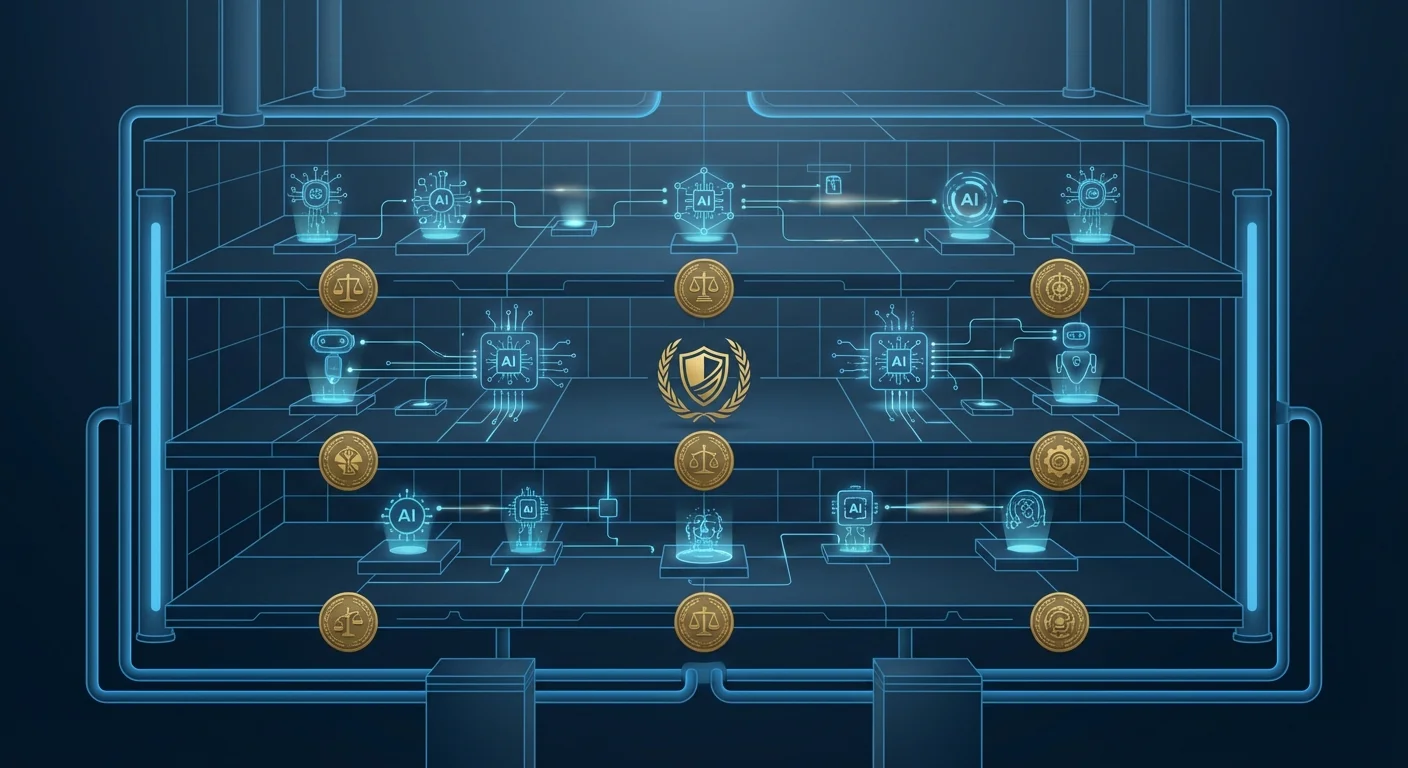
In multi-agent systems, security is not an add-on feature but an architectural cornerstone. When agents can make decisions on behalf of humans, access data, and call external services, any security vulnerability could cause serious business impact. Below is the security architecture design we practice in enterprise-grade agent interoperability systems.
8.1 Layered Security Model
Agent Interoperability Security Architecture:

┌──────────────────────────────────────────────────┐
│  Layer 4: Business Policy Layer                    │
│  ── Agent behavior policies, risk thresholds,      │
│     escalation rules                               │
├──────────────────────────────────────────────────┤
│  Layer 3: A2A Communication Security Layer         │
│  ── OAuth 2.0 / mTLS authentication               │
│  ── Task authorization chain (who authorized what) │
│  ── Agent Card signature verification              │
│  ── Communication encryption (TLS 1.3)             │
├──────────────────────────────────────────────────┤
│  Layer 2: MCP Tool Security Layer                  │
│  ── Tool operation scope restrictions              │
│  ── Human-in-the-Loop (high-risk ops need          │
│     human confirmation)                            │
│  ── Input validation and sanitization              │
│  ── Rate limiting and anomaly detection            │
├──────────────────────────────────────────────────┤
│  Layer 1: Infrastructure Security Layer            │
│  ── Network isolation (VPC / Private Link)         │
│  ── Log auditing and SIEM integration              │
│  ── Key management (KMS / Vault)                   │
│  ── Container security (image scanning /           │
│     runtime protection)                            │
└──────────────────────────────────────────────────┘
8.2 Authorization Chain Design
In multi-agent systems, "authorization" is no longer a simple user-system binary relationship but can form multi-level delegation chains. For example: User authorizes Orchestrator Agent to execute a report task → Orchestrator delegates Research Agent to conduct research → Research Agent needs to access a database. At each hop in this chain, explicit authorization records are needed.
A2A's Task object is naturally suited to carry authorization chain information. We recommend embedding authorization tokens in the Task's metadata, using JWT (JSON Web Token) format to carry original authorizer information, authorization scope, and time limits. Tool operations on the MCP side then filter permissions based on the scope in the authorization chain — if the authorization chain does not include "database write" scope, the MCP Server should refuse to execute write operations even if the agent attempts to call them.
8.3 Auditing and Observability
Enterprise-grade agent systems must have comprehensive auditing capabilities. Every A2A Task creation, status change, and Message exchange, as well as every MCP tool call and resource access, should be recorded in a unified audit log. We recommend integrating with the enterprise's existing SIEM (Security Information and Event Management) system, allowing security teams to monitor all agent behavior from a single dashboard.
NIST's AI Agent security framework[6] particularly emphasizes "explainability": when an agent makes a specific decision, audit logs should be able to reconstruct its complete decision context — including what data it referenced (MCP layer records), what information it exchanged with which agents (A2A layer records), and the reasoning process (agent framework layer records).
IX. Outlook: Future Evolution of Agent Interoperability Protocols
The emergence of A2A and MCP marks a pivotal turning point in the AI Agent ecosystem — from "operating in silos" to "standardized interoperability." Looking ahead to H2 2026 and 2027, we expect the following trends to accelerate[4][5]:
Rise of Agent Marketplaces: Standardized Agent Cards make the publishing, discovery, and procurement of agent capabilities feasible. Enterprises can select and integrate third-party agents from a marketplace just like purchasing SaaS services, significantly reducing build costs. Google Cloud and Salesforce are already preparing their respective Agent Marketplaces.
Cross-Organizational Agent Federation: A2A's HTTP transport characteristics make cross-organizational agent collaboration technically fully feasible. For example, a brand's inventory management agent can communicate directly with a supply chain partner's logistics agent for real-time supply-demand coordination — without the two companies building point-to-point system integration.
Protocol Convergence and Simplification: As the Linux Foundation Interoperability Working Group progresses[3], some functional overlap between A2A and MCP may converge. For example, MCP's Streamable HTTP transport and A2A's HTTP + SSE transport may unify into a single standard; or an "MCP over A2A" encapsulation mode may emerge, allowing remote MCP Servers to be accessed through A2A channels.
Regulatory Compliance Becomes Mandatory: As AI regulations across countries are implemented, the security, auditability, and explainability of agent communication will upgrade from "best practice" to "regulatory requirement." Building agent interoperability architectures that comply with standards early is a strategic investment to mitigate future compliance risks.
The standardization of AI Agent interoperability protocols is not just a technological evolution but a reshaping of the industry landscape. Enterprises that master the A2A + MCP integration architecture first will gain a first-mover advantage in the upcoming Agentic AI era — whether in internal operational efficiency, cross-organizational collaboration capabilities, or the ability to participate in the Agent ecosystem economy.
Launch Your AI Agent Interoperability Architecture
Meta Intelligence's AI architecture team possesses comprehensive technical capabilities spanning MCP Server construction, A2A endpoint design, Agent framework selection, and enterprise-grade security architecture. We have helped multiple enterprises complete the planning and deployment of AI Agent interoperability architectures — from semiconductor supply chains to financial services, from cross-departmental collaboration to cross-organizational federation. Whether you are at the evaluation, planning, or pilot-ready stage, we can provide tailored strategic advice and end-to-end implementation support.
Contact Us