Haven't installed OpenClaw yet? Click here for one-line install commands
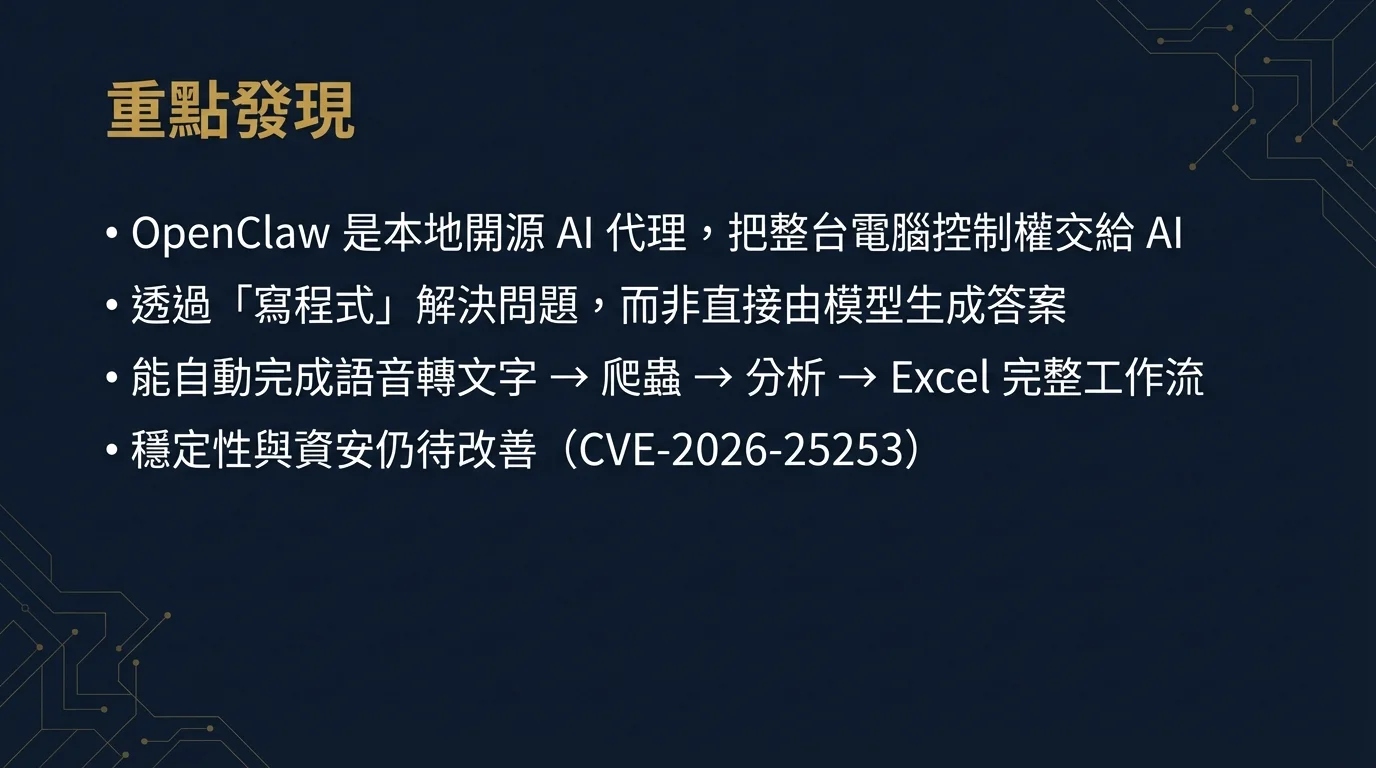
curl -fsSL https://openclaw.ai/install.sh | bashiwr -useb https://openclaw.ai/install.ps1 | iexcurl -fsSL https://openclaw.ai/install.cmd -o install.cmd && install.cmd && del install.cmd- OpenClaw tutorial (formerly ClawdBot / MoltBot) is an open-source AI agent installed on your local computer. Its biggest difference from ChatGPT or Manus is that it hands over full control of your entire computer to AI
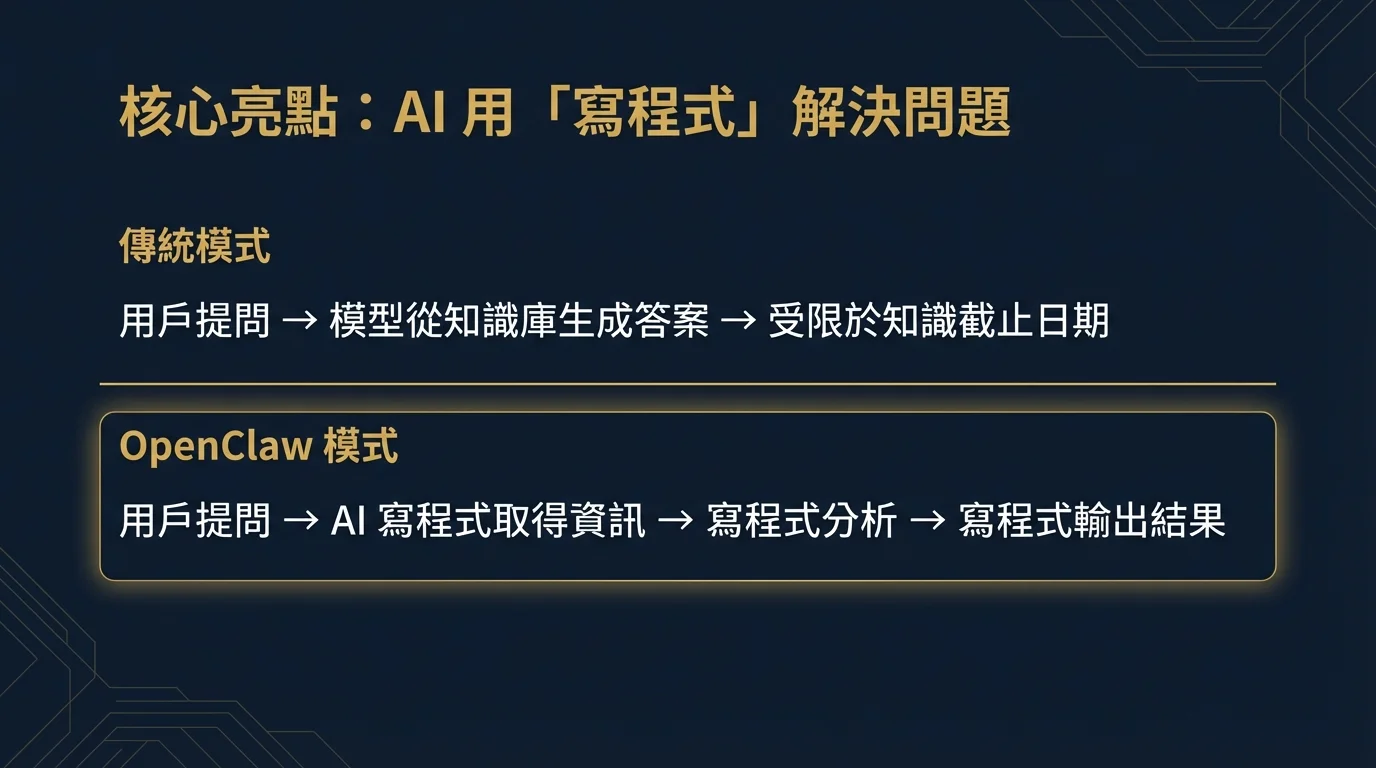
- First-time users easily mistake it for "just another chat tool wired to a large model," but its core highlight is that it extensively uses LLMs to "write code" to solve user problems, rather than having the model directly generate answers
- Our hands-on testing showed that OpenClaw can autonomously complete an entire workflow from voice-to-text, Python web scraping, data analysis to Excel output — all without any human intervention
- There are still unexplained freezing and stability issues, and behind its record-breaking rise as the fastest GitHub project to reach 100K stars, there are serious security concerns (CVE-2026-25253)
1. What Is OpenClaw: The Story Behind Three Name Changes
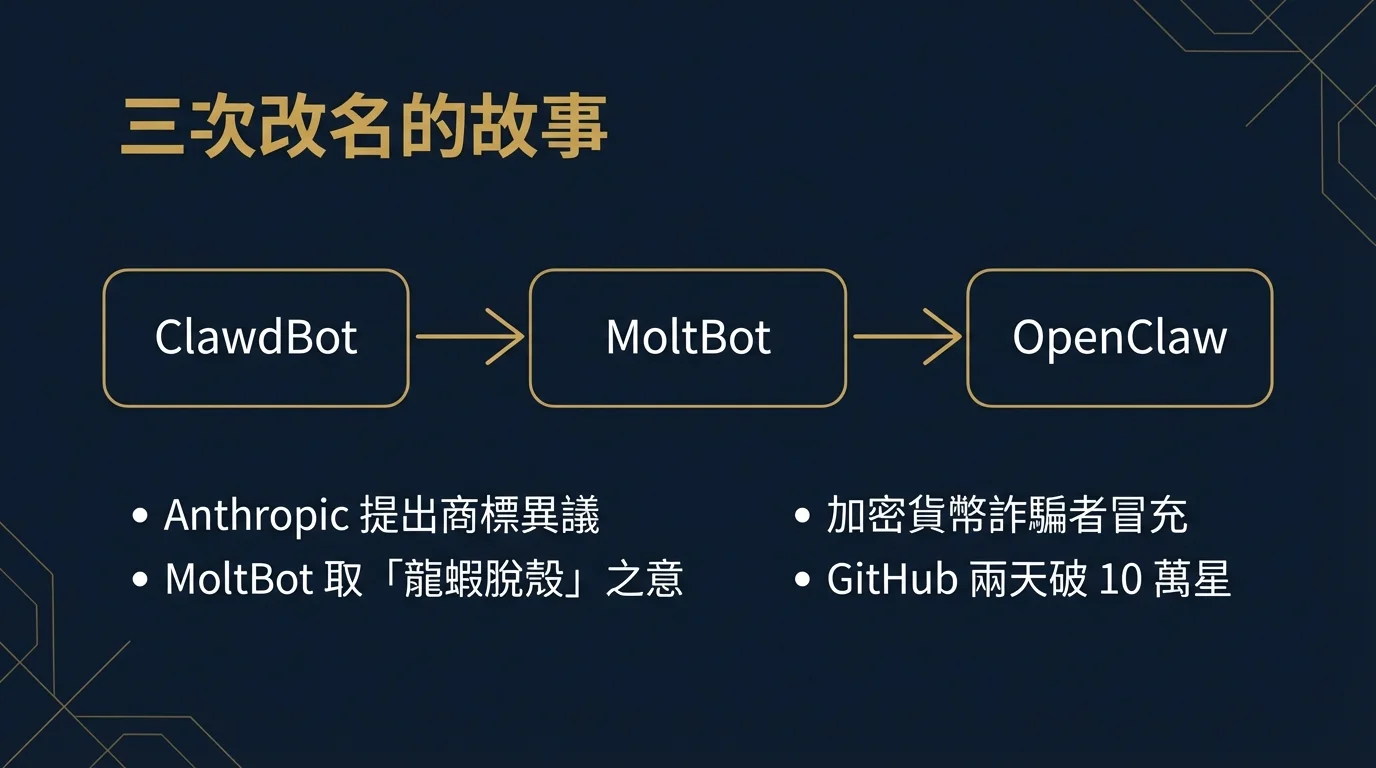
OpenClaw is an open-source autonomous AI agent developed by Austrian software developer Peter Steinberger (founder of PSPDFKit)[1]. Its naming history is a story in itself: originally called ClawdBot (a play on Anthropic's Claude), it was forced to rename to MoltBot (a reference to lobster molting) in January 2026 after Anthropic raised a trademark objection. Three days later, the name was changed again to OpenClaw because MoltBot was not catchy enough and cryptocurrency scammers had rushed to impersonate it[2].
The project's growth rate on GitHub shattered all records: it surpassed 100,000 stars within two days, peaking at 710 new stars per hour[3]. For comparison, React took about 8 years and Linux about 12 years to reach similar star counts. As of early February 2026, OpenClaw had accumulated over 145,000 stars and 20,000 forks.
2. The Fundamental Difference from ChatGPT and Manus AI
Over the past few days, our team has been intensively testing OpenClaw. The first and most intuitive impression was: it is an entirely different class of tool compared to ChatGPT or Manus AI.
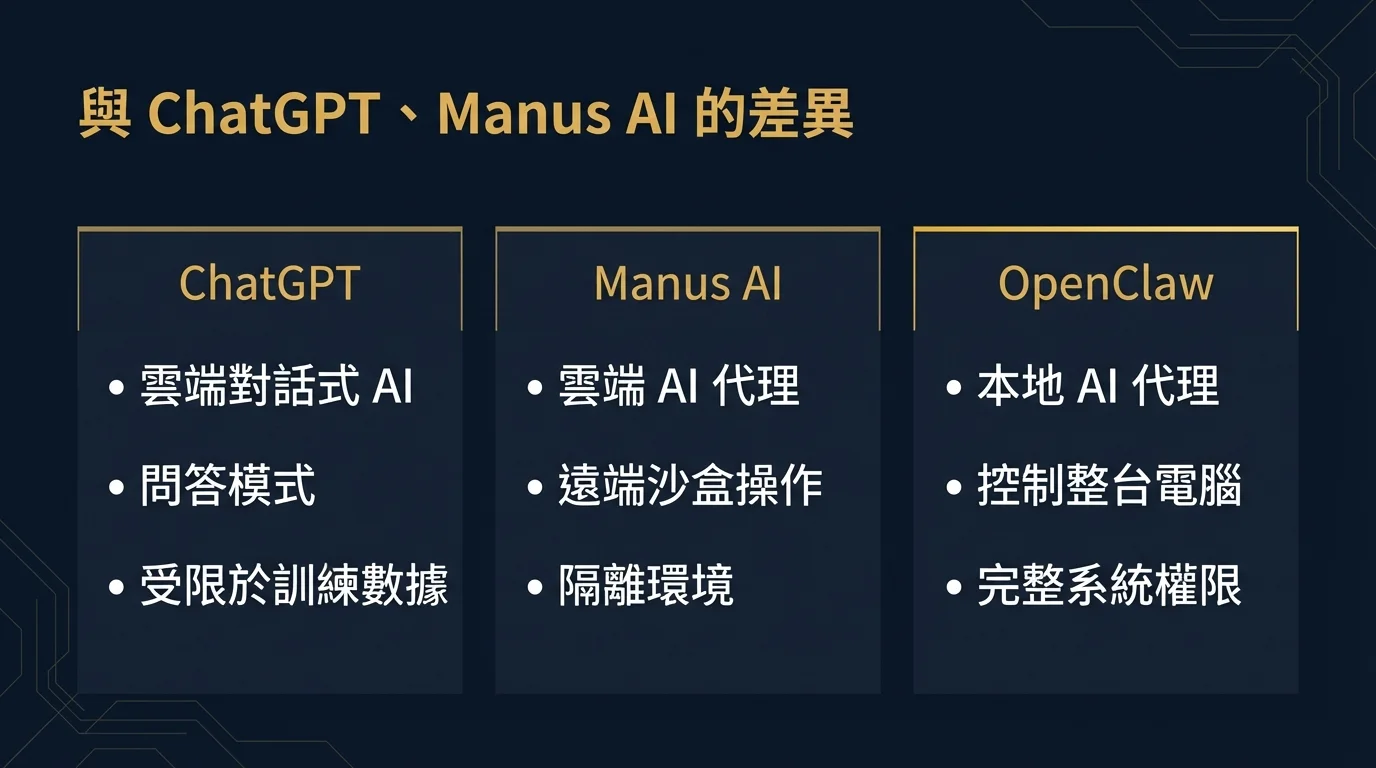
ChatGPT is essentially a cloud-based conversational AI — you ask questions, and it retrieves information and answers. Manus AI is a cloud-based AI agent that can operate web applications in a remote sandbox environment. OpenClaw's positioning is fundamentally different: it installs on your own computer (or cloud server) and then hands full control of your entire computer to AI[4].
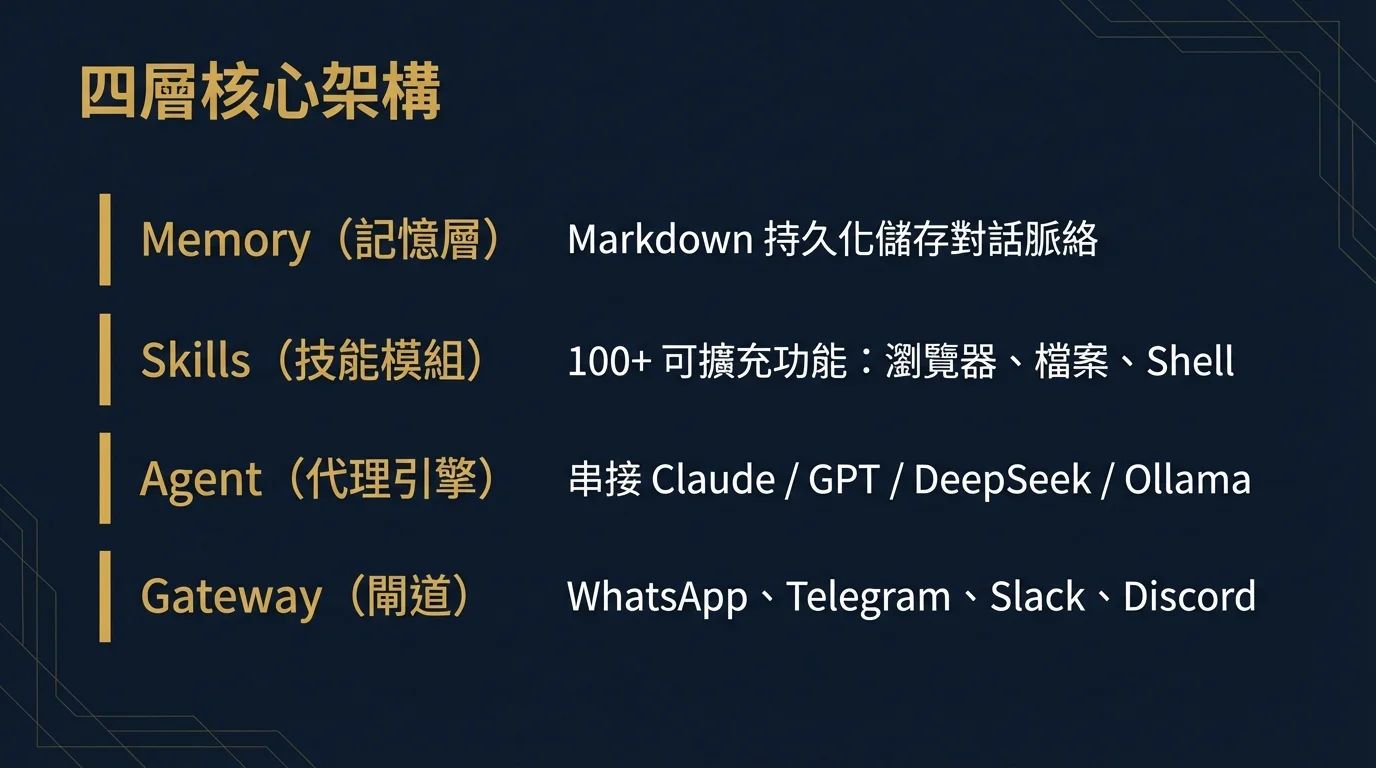
Specifically, OpenClaw's architecture consists of four core layers[5]:
- Gateway: Connects to over 10 messaging platforms including WhatsApp, Telegram, Slack, Discord, and Signal
- Agent (Engine): Integrates external LLMs (Claude, GPT, DeepSeek, or Ollama local models) as its reasoning core
- Skills (Modules): Over 100 extensible capabilities — browser automation, file system operations, calendar integration, shell command execution, and more
- Memory (Persistence Layer): Stores conversation context and user preferences persistently using Markdown files
This means you can send a message via LINE or WhatsApp, and OpenClaw will execute the corresponding operation on your computer — sending emails, organizing files, running programs, or even controlling smart home devices. This "AI-managed computer" paradigm is something none of the mainstream AI tools currently achieve.
3. The Initial Misunderstanding: Thinking It Was Just Another Chat Wrapper
Frankly, when our team first started using OpenClaw, our initial reaction was one of disappointment. The interface looked like just another chat tool wired to a large model, with MCP (Model Context Protocol) capabilities added. It seemed no different from using the Claude API or ChatGPT directly, and was arguably less impressive than Manus AI with its polished web interface.
Platformer's review made similar observations[6], with many early users going through a cycle of "initial amazement, followed by disappointment, then renewed understanding." AI researcher Gary Marcus went so far as to say that OpenClaw is merely a wrapper around large models, and most experienced developers could build something similar[7].
But as we used it more deeply, we began to understand its true value.
4. The Real Highlight: AI Solving Problems by Writing Code
What impressed us most about OpenClaw was not its interface or feature list, but the way it solves problems.
Typical AI tools (ChatGPT, Gemini, Claude) solve user problems by directly generating answers from the LLM's enterprise knowledge management capabilities. OpenClaw takes a different approach — it extensively uses LLMs to write code to solve user problems.
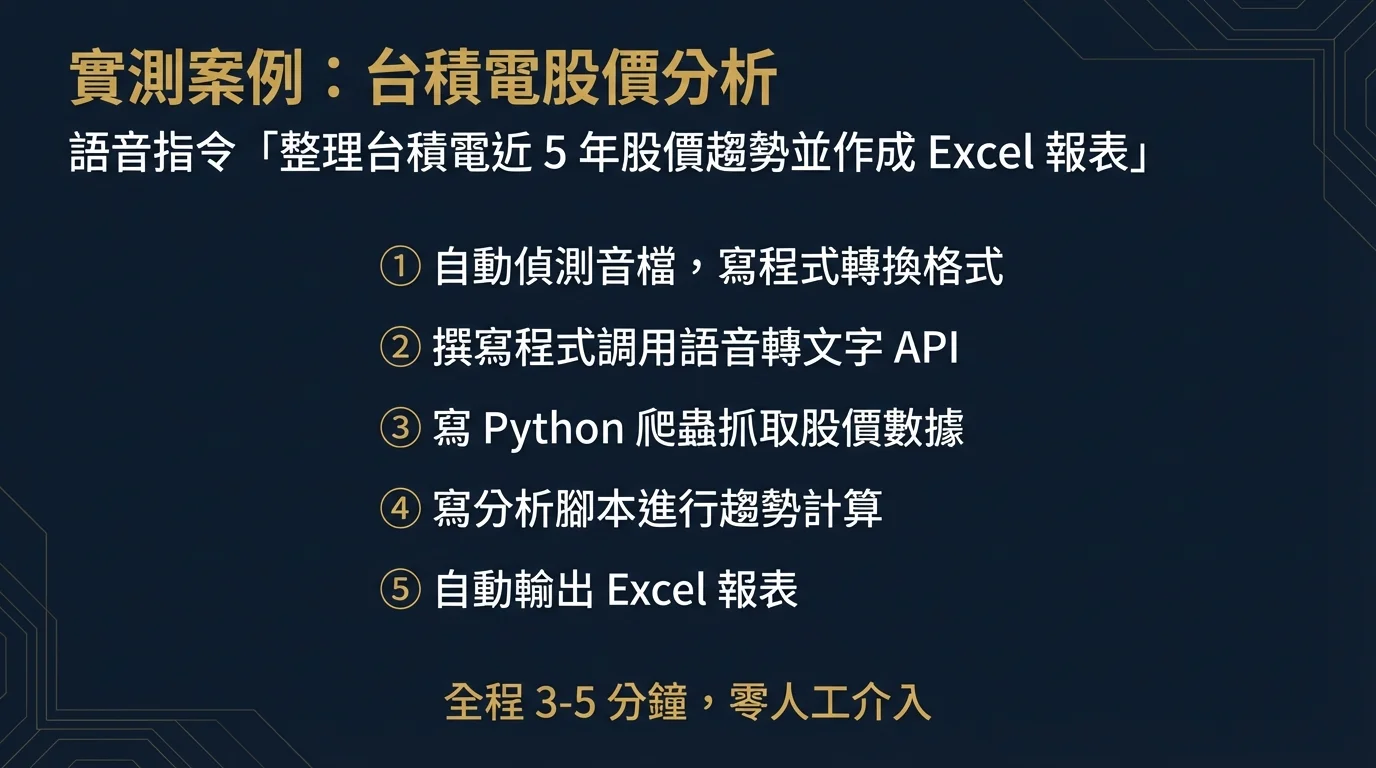
Here is an actual example from our testing: we used a voice prompt saying "Please compile TSMC's stock price trends over the past 5 years and create an Excel report." What happened next had every team member crowding around the screen:
- OpenClaw detected the input was an audio file and wrote a program itself to convert the audio into a format acceptable by the API
- It then wrote another program to call a speech-to-text API, converting the voice into text instructions
- Next, it used Python and wrote a web scraper itself to fetch TSMC's historical stock price data
- After downloading the stock prices, it wrote an analysis script itself to organize the data and calculate trends
- Finally, it wrote a program itself to output the analysis results in Excel format, completing the report
The entire process took about 3 to 5 minutes with no human intervention required. At every step, OpenClaw generated code in real time, executed it, checked the results, and moved on to the next step.
5. The Potential: AI Solving Problems Through Code, Not Limited by the Model Itself
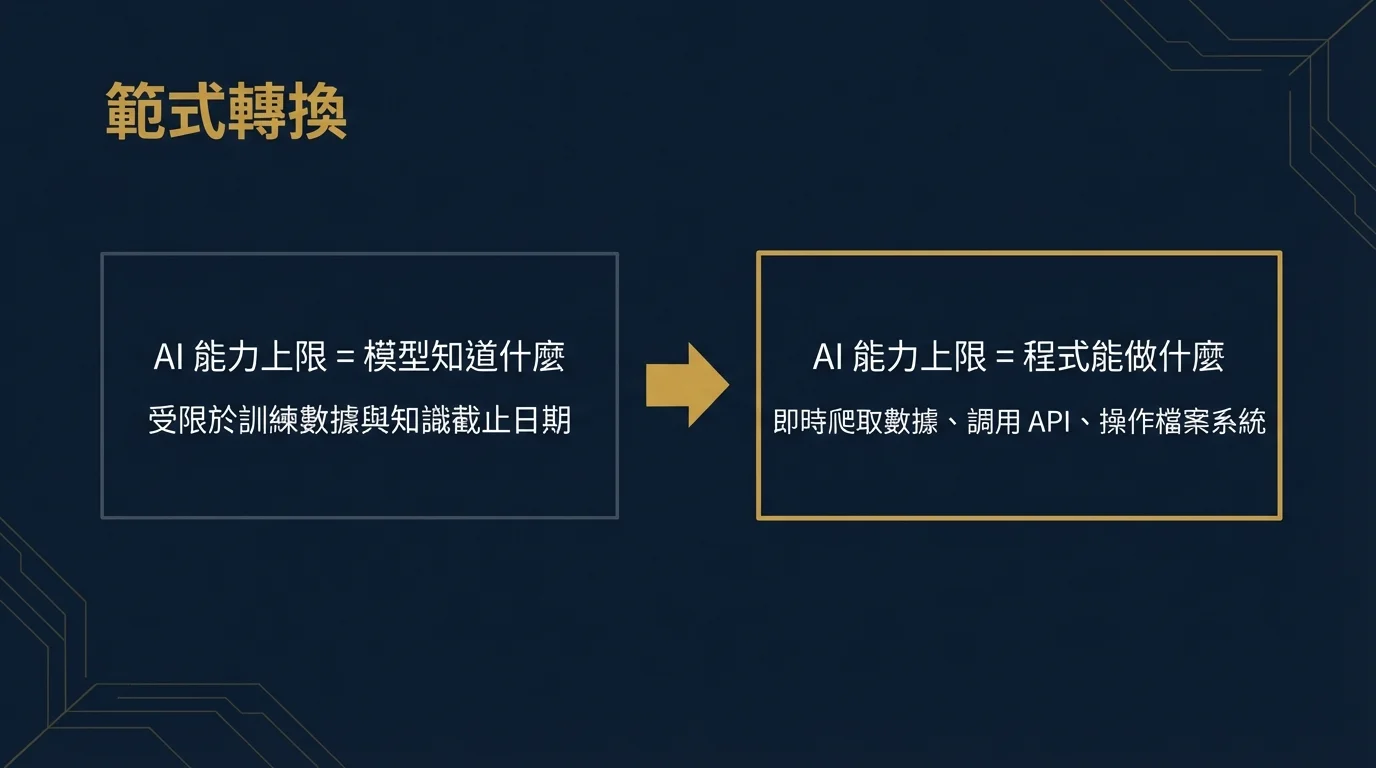
This paradigm of "AI solving problems by writing code" is, in our view, OpenClaw's most revolutionary design philosophy. It reveals an important paradigm shift:
Traditional paradigm: User asks a question -> LLM directly generates an answer from its training knowledge -> Limited by the model's training data, knowledge cutoff date, and context window
OpenClaw paradigm: User asks a question -> LLM determines what information and tools are needed -> Writes code to obtain information -> Writes code to process and analyze -> Writes code to output results
This means AI is no longer limited by what the LLM "knows" but rather by "what code it can write" — and modern LLMs' code-writing capabilities are already remarkably powerful. It can scrape the latest data in real time, call any API, operate the local file system, and execute complex data analysis pipelines. The Pragmatic Engineer's in-depth report also noted[8] that Steinberger himself describes his development process as "I ship code I don't read" — the volume of code generated by OpenClaw has already exceeded what humans can review line by line.
For enterprises, the potential of this paradigm is enormous. Imagine a scenario: a marketing director says via voice "Analyze our social media engagement data across all platforms from last month, compare it with competitors, and create a presentation." OpenClaw can write its own scraper to gather data, write analysis scripts for comparison, write code to generate charts, and even write code to compile charts into a PowerPoint — all completed automatically.
6. Current Drawbacks: Stability and Security
6.1 Unexplained Freezes
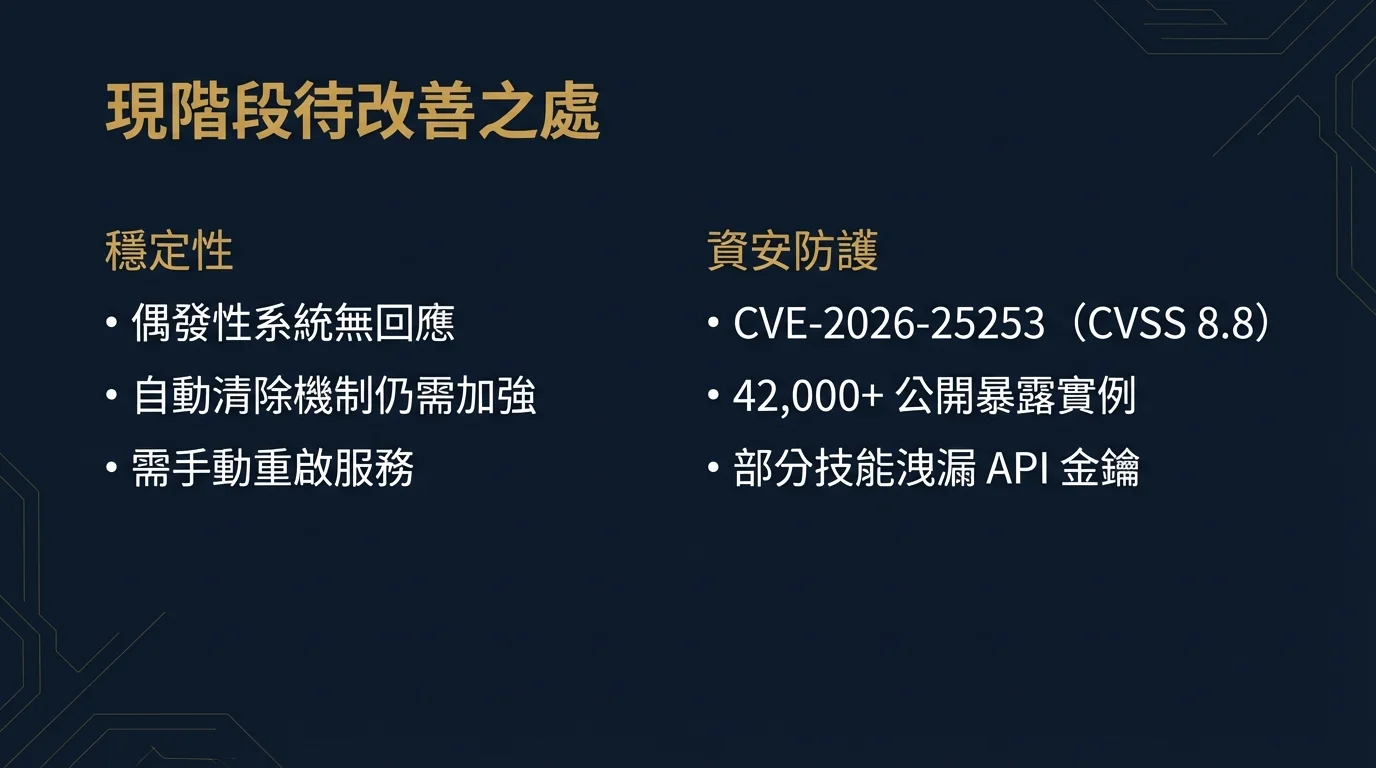
The biggest issue we encountered in our hands-on testing was stability. OpenClaw has a certain probability of freezing for unknown reasons — the system becomes completely unresponsive and cannot accept new commands. Although OpenClaw has a built-in automatic cleanup mechanism that can detect and delete tasks that have been stuck for too long, in certain cases this mechanism itself fails, ultimately causing the entire agent to crash completely.
When this happens, the only solution is to manually restart the OpenClaw service on the host machine. For users deployed in the cloud, this means needing to SSH into the server to perform the operation — clearly not an acceptable experience for typical users.
6.2 Serious Security Concerns
Even more concerning are the security issues. In early February 2026, security researchers discovered the CVE-2026-25253 vulnerability (CVSS 8.8 High)[9] — an attacker only needs to trick a user into clicking a specially crafted link to hijack OpenClaw's full control via cross-site WebSocket hijacking, enabling arbitrary command execution on the user's computer.
CrowdStrike's investigation further revealed[10] that there are over 42,000 publicly exposed OpenClaw instances on the internet, of which 93.4% have authentication bypass vulnerabilities. The Register's report noted[11] that approximately 7.1% of skills in the OpenClaw skills marketplace leak API keys in plaintext. Cisco's security team went further[12], stating that personal AI agents like OpenClaw are fundamentally a cybersecurity nightmare — they combine shell access, network connectivity, and prompt injection attack surfaces, making them ideal targets for hackers.
Considering that OpenClaw has full control of the computer, the severity of these security vulnerabilities far exceeds that of typical applications. Gary Marcus used a vivid analogy[7]: using OpenClaw is like handing all your passwords to a stranger at a bar.
7. Our Perspective: Worth Watching, But Not Ready for Production
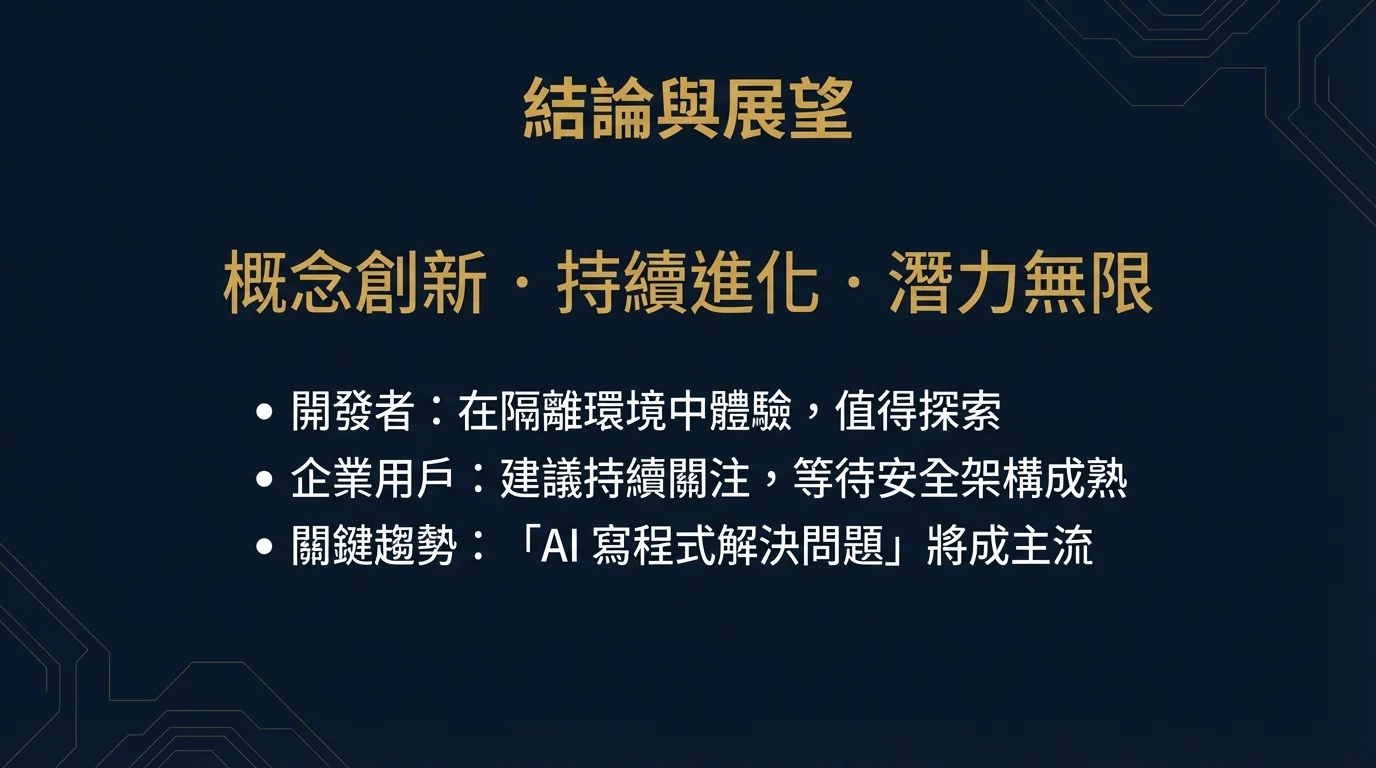
After several days of intensive testing, our team's overall assessment of OpenClaw is: visionary concept, rough execution, enormous potential.
The "AI solving problems by writing code" paradigm it demonstrates may be an important direction for AI agent development. When AI is no longer limited by the model's own knowledge boundaries and can write code in real time to obtain, process, and analyze any information, its capability ceiling shifts from "what the model knows" to "what code can do" — and the latter is virtually unlimited.
However, at this stage, insufficient stability and concerning security make it unsuitable for any production environment. For developers with strong technical curiosity, experiencing OpenClaw in an isolated test environment is worthwhile; but for enterprise users, we recommend watching and waiting until its security architecture and stability show substantial improvement before considering adoption.
The era of AI agents is indeed arriving. OpenClaw's viral success is no accident — it taps into a deep-seated need for AI automation. But as with every technology wave, the first wave of products tends to be the roughest. The real question is not whether OpenClaw is useful right now, but how the "AI writing code to solve problems" paradigm it represents will be realized by more mature products over the next one to two years.
We will continue tracking the development of OpenClaw and similar AI agents. If your enterprise is evaluating adoption strategies for AI automation tools, we welcome in-depth technical discussions with our research team — in an era of abundant tools, choosing the right direction matters more than chasing trends.
Presentation Slides