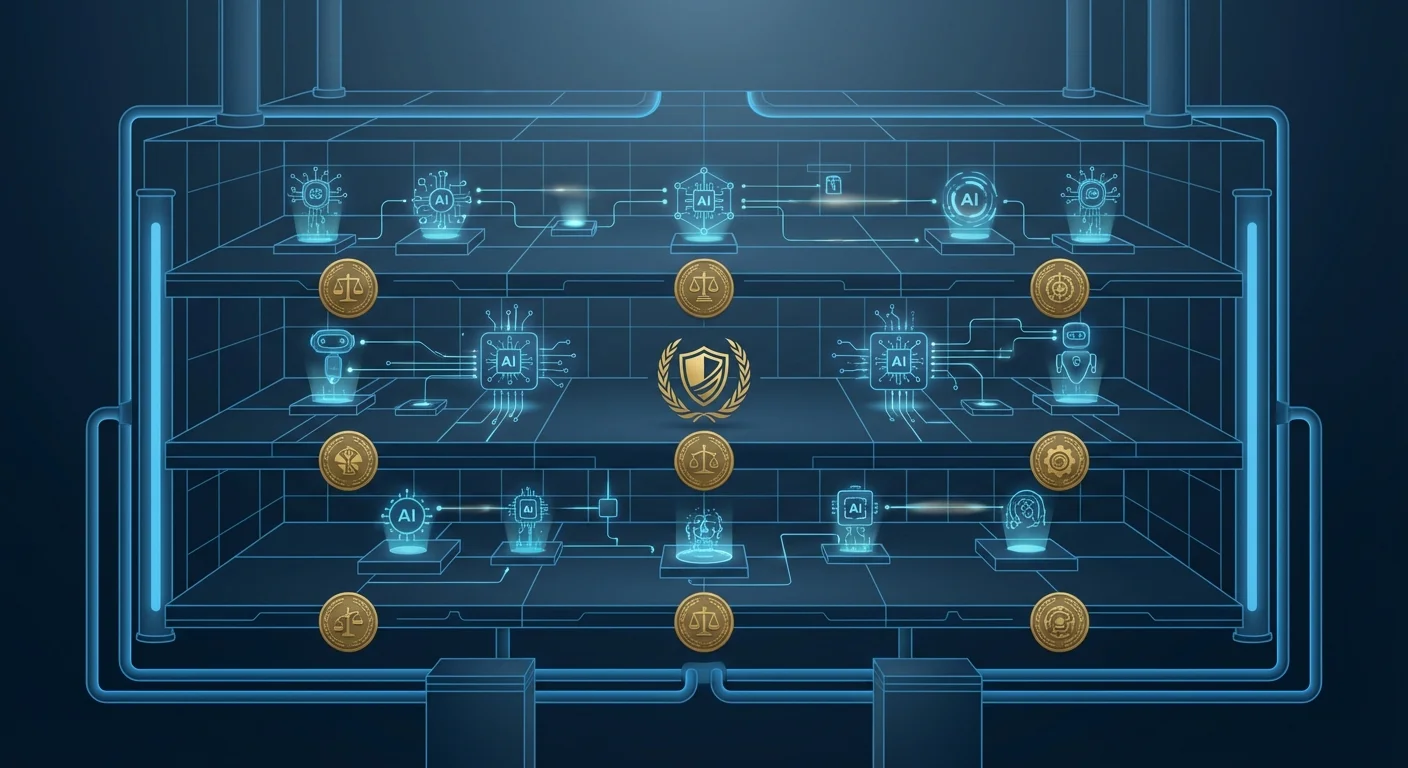
- Gartner predicts 40% of enterprise applications will integrate AI Agents by 2026 (up from under 5% in 2025)[1], yet simultaneously warns that over 40% of Agentic AI projects will be canceled by end of 2027[2] — the dividing line between success and failure is architecture selection, not the technology itself
- McKinsey's survey shows 62% of enterprises are experimenting with AI Agents and 23% are scaling — but only 6% qualify as true AI high performers[3]. Deloitte reports that 83% of enterprises view Sovereign AI as strategically important, with 74% planning to deploy Agentic AI within two years[5]
- MIT Technology Review finds that 75% of global enterprises expect to adopt Composable AI architectures by 2027, replacing monolithic systems[4]. Architectural composability is becoming the decisive factor for enterprise AI success
- Lenovo's 2026 TCO analysis shows that under high-utilization scenarios, on-premise deployment pays for itself in under 4 months and can be over 18x cheaper than cloud APIs long-term[11] — but that does not mean every enterprise should build its own infrastructure
1. Enterprise AI Agent Adoption Is at a Crossroads
The enterprise AI landscape in 2026 is undergoing a structural shift. Generative AI has evolved from a tool that answers questions into an agent that understands objectives and autonomously executes tasks. Gartner calls this Agentic AI, predicting that by the end of 2026, 40% of enterprise applications will integrate AI Agents — up from less than 5% at the start of 2025[1]. Global AI spending is expected to reach $2.52 trillion in 2026, a 44% year-over-year increase[13].
But behind this rapid expansion lurks significant risk. Gartner simultaneously issued a sobering forecast: over 40% of Agentic AI projects will be canceled by the end of 2027, due to runaway costs, unclear business value, and inadequate risk management[2]. McKinsey's 2025 global survey paints an even sharper picture — 88% of enterprises use AI, 62% are experimenting with AI Agents, yet only 6% are true "AI high performers"[3].
This paradox of widespread adoption but rare success is not a model capability problem. It is an architecture decision problem. HBR's analysis captures the issue precisely: incumbents fail to be transformed by new technology not because they lack execution capability, but because they do not recognize that the technology demands entirely new modes of work coordination[7]. AI Agents are not plug-in modules that slot into existing IT architectures — they require organizations to rethink data flows, decision chains, and the fundamental patterns of human-machine collaboration.
This article provides CTOs and technical decision-makers with a systematic architecture selection guide: from understanding the fundamental differences between Agentic AI and traditional GenAI, through evaluation matrices for build vs. SaaS vs. hybrid deployment, to data sovereignty, TCO analysis, and security frameworks. The goal is to help you land on the right side of Gartner's dual prediction — in the 40% that succeed, not the 40% that get canceled.
2. Agentic AI vs. Traditional GenAI: A Fundamental Architectural Divide
Before discussing architecture choices, it is essential to understand the fundamental difference between Agentic AI and traditional GenAI from an enterprise infrastructure perspective. These two paradigms place radically different demands on your stack.
2.1 From Responding to Commands to Autonomous Execution
Traditional GenAI applications — ChatGPT integrations, copywriting generators, knowledge base Q&A — are stateless and reactive. A user sends a prompt, the model returns a response, and the interaction ends. The enterprise IT footprint is minimal: an API gateway and basic authentication.
Agentic AI is stateful and proactive. An AI Agent receives a goal (not a command), decomposes it into subtasks, invokes tools, evaluates intermediate results, adjusts its approach, and ultimately delivers an outcome. This means the Agent needs persistent memory, a tool integration layer, decision audit logs, and error recovery mechanisms — none of which exist in a traditional API-call architecture.
A joint report from HBR and Google Cloud Consulting highlights the most common organizational failure mode: "Agent Sprawl" — individual departments building isolated AI Agents without a unified coordination framework, leading to cost explosions and governance breakdowns[6].
2.2 Three Dimensions of Architectural Requirements
Deploying Agentic AI requires capabilities across at least three dimensions that go well beyond traditional GenAI architectures:
Data Layer: Agents need access to real-time, structured, and unstructured enterprise data — not just a queryable knowledge base, but an actionable data environment. This demands levels of real-time availability, consistency, and security in data pipelines that far exceed what traditional BI or RAG use cases require.
Integration Layer: Agents interact with existing enterprise systems — ERP, CRM, financial platforms, manufacturing execution systems (MES) — through tool calls (Function Calling / MCP). Every tool invocation is a potential security boundary breach point.
Governance Layer: Autonomous agent decisions require traceable audit trails, human-in-the-loop escalation mechanisms, and safe fallback strategies for failure scenarios. These capabilities are virtually nonexistent in traditional GenAI deployments.
3. The Architecture Selection Matrix: Build vs. SaaS vs. Hybrid
With the architectural requirements of Agentic AI established, the core decision becomes: should your enterprise build, adopt SaaS, or pursue a hybrid approach? MIT Technology Review's research emphasizes that successful AI transformation starts by selecting the right "Iconic Use Case" — neither an unrealistic moonshot nor an inconsequential tactical fix[8]. Your architecture choice must be tightly aligned with the characteristics of your target use cases.
3.1 Full On-Premise / Private Cloud Build
When it fits: Highly sensitive data (healthcare, finance, defense); complete control over model behavior and data flows required; dedicated ML engineering team (5+ FTEs); AI is a core competitive differentiator, not a supporting tool.
Advantages:
- Lenovo's 2026 TCO analysis shows that in high-utilization scenarios, on-premise deployment pays for itself in under 4 months, with per-million-token costs over 18x lower than cloud APIs[11]
- Complete data sovereignty — data never leaves the enterprise perimeter
- Full model customization, fine-tuning, and version control
Risks:
- High upfront capital expenditure (GPU servers, cooling, networking)
- Ongoing MLOps staffing requirements and GPU refresh cycles
- Technology moves fast — a bespoke architecture can become obsolete within 18 months
3.2 Full SaaS / API-Driven (MaaS: Model-as-a-Service)
When it fits: Rapid proof-of-concept validation; AI augmentation for non-core functions (customer service, marketing, document processing); team lacks dedicated ML engineering; data sensitivity is moderate or low.
Advantages:
- Zero upfront capital expenditure, pay-as-you-go pricing
- Instant access to state-of-the-art models (GPT-4o, Claude, Gemini, etc.)
- Vendor handles maintenance, upgrades, and security patching
Risks:
- API costs can escalate dramatically as you scale — Lenovo's report notes that visible costs account for only 15-20% of total AI spend[11]
- Data transmitted to third-party clouds raises privacy regulation and customer trust concerns
- Exposure to vendor pricing changes and terms-of-service shifts
- Model behavior is not fully controllable — the "black box" problem is especially acute in regulated industries
3.3 Hybrid Deployment (Composable AI Architecture)
When it fits: The optimal choice for most enterprises — particularly those facing simultaneous demands for rapid innovation and data sovereignty.
MIT Technology Review and IDC project that 75% of global enterprises will shift to Composable AI architectures by 2027[4]. The core principle of Composable AI is modularity — decomposing the AI system into independently replaceable components (models, memory, tools, orchestrators) connected through standardized interfaces (such as MCP and A2A), enabling organizations to flexibly assemble the best solution for each use case.
A typical hybrid architecture:
- Sensitive workloads (finance, compliance, HR): Open-source models (e.g., Llama, Mistral) deployed on-premise — data stays within the enterprise boundary
- Creative and analytical workloads (marketing, customer service, research): Cloud APIs (GPT-4o, Claude) for access to frontier model capabilities
- Orchestration layer: A unified agent orchestration platform that manages the lifecycle, permissions, and audit trails for all agents
4. Data Sovereignty and Sovereign AI: Beyond Compliance, a Competitive Advantage
Data sovereignty is evolving from a regulatory checkbox into a core element of enterprise competitive strategy. Deloitte's 2026 report shows that 83% of enterprises now view Sovereign AI as strategically important, with 77% factoring a vendor's country of origin into their AI procurement decisions[5]. A joint report from the World Economic Forum (WEF) and Bain & Company estimates that global Sovereign AI compute investment will approach $100 billion in 2026[12].
4.1 What Is Sovereign AI?
Sovereign AI refers to a nation's or organization's ability to maintain autonomous control over the full AI stack — from compute infrastructure and training data to model weights and inference environments. This does not mean building everything in-house. It means ensuring that under any scenario — vendor disruption, geopolitical shifts, regulatory changes — the enterprise can continue operating its AI capabilities without interruption.
4.2 Data Sovereignty Considerations for Asia-Pacific Enterprises
For enterprises operating in the Asia-Pacific region, data sovereignty raises three particularly acute considerations:
Geopolitical risk: Enterprises in geopolitically sensitive markets face elevated risk from over-reliance on a single cloud provider. If core AI capabilities are built entirely on U.S.-based cloud infrastructure, any disruption to transpacific communications could halt business operations.
Supply chain sensitivity: Semiconductor and electronics supply chain data carries enormous strategic value. Sending such data to any third-party cloud — regardless of jurisdiction — can trigger concerns from major customers in the U.S., Japan, and Europe.
Regulatory trajectory: Multiple Asia-Pacific jurisdictions are advancing AI governance legislation, and some are expected to impose data localization requirements for specific industries. Enterprises that proactively adopt hybrid architectures will have a first-mover advantage when these regulations take effect.
5. TCO Analysis: Looking Beyond API Costs
Most enterprises make a critical mistake when evaluating AI architecture costs: they only account for visible expenses. Lenovo's 2026 TCO analysis makes clear that visible costs (API fees, hardware purchases, software licenses) represent only 15-20% of total AI spend[11]. The rest is hidden in the categories below.
5.1 The Complete TCO Breakdown
Infrastructure costs (15-25%): GPU servers, network bandwidth, cooling and power, data center space (on-premise), or API fees and cloud compute resources (SaaS).
Data engineering costs (25-35%): Data cleaning, labeling, pipeline development, ETL process engineering, data quality monitoring. This is consistently the most underestimated cost category — most enterprise data is nowhere near "AI-ready."
Integration and customization costs (15-20%): Agent integration with existing systems (ERP, CRM, MES), prompt engineering, workflow redesign.
People and organizational costs (15-25%): ML engineers, MLOps staff, business translators (the people who convert business requirements into technical specifications), change management, and internal training programs.
Governance and compliance costs (5-10%): Audit trail infrastructure, security assessments, compliance reporting, risk management processes.
5.2 TCO Comparison Across Three Architectures
| Cost Dimension | Full On-Premise | Full SaaS | Hybrid |
|---|---|---|---|
| Upfront Investment | High (hardware + environment setup) | Low (pay-as-you-go) | Medium (partial hardware + SaaS) |
| Long-Term Compute Cost | Low (at high utilization) | Scales with volume | Optimizable by workload |
| Headcount | High (5+ ML team) | Low (1-2 people) | Medium (3-4 people) |
| Flexibility | Low (hardware lock-in) | High (switch anytime) | Highest (swap any module) |
| Data Sovereignty | Full control | Vendor-dependent | Tiered control |
| Technology Risk | High obsolescence risk | Vendor lock-in | Lowest (incremental migration) |
Google Cloud's 2025 survey provides encouraging data: 52% of enterprises have deployed AI Agents, and among those, 74% achieved ROI within the first year. Additionally, 88% of early Agentic AI adopters report positive returns on at least one use case[14]. But these results assume the right architecture choices. A misaligned architecture does not just fail to deliver ROI — it becomes a sunk-cost trap.
6. Security Framework: Agent Security Boundaries Are More Complex Than You Think
The security challenges posed by AI Agents are fundamentally different from those of traditional GenAI. Traditional GenAI security is primarily about output quality — hallucinations, bias, inappropriate content. AI Agent security is about action consequences — because agents can interact with live systems (reading and writing databases, calling APIs, manipulating files), a single vulnerability can directly cause business damage.
6.1 The NIST AI Agent Standards Initiative
In February 2026, NIST formally launched its "AI Agent Standards Initiative"[9], focusing on four pillars:
Security controls and risk management: Agent actions must be traceable, constrainable, and interruptible. Every tool invocation should be logged in an audit trail.
Governance and oversight: Organizations must establish lifecycle management for agents — a complete governance framework from development and testing through deployment and retirement. Deloitte's survey reveals a stark gap: while 74% of enterprises plan to deploy Agentic AI within two years, only 21% have mature agent governance mechanisms in place[5].
Human-machine collaboration and escalation: Agents must have clearly defined human-in-the-loop trigger conditions — specifying which decisions can be executed autonomously and which require human confirmation.
Access control and accountability: Agent permissions should follow the principle of least privilege, and every action must be clearly attributable to a responsible party.
6.2 OWASP Top 10 for Agentic Applications
In December 2025, OWASP published its "Top 10 for Agentic Applications for 2026"[10], co-authored by over 100 security researchers and already cited by Microsoft and NVIDIA as a reference standard. The most critical risk categories include:
Goal Hijacking: Attackers use prompt injection or malicious tool responses to redirect an agent's objective, causing it to execute unintended actions.
Tool Misuse: An agent invokes tools beyond their intended scope — for example, an agent designed to query orders is manipulated into modifying order amounts.
Identity and Privilege Abuse: Agents running under high-privilege service accounts create attack surfaces far larger than traditional application vulnerabilities when compromised.
Cascading Failures: In multi-agent systems, one agent's erroneous decision can trigger chain reactions that propagate across entire business processes.
7. Decision Tree: Which AI Agent Architecture Fits Your Enterprise?
Drawing on the analysis above, here is a structured decision process to help CTOs quickly identify the most appropriate architecture path:
Step 1: Assess Data Sensitivity
High sensitivity (finance, healthcare, defense, core supply chain data): This data should not leave the enterprise perimeter. Core agents must run on-premise or in a private cloud. Arrow points to: on-premise or hybrid.
Moderate to low sensitivity (marketing, customer service, general operations): Cloud APIs are acceptable under appropriate compliance frameworks. Arrow points to: SaaS or hybrid.
Step 2: Assess Team Capabilities
Dedicated ML engineering team (5+ FTEs) with MLOps experience: You have the capacity to operate self-hosted infrastructure. Arrow points to: on-premise or hybrid.
Team is primarily software engineering with no dedicated ML staff: The operational burden of self-hosting will exceed your team's capacity. Arrow points to: SaaS, or hybrid with an external technology partner.
Step 3: Assess Scale and Budget
Monthly API call volume exceeds 500K or AI spend exceeds 1% of annual revenue: SaaS marginal costs will escalate rapidly. Arrow points to: evaluate on-premise or hybrid TCO advantages.
Monthly call volume under 100K and AI serves an auxiliary function: SaaS offers maximum flexibility and minimum risk. Arrow points to: SaaS.
Step 4: Assess Technology Evolution Risk
AI is a core competitive differentiator: You must maintain technological autonomy and the ability to rapidly integrate new models and frameworks. Arrow points to: hybrid (Composable AI).
AI is an operational efficiency tool: Stability and reliability matter more than cutting-edge capabilities. Arrow points to: SaaS is sufficient.
| Enterprise Type | Recommended Architecture | Typical Scenario |
|---|---|---|
| Finance / Healthcare / Defense | Primarily on-premise + limited SaaS | Core workloads on-premise; non-sensitive functions in the cloud |
| Manufacturing (with supply chain data) | Hybrid deployment | Production-line AI on-premise; customer service / marketing in the cloud |
| Services / Retail | Primarily SaaS + evaluate hybrid | Launch fast with APIs; migrate to hybrid as you scale |
| Tech Startups | SaaS for validation, then hybrid | Use SaaS for PoC; build owned infrastructure after product-market fit |
| Multinational Enterprises | Hybrid (multi-region sovereign) | Region-specific deployments compliant with local regulations |
8. Preventing Agent Sprawl: An Enterprise AI Agent Governance Framework
HBR and Google Cloud Consulting's report issues a clear warning about "Agent Sprawl" — departments independently building siloed AI Agents, eventually creating an unmanageable ecosystem of redundant, ungoverned, and cost-overlapping agents[6]. Avoiding this trap requires an enterprise-wide governance framework built on four pillars:
Unified agent orchestration platform: Whether agents run on-premise or in the cloud, a single orchestration layer should manage their lifecycle, permissions, and communications. This does not mean standardizing on a single vendor — it means standardizing the management interface.
Standardized agent interfaces: Adopt protocols like MCP (Model Context Protocol) or A2A (Agent-to-Agent) to ensure interoperability between agents and the ability to swap underlying models without disrupting business logic.
Centralized cost and performance monitoring: Every agent's API consumption, inference latency, task completion rate, and error rate should be visible on a central dashboard. This is the data foundation CTOs need to make "scale up" or "decommission" decisions.
Incremental deployment strategy: Do not deploy 10 agents across 10 departments simultaneously. Choose a single high-impact, low-risk "Iconic Use Case"[8] as your beachhead, build internal confidence and learning curves, and then systematically expand to other business functions.
9. Conclusion: Architecture Decisions Determine AI Outcomes
Enterprise architecture selection in the AI Agent era is not a purely technical decision. It involves strategic judgments about data sovereignty, long-term cost structure planning, security risk assessment, and the organizational capacity to drive change. Gartner's dual prediction — "40% integration / 40% cancellation"[1][2] — is fundamentally making the same point: outcomes depend on the quality of architecture decisions, not the capability of the AI technology.
MIT Technology Review's report provides a powerful conclusion: 75% of global enterprises plan to adopt Composable AI architectures by 2027[4]. This is not because Composable AI is the cheapest option, but because it is the only architecture model that can simultaneously satisfy two seemingly contradictory demands — rapid innovation and long-term controllability.
For CTOs currently evaluating AI Agent architectures, our recommendation is this: do not pursue the "perfect architecture." Pursue the evolvable architecture. Start with SaaS to rapidly validate business value. Once validated, progressively migrate core capabilities to controlled environments. The end state is a Composable AI platform that flexibly assembles the right components for each business need — the most resilient path forward in a landscape of extreme technological uncertainty.
Meta Intelligence partners with enterprises across the full lifecycle — from AI strategy and architecture design to PoC development and production deployment. Whether you are a CTO evaluating AI Agent infrastructure, a CFO seeking rigorous TCO analysis, or a CDO driving organizational AI transformation, our team brings the deep technical expertise and hands-on implementation experience to help your enterprise find its optimal AI architecture path.