- Published by Palgrave Macmillan (Springer Nature), 256 pages across 11 chapters
- A dedicated chapter on the economic implications of the metaverse authored by a Bank for International Settlements (BIS) economist team, simultaneously published as BIS Papers No. 144
- Contributions from former NUS Faculty of Law Dean Tan Cheng-Han, S.C. and Senior Associate Professor Daniel Seng
- Cambridge Judge Business School researchers Keith Bear and Dr. Henning Stein contribute chapters on metaverse finance and investment
About the Book
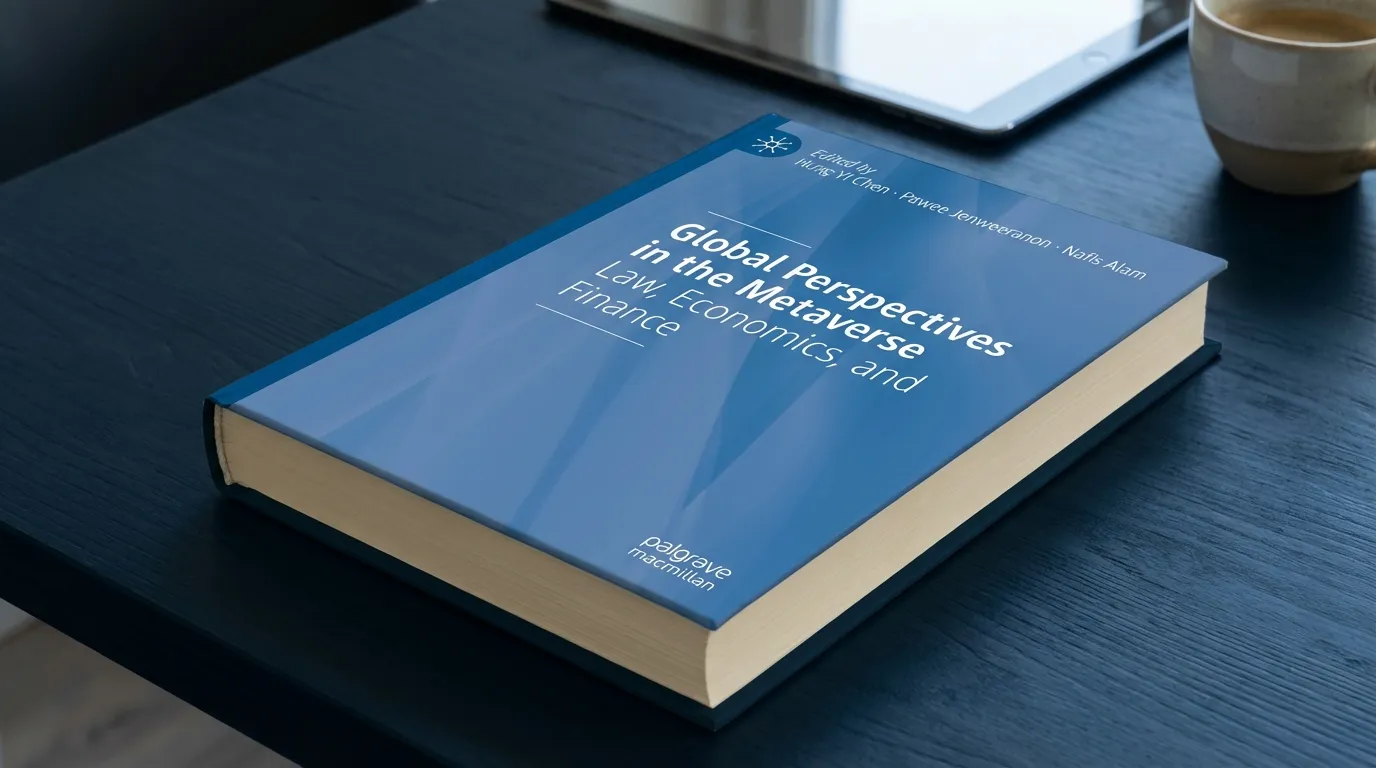
Global Perspectives in the Metaverse: Law, Economics, and Finance is an academic monograph co-edited by Meta Intelligence founder Hungyi Chen (Hung-Yi Chen) and Cambridge Centre for Alternative Finance research partners Nafis Alam and Pawee Jenweeranon, published by Palgrave Macmillan in May 2024[1].
The metaverse is undergoing rapid technological evolution and commercial exploration, yet systematic academic research on its legal, economic, and financial dimensions remains relatively scarce. This book brings together scholars and practitioners from leading institutions including the Bank for International Settlements (BIS), National University of Singapore (NUS), University of Cambridge, Singapore Management University (SMU), and University of Zurich, offering novel analytical frameworks and research findings from a global comparative perspective.
Core Highlights: Co-Authored by Leading International Institutions
The most distinctive academic value of this book lies in bringing together experts from some of the world's most influential international institutions. This is not merely an academic publication, but a concrete demonstration of Meta Intelligence's global think tank research capabilities.
Bank for International Settlements (BIS)
Chapter 6, "The Economic Implications of Services in the Metaverse," was co-authored by three BIS economists Carlos Cantu, Cecilia Franco, and Jon Frost[2]. Jon Frost currently serves as Head of Economics for the Americas at BIS. This chapter was simultaneously published as BIS Papers No. 144, making it one of the Bank for International Settlements' most significant official studies on the economic implications of the metaverse. As the "central bank of central banks," the participation of the BIS research team in this book underscores its authority in global financial policy research.
National University of Singapore (NUS)
Chapter 2, "Online Harms in the Metaverse," was co-authored by former NUS Faculty of Law Dean Tan Cheng-Han, S.C. and Senior Associate Professor Daniel Seng Kiat-Boon[3]. Tan Cheng-Han served as Dean of the NUS Faculty of Law from 2001 to 2011 and currently serves as Chairman of SGX RegCo (Singapore Exchange Regulation), making him one of Singapore's most influential legal scholars. Daniel Seng holds a doctorate from Stanford Law School and serves as a consultant to the World Intellectual Property Organization (WIPO), specializing in information technology law.
Cambridge Judge Business School
Cambridge's academic contribution to this book is particularly prominent. Chapter 9, "Money in the Metaverse," was authored by Cambridge Centre for Alternative Finance (CCAF) researcher Keith Bear[4], who is also a former Global Head of Financial Markets at IBM and leads the Cambridge Digital Assets research program. Chapter 8, "Embracing the Next Genesis Trend: An Investment Perspective on the Metaverse," was authored by Cambridge Judge Business School finance researcher Dr. Henning Stein[5], who previously served as Global Head of Thought Leadership and Market Strategy at asset management giant Invesco.
Chapter Overview
The book comprises eleven chapters across 256 pages, comprehensively examining frontier metaverse topics across three dimensions: law, economics, and finance:
Part I: Law and Governance
- Chapter 1: Introduction -- Co-authored by Hungyi Chen, Alam, and Jenweeranon, defining the research scope and book structure
- Chapter 2: Online Harms in the Metaverse -- Former NUS Faculty of Law Dean Tan Cheng-Han, S.C. and Daniel Seng explore legal protection issues in virtual worlds
- Chapter 3: Regulatory Framework for the Metaverse -- Nafis Alam analyzes the regulatory challenges and governance models of the metaverse
- Chapter 4: Digital Governance -- How to Harness the Potential of the Metaverse? -- Hungyi Chen proposes a policy framework for metaverse digital governance
- Chapter 5: Criminal Law in the Metaverse -- Singapore University of Social Sciences' Alexander Woon explores the definition of crimes in virtual worlds
Part II: Economics and Investment
- Chapter 6: The Economic Implications of Services in the Metaverse -- Authored by BIS economists Cantu, Franco, and Frost (BIS Papers No. 144)
- Chapter 7: The Future of Digital Infrastructure -- Paul Schulte (former U.S. National Security Council advisor) and Zhejiang University visiting scholar Roman Shemakov analyze global enterprise AR strategies
- Chapter 8: An Investment Perspective on the Metaverse -- Cambridge's Dr. Henning Stein examines metaverse investment opportunities from an asset management perspective
Part III: Finance and Tokenization
- Chapter 9: Money in the Metaverse -- Cambridge's Keith Bear (former IBM Global Head of Financial Markets) explores monetary systems in virtual worlds
- Chapter 10: Reimagining the Property Rights Paradigm -- The Metaverse and Tokenization -- Jenweeranon analyzes NFTs and tokenized assets from a property law perspective
- Chapter 11: DeFi and the Metaverse -- Singapore Management University (SMU) Professor Nydia Remolina[6] explores the legal challenges of decentralized finance
International Academic Collaboration Network
The book's authors span eight countries and regions, over ten top universities, and international organizations, demonstrating Meta Intelligence's powerful research convening capability as a global think tank[7]:
- International Organization -- Bank for International Settlements (BIS, Basel, Switzerland)
- United Kingdom -- Cambridge Judge Business School Centre for Alternative Finance (CCAF)
- Singapore -- National University of Singapore Faculty of Law (NUS Law), Singapore Management University (SMU), Singapore University of Social Sciences (SUSS)
- Switzerland -- University of Zurich Swiss FinTech Innovation Lab
- Australia -- Monash University Malaysia
- Thailand -- Thammasat University Faculty of Law
- China -- Zhejiang University International Business School (ZIBS)
Publication Details
- Publisher: Palgrave Macmillan (Springer Nature)
- Publication Date: May 11, 2024
- Pages: XXIII + 256 pages
- ISBN (Hardcover): 978-3-031-54801-7
- ISBN (eBook): 978-3-031-54802-4
- DOI: 10.1007/978-3-031-54802-4